| Costoma cirrophaea | |
|---|---|
| Scientific classification | |
| Kingdom: | |
| Phylum: | |
| Class: | |
| Order: | |
| Family: | |
| Genus: | |
| Species: | C. cirrophaea |
| Binomial name | |
| Costoma cirrophaea (Meyrick, 1924) | |
| Synonyms | |
| |
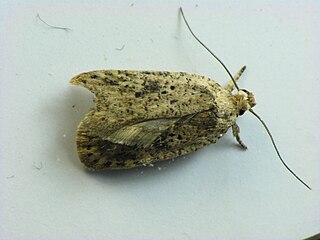
Costoma cirrophaea is a moth in the family Depressariidae. It was described by Meyrick in 1924. It is found in Bolivia. [1]
Moths comprise a group of insects related to butterflies, belonging to the order Lepidoptera. Most lepidopterans are moths, and there are thought to be approximately 160,000 species of moth, many of which have yet to be described. Most species of moth are nocturnal, but there are also crepuscular and diurnal species.
Depressariidae is a family of moths. It has formerly been treated as a subfamily of Gelechiidae, but is now recognised as a separate family, comprising about 2300 species worldwide.
Bolivia, officially the Plurinational State of Bolivia, is a landlocked country located in western-central South America. The capital is Sucre, while the seat of government and financial center is located in La Paz. The largest city and principal industrial center is Santa Cruz de la Sierra, located on the Llanos Orientales, a mostly flat region in the east of the country.
The wingspan is 26–28 mm. The forewings are ashy-ochreous-grey with a narrow yellow basal fascia, edged posteriorly with ferruginous suffusion. From beyond this a rather broad light yellow costal stripe runs to near the apex and the dorsal and terminal edge are slenderly light yellow. The hindwings are yellow-whitish, suffused pale grey posteriorly. [2]
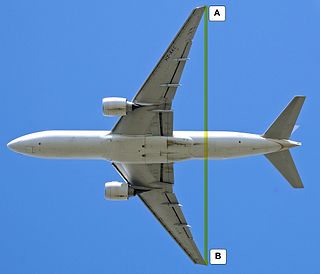
The wingspan of a bird or an airplane is the distance from one wingtip to the other wingtip. For example, the Boeing 777-200 has a wingspan of 60.93 metres, and a wandering albatross caught in 1965 had a wingspan of 3.63 metres, the official record for a living bird. The term wingspan, more technically extent, is also used for other winged animals such as pterosaurs, bats, insects, etc., and other fixed-wing aircraft such as ornithopters. In humans, the term wingspan also refers to the arm span, which is distance between the length from one end of an individual's arms to the other when raised parallel to the ground at shoulder height at a 90º angle. Former professional basketball player Manute Bol stands at 7 ft 7 in (2.31 m) and owns one of the largest wingspans at 8 ft 6 in (2.59 m).
Xyroptila peltastes is a moth of the family Pterophoridae. It is found in Australia.
Zacorisca euthalama is a species of moth of the family Tortricidae. It is found on Seram Island of Indonesia.
Dichomeris thrypsandra is a moth in the family Gelechiidae. It was described by Meyrick in 1923. It is found in Ecuador.
Dichomeris argentaria is a moth in the family Gelechiidae. It was described by Meyrick in 1913. It is found in South Africa (Mpumalanga).
Dichomeris cotifera is a moth in the family Gelechiidae. It was described by Meyrick in 1913. It is found in South Africa (Mpumalanga).
Kiwaia aerobatis is a moth in the family Gelechiidae. It was described by Meyrick in 1924. It is found in New Zealand.
Aristotelia ptilastis is a moth of the family Gelechiidae. It was described by Meyrick in 1909. It is found in South Africa, where it has been recorded from the Western Cape.
Metzneria sanguinea is a moth of the family Gelechiidae. It was described by Meyrick in 1934. It is found in Rwanda.
Mysaromima liquescens is a moth of the Depressariidae family. It is found in Colombia and Brazil.
Stenoma himerodes is a moth of the Depressariidae family. It is found in French Guiana.
Heteralcis rhizophora is a moth in the Lecithoceridae family. It was described by Meyrick in 1919. It is found in India (Madras).
Comocritis pieria is a moth in the Xyloryctidae family. It was described by Meyrick in 1906. It is found in Sri Lanka and India (Assam).
Habrophylax chalcochtha is a moth in the family Depressariidae, and the only species in the genus Habrophylax. It was described by Meyrick in 1931 and is found in Brazil.
Aeolanthes dicraea is a moth in the Depressariidae family. It was described by Edward Meyrick in 1908. It is found in India (Assam).
Gonionota comastis is a moth in the Depressariidae family. It was described by Edward Meyrick in 1909. It is found in Peru and Colombia.
Gonionota vivida is a moth in the Depressariidae family. It was described by Edward Meyrick in 1926. It is found in Bolivia.
Antaeotricha copromima is a moth in the family Depressariidae. It was described by Edward Meyrick in 1930. It is found in French Guiana and Brazil.
Cerconota hydrelaeas is a moth in the family Depressariidae. It was described by Edward Meyrick in 1931. It is found in French Guiana.
Cerconota tabida is a moth in the family Depressariidae. It was described by Arthur Gardiner Butler in 1877. It is found in the Brazilian states of Amazonas and Pará and in the Guianas.
Imma monocosma is a moth in the family Immidae. It was described by Alexey Diakonoff and Yutaka Arita in 1979. It is found on the Japanese islands of Kyusyu and Honshu.
| This article on a moth of the subfamily Depressariinae is a stub. You can help Wikipedia by expanding it. |