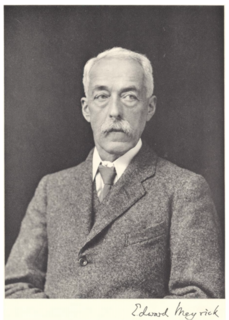
Edward Meyrick FRS was an English schoolmaster and amateur entomologist. He was an expert on microlepidoptera and some consider him one of the founders of modern microlepidoptera systematics.

Moûtiers, historically also called Tarentaise, is a commune in the Savoie department in the Auvergne-Rhône-Alpes region in south-eastern France.

Pyraustinae is a large subfamily of the lepidopteran family Crambidae, the crambid snout moths. It currently includes over 1,400 species, the majority of them tropical but some found in temperate regions including both North America and Europe.

Spilomelinae is a very species-rich subfamily of the lepidopteran family Crambidae, the crambid snout moths. With 4,132 described species in 340 genera worldwide, it is the most speciose group among pyraloids.

The Lecithoceridae, or long-horned moths, are a family of small moths described by Simon Le Marchand in 1947. Although lecithocerids are found throughout the world, the great majority are found in the Indomalayan realm and the southern part of the Palaearctic realm.

Crambinae is a large subfamily of the lepidopteran family Crambidae, the crambid snout moths. It currently includes over 1,800 species worldwide. The larvae are root feeders or stem borers, mostly on grasses. A few species are pests of sod grasses, maize, sugar cane, rice, and other Poaceae. The monophyly of this group is supported by the structure of the tympanal organs and the phallus attached medially to the juxta.

Amata is a genus of tiger moths in the family Erebidae. The genus was erected by Johan Christian Fabricius in 1807.
Darantasia is a genus of moths in the family Erebidae. The genus was erected by Francis Walker in 1859.

Kiwaia is a genus of moths in the family Gelechiidae. Two subgenera are currently recognised, (i) the nominotypical subgenus with 25 species from New Zealand, and (ii) subgenus Empista with 4 species from the Palaearctic Region.
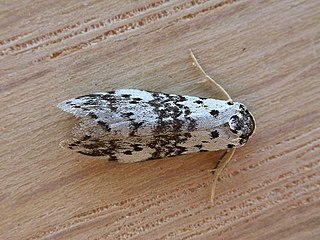
Thallarcha is a genus of moths in the subfamily Arctiinae.

Bradina is a genus of moths of the family Crambidae.

Nacoleia is a genus of moths of the family Crambidae described by Francis Walker in 1859.
Piletocera is a genus of moths of the family Crambidae. The genus was first described by Julius Lederer in 1863.
Timyra is a genus of moths in the family Lecithoceridae.

Macrobathra is a genus of moths in the family Cosmopterigidae. Most species are endemic to Australia.
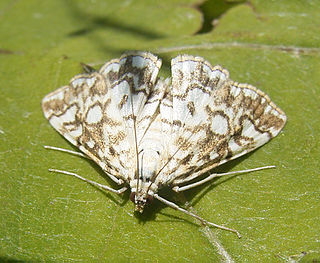
Acentropinae is a fairly small subfamily of the lepidopteran family Crambidae, the crambid snout moths. Species of this subfamily are exclusively found in wetlands and aquatic habitats.
Copromorpha is a genus of moths in the family Copromorphidae.
Apatetrinae is a subfamily of moths in the family Gelechiidae. The subfamily was described by Edward Meyrick in 1947.

Margaroniini is a tribe of the species-rich subfamily Spilomelinae in the pyraloid moth family Crambidae. The tribe was erected by Charles Swinhoe and Everard Charles Cotes in 1889.
