The Provinces of the Philippines are the primary political and administrative divisions of the Philippines. There are 81 provinces at present, further subdivided into component cities and municipalities. The National Capital Region, as well as independent cities, are independent of any provincial government. Each province is governed by an elected legislature called the Sangguniang Panlalawigan and by an elected governor.
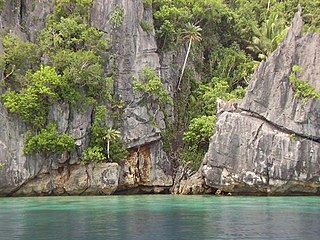
Caraga, officially known as the Caraga Administrative Region or simply Caraga Region and designated as Region XIII, is an administrative region in the Philippines occupying the northeastern section of the island of Mindanao. The Caraga Region was created through Republic Act No. 7901 on February 23, 1995. The region comprises five provinces: Agusan del Norte, Agusan del Sur, Surigao del Norte, Surigao del Sur and Dinagat Islands; six cities: Bayugan, Bislig, Butuan, Cabadbaran, Surigao and Tandag; 67 municipalities and 1,311 barangays. Butuan is the regional administrative center.

Cagdianao, officially the Municipality of Cagdianao, is a 3rd class municipality in the province of Dinagat Islands, Philippines. According to the 2015 census, it has a population of 16,808 people.
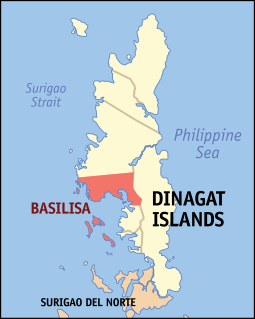
Basilisa, officially the Municipality of Basilisa, is a 4th class municipality in the province of Dinagat Islands, Philippines. According to the 2015 census, it has a population of 36,880 people.

Dinagat, officially the Municipality of Dinagat, is a 5th class municipality in the province of Dinagat Islands, Philippines. According to the 2015 census, it has a population of 10,632 people.
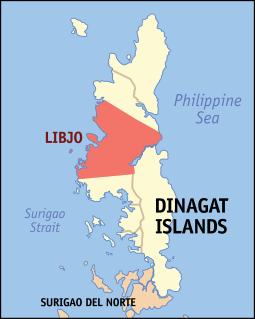
Libjo, officially the Municipality of Libjo, is a 5th class municipality in the province of Dinagat Islands, Philippines. According to the 2015 census, it has a population of 17,760 people.

Loreto, officially the Municipality of Loreto, is a 4th class municipality in the province of Dinagat Islands, Philippines. According to the 2015 census, it has a population of 9,309 people.

Surigao City, officially the City of Surigao, is a 3rd class city and capital of the province of Surigao del Norte, Philippines. According to the 2015 census, it has a population of 154,137 people.

Tubajon, officially the Municipality of Tubajon, is a 5th class municipality in the province of Dinagat Islands, Philippines. According to the 2015 census, it has a population of 8,276 people.
The Legislative district of Surigao was the representation of the historical province of Surigao in the various national legislatures of the Philippines until the election of representatives for its successor provinces in 1961. The undivided province's representation encompassed the present-day provinces of Surigao del Norte, Surigao del Sur and Dinagat Islands.
The Legislative districts of Surigao del Norte are the representations of the province of Surigao del Norte in the various national legislatures of the Philippines. The province is currently represented in the lower house of the Congress of the Philippines through its first and second congressional districts.
The Legislative district of Dinagat Islands is the representation of the province of Dinagat Islands in the various national legislatures of the Philippines. The province is currently represented in the lower house of the Congress of the Philippines through its lone congressional district.
The Quezon del Sur creation plebiscite was a plebiscite on the creation of the Province of Quezon del Sur from Quezon; the original Quezon province would have been renamed to "Quezon del Norte" had the plebiscite been approved by the residents of Quezon. The plebiscite was held on December 13, 2008, and the result was a slight majority rejecting the creation of the province.

Caraga Region is located at northeastern part of Mindanao. It has five (5) provinces, namely: Dinagat Province, Surigao del Norte, Surigao del Sur, Agusan del Norte and Agusan del Sur. Caraga Region is now hosting several mining projects producing various mineral commodities particularly but not limited to gold, copper, chrome, nickel, iron and limestone for concrete cement production. This makes the Department of Environment and Natural Resources, Mines and Geosciences Bureau, Regional Office No. 13 with Office located in Surigao City plays important role in the region's economy, job generation, social and environmental enhancement and protection and ensuring government shares through royalties and taxes.

Surigao is a former province of the Philippines. Originally a Spanish-era district, became a chartered province on May 15, 1901. The province was dissolved on 1960, comprising what are now the provinces of Surigao del Norte, Surigao del Sur, and Dinagat Islands.


