| ||||||||||||||||||||
| ||||||||||||||||||||
| ||||||||||||||||||||
| This article is part of a series on the politics and government of the Philippines |
|---|
Constitutional commissions |
The 2013 general election in the Autonomous Region in Muslim Mindanao (ARMM) were held on May 13, 2013. Originally scheduled for October 2011, this was the first ARMM election that was synchronized with the general elections in the Philippines; previously, ARMM elections were held outside the general election day. When the elected officials of the 2008 ARMM elections ended their terms in 2011, President Benigno Aquino III appointed officers-in-charge until the officials elected in 2013 can take their place.
The Autonomous Region in Muslim Mindanao was an autonomous region of the Philippines, located in the Mindanao island group of the Philippines, that consisted of five predominantly Muslim provinces: Basilan, Lanao del Sur, Maguindanao, Sulu, and Tawi-Tawi. It was the only region that had its own government. The region's de facto seat of government was Cotabato City, although this self-governing city was outside its jurisdiction.
The President of the Philippines is the head of state and head of government of the Philippines. The President leads the executive branch of the Philippine government and is the commander-in-chief of the Armed Forces of the Philippines. The President is directly elected by the people, and is one of only two nationally elected executive officials, the other being the Vice President of the Philippines. However, four vice presidents have assumed the presidency without having been elected to the office, by virtue of a president's intra-term death or resignation.
The governor and vice governor are elected via first past the post system; they are elected separately and may come from different parties. Elections for the regional assembly are via plurality-at-large voting, with each assembly district (coextensive with legislative districts as used in House of Representatives elections) having three seats. A voter has can vote for up to the three candidates, with the candidates with the three highest total number of votes being elected.
Plurality-at-large voting, also known as block vote or multiple non-transferable vote (MNTV), is a non-proportional voting system for electing several representatives from a single multimember electoral district using a series of check boxes and tallying votes similar to a plurality election. Multiple winners are elected simultaneously to serve the district. Block voting is not a system for obtaining proportional representation; instead the usual result is that where the candidates divide into definitive parties the most popular party in the district sees its full slate of candidates elected, resulting in a landslide.
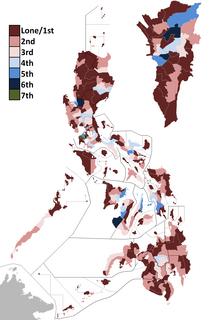
The legislative districts of the Philippines are the divisions of the Philippines' provinces and cities for representation in the various legislative bodies. Congressional districts are for House of Representatives, while there are districts for Sangguniang Panlalawigan, and some Sangguniang Panlungsod. For purposes of representation, the Senate, most Sangguniang Panlungsod, Sangguniang Bayan, Sangguniang Barangay and Sangguniang Kabataan are all elected at-large, although there were previously senatorial districts.
| Party | Candidate | Votes | % | |
|---|---|---|---|---|
| Liberal | Mujiv Hataman | 232,253 | 59.30 | |
| Independent | Pax Mangudadatu | 99,998 | 25.53 | |
| Independent | Nur Misuari | 50,528 | 12.90 | |
| Independent | Yusoph Mama | 6,624 | 1.69 | |
| DPP | Aishah Prudencio | 1,203 | 0.31 | |
| Independent | Elsie Orenjudos | 1,055 | 0.27 | |
| Valid ballots | 391,661 | 84.09 | ||
| Invalid or blank votes | 74,114 | 15.91 | ||
| Total votes | 465,775 | 100.00 | ||
| Liberal hold | ||||
| Party | Candidate | Votes | % | |
|---|---|---|---|---|
| Liberal | Haroun Al-Rashid Lucman | 245,321 | 75.16 | |
| PDP-Laban | Bashier Manalao | 28,863 | 8.84 | |
| PMP | Sultan Bob Datimbang | 27,434 | 8.41 | |
| Independent | Abdulaziz Mangandaki | 9,568 | 2.93 | |
| Independent | Mitchell Manalocon | 5,752 | 1.76 | |
| Ompia | Pundatoon Bagul | 5,233 | 1.60 | |
| Independent | Panny Sharief | 2,764 | 0.85 | |
| Independent | Marconi Paiso | 1,443 | 0.44 | |
| Valid ballots | 326,378 | 70.07 | ||
| Invalid or blank votes | 139,397 | 29.92 | ||
| Total votes | 465,775 | 100.00 | ||
| Liberal hold | ||||
These figures came from the COMELEC "Transparency" server and are therefore partial and unofficial.
| Party | Entered | Popular vote | Seats won | |||
|---|---|---|---|---|---|---|
| Total | % | Total | % | |||
| Liberal | 22 | 587,525 | 64.55% | 20 | 83.3% | |
| PDP-Laban | 13 | 100,811 | 11.08% | 1 | 4.2% | |
| NPC | 3 | 34,448 | 3.79% | 0 | 0.0% | |
| UNA | 1 | 22,357 | 2.46% | 0 | 0.0% | |
| Ompia | 3 | 19,894 | 2.19% | 0 | 0.0% | |
| PMP | 3 | 19,220 | 2.11% | 0 | 0.0% | |
| Nacionalista | 1 | 11,290 | 1.24% | 1 | 4.2% | |
| Akbayan | 1 | 1,448 | 0.16% | 0 | 0.0% | |
| Aksyon | 1 | 1,401 | 0.15% | 0 | 0.0% | |
| Independent | 31 | 111,684 | 12.27% | 3 | 12.5% | |
| Totals | 79 | 910,118 | 100% | 24 | 100% | |
The Illinois General Assembly (IGA) is the bicameral legislature of the U.S. state of Illinois and comprises the Illinois House of Representatives and the Illinois Senate. The General Assembly was created by the first state constitution adopted in 1818. The State Senate has 59 members while the House has 118 members, all elected from single-member districts. A Senate district is formed by combining two adjacent House districts. The current General Assembly is Illinois's 100th. The General Assembly meets in the Illinois State Capitol in Springfield, Illinois. Its session laws are generally adopted by majority vote in both houses, and upon gaining the assent of the Governor of Illinois. They are published in the official Laws of Illinois.
The Illinois House of Representatives is the lower house of the Illinois General Assembly, the bicameral legislature of the U.S. state of Illinois. The body was created by the first Illinois Constitution adopted in 1818. The House consists of 118 representatives elected from individual legislative districts for two-year terms with no limits; redistricted every 10 years, based on the 2010 U.S. census each representative represents approximately 108,734 people.
The Japanese political process has three types of elections: general elections to the House of Representatives held every four years, elections to the House of Councillors held every three years to choose one-half of its members, and local elections held every four years for offices in prefectures, cities, and villages. Elections are supervised by election committees at each administrative level under the general direction of the Central Election Administration Committee, an attached organization to the Ministry of Internal Affairs and Communications (MIC). The minimum voting age in Japan's non-compulsory electoral system was reduced from twenty to eighteen years in June 2016. Voters must satisfy a three-month residency requirement before being allowed to cast a ballot.
Elections in Belize are the duly held elections held at various levels of government in the nation of Belize.
Philippine elections are of several types. The president, vice-president, and the senators are elected for a six-year term, while the members of the House of Representatives, governors, vice-governors, members of the Sangguniang Panlalawigan, mayors, vice-mayors, members of the Sangguniang Panlungsod/members of the Sangguniang Bayan, barangay officials, and the members of the Sangguniang Kabataan are elected to serve for a three-year term.
Elections in Puerto Rico are guaranteed by Article VI of the Constitution of Puerto Rico and the Electoral Code of Puerto Rico for the 21st Century Act. All processes are overseen and managed in whole by the Puerto Rico State Elections Commission; an autonomous agency of the executive branch of the government of Puerto Rico.
Legislative and local elections were held in the Philippines on May 14, 2007. Positions contested included half the seats in the Senate, which are elected for six-year terms, and all the seats in the House of Representatives, who were elected for three-year terms. The duly elected legislators of the 2007 elections joined the elected senators of the 2004 elections to comprise the 14th Congress of the Philippines.
Elections in California are held to fill various local, state and federal seats. In California, regular elections are held every even year ; however, some seats have terms of office that are longer than two years, so not every seat is on the ballot in every election. Special elections may be held to fill vacancies at other points in time. Recall elections can also be held. Additionally, statewide initiatives, legislative referrals and referenda may be on the ballot.
A general election was held in the Philippines on May 13, 2013. It was a midterm election—the officials elected will be sworn in on June 30, 2013, midway through President Benigno Aquino III's term of office.
ARMM Regional Assembly, also known as ARMM Regional Legislative Assembly, was the devolved unicameral regional legislature of the Autonomous Region of Muslim Mindanao (ARMM). It was known as the "Little Congress" of the ARMM.
Autonomous Region in Muslim Mindanao general elections was held in the ARMM for the regional governor, vice-governor posts and election of members of the ARMM Regional Legislative Assembly on August 11, 2008. The electronic voting used is the first in Philippines election history. The P 500 million COMELEC's "ARMM balloting" is a pilot program for the 2010 national polling.
Sema vs. COMELEC is a court case that was heard before the Supreme Court of the Philippines. It was consolidated with Marquez v. COMELEC. It held that the Regional Assembly of the Autonomous Region in Muslim Mindanao does not have the power to create provinces and cities. Thus, the creation of the province of Shariff Kabunsuan was unconstitutional and that province no longer exists as a political entity in the Philippines.
New Jersey's 4th Legislative District is one of 40 in the state. As of the 2011 apportionment the district covers the Camden County municipalities of Chesilhurst, Clementon, Gloucester Township, Laurel Springs, Lindenwold and Winslow Township; and the Gloucester County municipalities of Monroe Township, Pitman and Washington Township.
Local elections were held on the Philippines on May 13, 2013, the same day and on the same ballot as national elections. Elected were governors, mayors and council members of Philippine provinces, Philippine cities and Philippine municipalities. Separate elections for barangay officials were held on October.
A general election in the Philippines took place on May 9, 2016, for executive and legislative branches for all levels of government – national, provincial, and local, except for the barangay officials.
The 2016 general election in the Autonomous Region in Muslim Mindanao (ARMM) was held on May 9, 2016. This was the second ARMM election that was synchronized with the general elections in the Philippines.
Local elections in the Philippines were held on May 9, 2016. This was conducted together with the 2016 general election for national positions. All elected positions above the barangay (village) level were disputed.
The 2019 Philippine general election will be conducted on May 13, 2019. It shall be a midterm election, where the winners will take office on June 30, 2019, midway the term of President Rodrigo Duterte.