The Wisconsin Range is a major mountain range of the Horlick Mountains in Antarctica, comprising the Wisconsin Plateau and numerous glaciers, ridges and peaks bounded by the Reedy Glacier, Shimizu Ice Stream, Horlick Ice Stream and the interior ice plateau.
Leonardo Glacier is a glacier flowing into Wilhelmina Bay between Sadler Point and Café Point, on the west coast of Graham Land, Antarctica. It was charted by the Belgian Antarctic Expedition under Gerlache, 1897–99, and was named by the UK Antarctic Place-Names Committee in 1960 for Leonardo da Vinci, artist, musician, architect and the first aeronautical scientist.
Daspit Glacier is a glacier 6 nautical miles (11 km) long, flowing east-northeast along the south side of Mount Shelby to the head of Trail Inlet, on the east coast of Graham Land, Antarctica. It was discovered by members of the East Base of the United States Antarctic Service, 1939–41, and was originally named Fleming Glacier after Rev. W.L.S. Fleming. It was photographed from the air in 1947 by the Ronne Antarctic Research Expedition under Finn Ronne, and charted in 1948 by the Falkland Islands Dependencies Survey. It was renamed by Ronne for Captain Lawrence R. Daspit, U.S. Navy, who assisted in obtaining Navy support for the Ronne expedition, the original name being transferred to Fleming Glacier on the Rymill Coast.

Andvord Bay is a bay 9 nautical miles (17 km) long and 3 nautical miles (6 km) wide, which lies between Beneden Head and Duthiers Point along the west coast of Graham Land.
Archer Glacier is a glacier flowing northwest into the head of Bolson Cove, Flandres Bay, on the west coast of Graham Land. It was first charted by the Belgian Antarctic Expedition under Adrien de Gerlache, 1897–99, and named by the United Kingdom Antarctic Place-Names Committee in 1960 for Frederick Scott Archer, an English architect who in 1849 invented the wet collodion process of photography, the first practical process on glass.

The Cruls Islands also known as the Crulls Islands are a group of small islands lying 1 nautical mile (2 km) west of the Roca Islands in the southern part of the Wilhelm Archipelago. They were discovered by the Belgian Antarctic Expedition, 1897–99, and named by Gerlache for Luís Cruls, a Belgian astronomer and later Director of the Observatory at Rio de Janeiro.
Depeaux Point is a point forming the south end of Petermann Island, in the Wilhelm Archipelago. It was discovered and named by the French Antarctic Expedition, 1908–10, under Jean-Baptiste Charcot.
Krebs Glacier is a glacier flowing west into the head of Charlotte Bay on the west coast of Graham Land, Antarctica. It was charted by the Belgian Antarctic Expedition under Gerlache, 1897–99, and was named by the UK Antarctic Place-Names Committee in 1960 for Arthur Constantin Krebs, who, with Charles Renard, constructed and flew the first dirigible airship capable of steady flight under control, in 1884.

Cape Tuxen is a rocky cape forming the south side of the entrance to Waddington Bay on Kiev Peninsula, the west coast of Graham Land. Discovered and named by the Belgian Antarctic Expedition, 1897–99, under Gerlache.
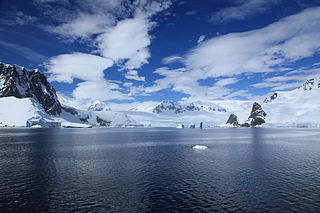
Penola Strait is a strait 11 nautical miles (20 km) long and averaging 2 nautical miles (3.7 km) wide, separating the Argentine Islands, Petermann Island and Hovgaard Island from the west coast of Graham Land. Traversed by the Belgian Antarctic Expedition under Gerlache on 12 February 1898. Named by the British Graham Land Expedition (BGLE), 1934–37, under Rymill, for the expedition ship Penola.
Cape Pérez is a prominent cape between Collins Bay and Beascochea Bay on Kiev Peninsula, the west coast of Graham Land. It was discovered by the Belgian Antarctic Expedition, 1897–99, under Adrien de Gerlache, but apparently not named by them until about 1904, when in working up their scientific reports they gave it the name Trooz. In the meantime, Charcot's French Antarctic Expedition, 1903–05, left for the Antarctic and in November 1904 resighted the same cape, to which they gave the name Trois Pérez, for the brothers Fernando, Leopoldo and Manuel Pérez of Buenos Aires. Maurice Bongrain in his report of 1914 acknowledges the Belgian name Trooz for this cape. However, the Advisory Committee on Antarctic Names has retained the Charcot name because of wider usage, and has given the name Trooz to the large glacier 5 nautical miles (9.3 km) northeast of Cape Pérez.
Mount Eastman is a mountain overlooking the head of Flandres Bay, 4 nautical miles (7 km) south of Pelletan Point on the west coast of Graham Land. It was charted by the Belgian Antarctic Expedition of 1897–99 under Gerlache. It was named by the UK Antarctic Place-Names Committee in 1960 for photographic innovator George Eastman.
Garnerin Point is a point on the west coast of Graham Land, Antarctica, projecting into Wilhelmina Bay southeast of Pelseneer Island. It was charted by the Belgian Antarctic Expedition under Gerlache, 1897–99, and was named by the UK Antarctic Place-Names Committee in 1960 for Andre J. Garnerin, a French aeronaut who was the first man to make a successful descent from a free balloon by parachute, in 1797.

Gerlache Island is the largest of the Rosenthal Islands lying off Gerlache Point on the west coast of Anvers Island, in the Palmer Archipelago of Antarctica. It was first roughly charted and named "Pointe de Gerlache" by the French Antarctic Expedition, 1903–05, under Jean-Baptiste Charcot, for Lieutenant Adrien de Gerlache. As a result of surveys by the Falkland Islands Dependencies Survey in 1956–58, this island is considered to be the feature named by Charcot; there is no prominent point in this vicinity which would be visible from seaward.
Godfroy Point is a point which marks the northern extremity of Petermann Island, in the Wilhelm Archipelago, Antarctica. It was discovered by the French Antarctic Expedition, 1908–10, and named by Jean-Baptiste Charcot for Rene Godfroy, sub-lieutenant on the Pourquoi-Pas?, who was responsible for the expedition's study of tides and the atmosphere.
Goodwin Glacier is a glacier flowing west into Flandres Bay southward of Pelletan Point on the west coast of Graham Land, Antarctica. It was charted by the Belgian Antarctic Expedition under Gerlache, 1897–99. It was named by the UK Antarctic Place-Names Committee in 1960 for Hannibal Goodwin, an American pastor who invented the first transparent nitrocellulose flexible photographic roll-film in 1887.
Midas Island is an island lying north-west of Apéndice Island in Hughes Bay, off the west coast of Graham Land, Antarctica. It was first seen by the Belgian Antarctic Expedition under Gerlache in 1898 and described as an island with two summits "like the ears of an ass". The name, given by the UK Antarctic Place-Names Committee in 1960, derives from this description; Midas, King of Phrygia, was represented in Greek satyric drama with the ears of an ass.
Miethe Glacier is a glacier 3 nautical miles (6 km) long, flowing northwest into Gerlache Strait to the south of Mount Banck, on the west coast of Graham Land, Antarctica. The glacier appears on an Argentine government chart of 1952. It was named by the UK Antarctic Place-Names Committee in 1960 for Adolf Miethe, a German chemist who introduced the first panchromatic emulsion for photographic plates in 1903.
Hotine Glacier is a glacier 10 nautical miles (19 km) long which is divided at its mouth by Mount Cloos, flowing west into both Deloncle Bay and Girard Bay on Kiev Peninsula, on the west coast of Graham Land, Antarctica. It was first charted by the Belgian Antarctic Expedition under Gerlache, 1897–99, and was named by the UK Antarctic Place-Names Committee in 1959 for Brigadier Martin Hotine, Director of Overseas Surveys.
Lautaro Island is an island 1 nautical mile (2 km) long, lying just west of Lemaire Island in Gerlache Strait, off the Antarctic Peninsula. It was probably first seen by the Belgian Antarctic Expedition (1897–99) under Gerlache. The island was named by the Chilean Antarctic Expedition (1948–49) after the Lautaro, one of the Chilean expedition ships working in the area that season.