Career
Warlow was educated at Corpus Christi College, Cambridge [2] and ordained Deacon in 1886 and Priest in 1887. [3] He was Curate at Stratton St Margaret and then St Saviour, Paddington. He went out to the North Western Frontier Province in 1889. He was at Dagshai, Ambala, Jullundur, Quetta, Murree, Umballa and Shimla before his time as Archdeacon; and at Brampford Speke and Venice afterwards.
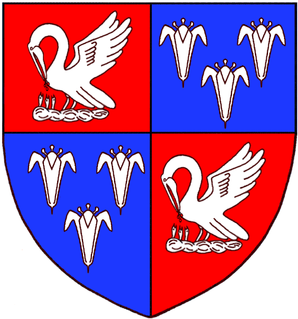
Corpus Christi College is a constituent college of the University of Cambridge. It is notable as the only college founded by Cambridge townspeople: it was established in 1352 by the Guild of Corpus Christi and the Guild of the Blessed Virgin Mary, making it the sixth-oldest college in Cambridge. With around 250 undergraduates and 200 postgraduates, it also has the second smallest student body of the traditional colleges of the University.

A deacon is a member of the diaconate, an office in Christian churches that is generally associated with service of some kind, but which varies among theological and denominational traditions. Major Christian churches, such as the Catholic Church, the Eastern Orthodox Church and the Anglican church, view the diaconate as part of the clerical state.

A priest or priestess is a religious leader authorized to perform the sacred rituals of a religion, especially as a mediatory agent between humans and one or more deities. They also have the authority or power to administer religious rites; in particular, rites of sacrifice to, and propitiation of, a deity or deities. Their office or position is the priesthood, a term which also may apply to such persons collectively.

Arthur Fawssett Alston was an Anglican bishop, the third Bishop of Middleton from 1938 until 1943.

Hugh Maudslay Hordern was the sixth Bishop of Lewes.
Eric James Bodington was an eminent Anglican priest and author in the early decades of the twentieth century.

Eric Rede Buckley was Archdeacon of Sudbury from 1930 until 1932.
Frank Edward Ford was the Archdeacon of the East Riding from 1957 to 1970.
The Ven. Arthur John Winnington-Ingram, MA was Archdeacon of Hereford, England, from 1942 to 1958.
The Ven. Thomas Berkeley Randolph , MA was Archdeacon of Hereford from 1959 to 1970.
The archdeacons in the Diocese in Europe are senior clergy of the Church of England Diocese in Europe. They each have responsibility over their own archdeaconry, of which there are currently seven, each of which is composed of one or more deaneries, which are composed in turn of chaplaincies.
The Very Reverend William James Grant (1929–2009) was Archdeacon, then Dean of Tuam, in the Church of Ireland in the last quarter of the 20th Century.
The Very Reverend Anthony Michael Allen Previté was Dean of Tuam then Archdeacon of Tuam in the last quarter of the 20th century and the first decade of the 21st.
John Oldcastle Cobham (1899–1987) was an Anglican priest and author.
Edward Francis Whately Eliot was an Anglican Archdeacon in the Mediterranean.
Nathaniel Gerard Railton was Archdeacon of Lindsey from 1941 until his death.
Robert Arthur William Coogan was Archdeacon of Hampstead from 1985 to 1984.
Arthur Babington Cartwright was Archdeacon of Malta from 1897 to 1901.
Ernest Canteolo Burt Philpott (1864-1935) was Archdeacon of Malta from 1925 until his death.
John Herbert Sharp was Archdeacon in South-Eastern Europe from 1935 to 1947.
Walter Norman Higgins was a British Church of England priest, most notably Archdeacon of Wells from 1940 to 1951.
Ernest Cyril Murray was an Anglican Archdeacon in Ireland.
This page is based on this
Wikipedia article Text is available under the
CC BY-SA 4.0 license; additional terms may apply.
Images, videos and audio are available under their respective licenses.