Related Research Articles

Nevada County is a county located in the U.S. state of California, in the Sierra Nevada. As of the 2020 census, its population was 102,241. The county seat is Nevada City. Nevada County comprises the Truckee-Grass Valley micropolitan statistical area, which is also included in the Sacramento-Roseville combined statistical area, part of the Mother Lode Country.

Nevada City is the county seat of Nevada County, California, United States, 60 miles (97 km) northeast of Sacramento, 84 miles (135 km) southwest of Reno and 147 miles (237 km) northeast of San Francisco. The population was 3,152 as of the 2020 census.

Amasa Leland Stanford was an American attorney, industrialist, philanthropist, and Republican Party politician from California. He served as the 8th governor of California from 1862 to 1863 and represented the state in the United States Senate from 1885 until his death in 1893. He and his wife Jane founded Stanford University, named after their late son.

Bodie is a ghost town in the Bodie Hills east of the Sierra Nevada mountain range in Mono County, California, United States. It is about 75 miles (121 km) southeast of Lake Tahoe, and 12 mi (19 km) east-southeast of Bridgeport, at an elevation of 8,379 feet (2554 m). Bodie became a boom town in 1876 after the discovery of a profitable vein of gold; by 1879 it had established 2,000 structures with a population of roughly 8,000 people.

John Bidwell, known in Spanish as Don Juan Bidwell, was an American pioneer, politician, and soldier. Bidwell is known as the founder of the city of Chico, California.

John Neely Johnson was an American lawyer and politician. He was elected as the fourth governor of California from 1856 to 1858, and later appointed justice to the Nevada Supreme Court from 1867 to 1871. As a member of the American Party, Johnson remains one of only two members of a third party to be elected to the California governorship.
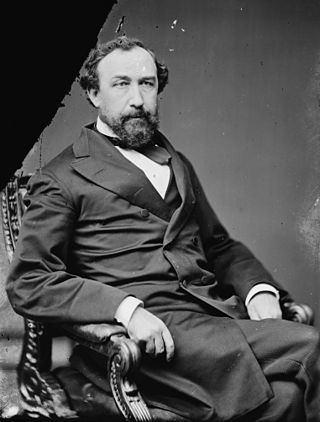
Newton Booth was an American entrepreneur and politician who served as the 11th governor of California from 1871 to 1875 and as U.S. Senator from California from 1875 to 1881. He was the only member of the Anti-Monopoly Party elected to the U.S. Senate.

Lorenzo Sawyer was an American lawyer and judge who was appointed to the Supreme Court of California in 1860 and served as the ninth Chief Justice of California from 1868 to 1870. He served as a United States circuit judge of the United States Circuit Courts for the Ninth Circuit and of the United States Court of Appeals for the Ninth Circuit. He is best known for handing down the verdict in the case of Woodruff v. North Bloomfield Gravel Mining Company; his verdict is frequently referred to as the "Sawyer Decision."

Mormon Island was once a mining town, which had an abundance of Mormon immigrants seeking gold in the American River during the California Gold Rush. Its site is in present-day Sacramento County, California.
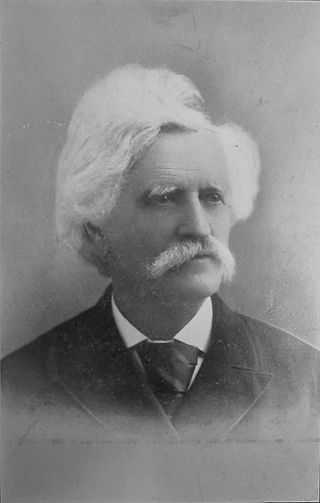
Harvey Willson Harkness was an American mycologist and natural historian best known for his early descriptions of California fungal species.

Dutch Flat is a small unincorporated community and census-designated place (CDP) in Placer County, California, United States, about 30 miles (48 km) northeast of Auburn along Interstate 80. It was founded by German immigrants in 1851 and was once one of the richest gold mining locations in California. Dutch Flat is now registered as a California Historical Landmark.

Harold Jay "Butch" Powers was the 36th lieutenant governor of California, serving from 1953–1959 under his fellow Republican, Governor Goodwin Knight.
Ferris Foreman was a lawyer, politician, and American soldier during the Mexican–American War, as well as a colonel commanding a volunteer regiment and the District of Southern California during the American Civil War.

The Sacramento Historic City Cemetery, located at 1000 Broadway, at 10th Street, is the oldest existing cemetery in Sacramento, California. It was designed to resemble a Victorian garden and sections that are not located in level areas are surrounded by brick or concrete retaining walls to create level terraces. The cemetery grounds are noted for their roses which are said to be among the finest in California.

Belle Cora, also known as Arabella Ryan, was a madam of the Barbary Coast of San Francisco during the mid-nineteenth century. She rose to public attention in 1855 when her lover, Charles Cora, killed U.S. Marshal William H. Richardson after they had a conflict at the theater. She died in 1862.
Nevada City Jewish Cemetery is a no longer active Jewish cemetery founded in 1854 by the Nevada Hebrew Society, and located in Nevada City, Nevada County, California. The last burial was during the summer of 1890. There are only 29 headstones that are visible. On October 29, 1972, the site was dedicated as a historical site.
References
- ↑ "Index to Politicians: Wait to Walberg". politicalgraveyard.com. Retrieved July 11, 2008.
- ↑ "Edwin G. Waite". joincalifornia.com. Retrieved July 11, 2008.
- ↑ "Politicians who lived in Nevada County". politicalgraveyard.com. Retrieved July 11, 2008.
- ↑ Mann, Ralph (1982). After the Gold Rush : society in Grass Valley and Nevada City, California, 1849–1870. Stanford, Calif.: Stanford University Press. p. 92. ISBN 0-8047-1136-4.
- ↑ "Title: The Discovery of Gold in California". siegelbooks.com. Archived from the original on April 20, 2012. Retrieved 2008-07-11.
- ↑ "Edwin G Waite". dave-francis.com. Retrieved July 11, 2008.
- ↑ "Sacramento Historic City Cemetery Burial Index" (PDF). Old City Cemetery Committee. 2005. Archived from the original (PDF) on June 26, 2011. Retrieved April 6, 2011.
 | This article about a member of the California State Assembly is a stub. You can help Wikipedia by expanding it. |