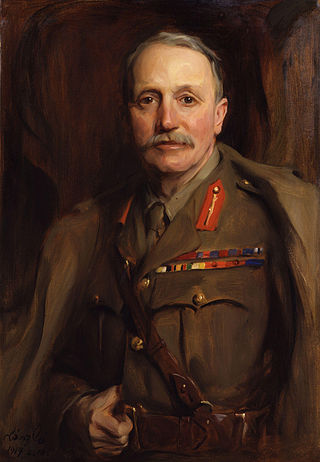
Elliott Wood

Last updated

Sir Elliott Wood
Elliott Wood 1924.jpg
c. 1924
Born(1844-05-05)5 May 1844
Ledbury, Herefordshire, England
Died7 September 1931(1931-09-07) (aged 87)
Hereford, Herefordshire, England
AllegianceFlag of the United Kingdom.svg  United Kingdom
Service/branchFlag of the British Army.svg  British Army
Years of service1864–1906
Rank Major-General
Unit Royal Engineers
Battles/wars Anglo-Egyptian War
Mahdist War
Second Boer War
Awards Knight Commander of the Bath
RelationsColonel Charles Knight Wood (brother)

Major-General Sir Elliott Wood, KCB (5 May 1844 – 7 September 1931) [1] was a British Army officer, who served in the Anglo-Egyptian War, the Sudan Campaign and the Second Boer War.

Contents

Military career

Wood was born in 1844, the son of Dr. Miles Astman Wood, of Ledbury. [1] He was commissioned a lieutenant in the Royal Engineers on 15 January 1864, and was promoted to captain on 30 September 1877. He served in the Anglo-Egyptian War in 1882, and was present at the Battle of Tell El Kebir (September 1882), for which he was mentioned in despatches, received the medal with clasps, the 4th class of the Order of Medjidie, the Khedive's star, and a brevet promotion to major on 18 November 1882. Two years later, he took part in the Sudan expedition of 1884 (twice mentioned in despatches), for which he received a brevet promotion to lieutenant-colonel on 21 May 1884. He continued in the Sudan Campaign of 1885, for which he was also mentioned in despatches, and appointed a Companion of the Order of the Bath (CB). [1] [2]

Following promotion to colonel on 21 May 1888, Wood was from 1889 to 1894 A.G.G. at Headquarters, and from 1894 to 1899 he was in command of the Royal Engineers at Malta. On 1 April 1899 he was appointed Commanding Royal Engineer at Aldershot Garrison. After the Second Boer War broke out in October 1899, he was asked to accompany Sir Redvers Buller and the 1st Army Corps as they went to South Africa. On arrival he was appointed Chief Engineer in South Africa, with local rank of major-general, and continued as such until the war ended in June 1902. For his war service he was thrice mentioned in despatches, received the Queen's South Africa Medal with five clasps and the King's South Africa Medal with two clasps, and was promoted to a Knight Commander of the Order of the Bath (KCB) in the 1901 South Africa Honours list (the order was dated to 29 November 1900). [3] [1] He returned to the United Kingdom on the SS Dunvegan Castle, which arrived in Southampton in early September 1902, [4] and was invested with the KCB by King Edward VII at Buckingham Palace on 24 October 1902. [5]

Wood was appointed in command of the Royal Engineers, 1st Army Corps based at Aldershot Garrison, on 8 September 1902, [6] and received the substantive rank of major-general on the same day [7] (this was later dated back to 22 August 1902 as he was promoted for Distinguished service in the Field in the October 1902 South Africa Honours list [8] ). He retired from the army in 1906.

In 1924 he published Life and Adventure in Peace and War.

Family

Wood married, in 1906, Annie Beatrice Bourne, daughter of Colonel Robert Bourne and widow of Horace R. Dugmore. They lived at Holmer Park, Hereford, and he died on 7 September 1931. [1]

Related Research Articles

<span class="mw-page-title-main">William Pulteney (British Army officer)</span> British general (1861–1941)

Lieutenant-General Sir William Pulteney Pulteney, was a British general during the First World War.

<span class="mw-page-title-main">William Nicholson, 1st Baron Nicholson</span> British Army officer (1845–1918)

Field Marshal William Gustavus Nicholson, 1st Baron Nicholson, was a British Army officer who served in the Second Anglo-Afghan War, the Mahdist War, the Third Anglo-Burmese War, the Second Boer War and the First World War. He became Chief of the Imperial General Staff and was closely involved in the reorganisation of the British Army in the early years of the 20th century.

<span class="mw-page-title-main">Dalrymple Arbuthnot</span> British Army general

Brigadier-General Sir Dalrymple Arbuthnot, 5th Baronet, CMG, DSO, JP was a British baronet and Army officer.

<span class="mw-page-title-main">James Grierson (British Army officer)</span> British soldier

Lieutenant-General Sir James Moncrieff Grierson, ADC (Gen.) was a British soldier.

<span class="mw-page-title-main">Charles W. H. Douglas</span> British Army general

General Sir Charles Whittingham Horsley Douglas, was a British Army officer who served in the Second Anglo-Afghan War, the First Boer War, the Suakin Expedition, the Second Boer War and the First World War. He was Chief of the Imperial General Staff during the first three months of the First World War but died from strain and overwork without having any meaningful influence on the outcome of the war.

<span class="mw-page-title-main">Spring R. Rice</span> British Army general

Major General Sir Spring Robert Rice was a British Army general who was on the staff of the British Expeditionary Force during the First World War.
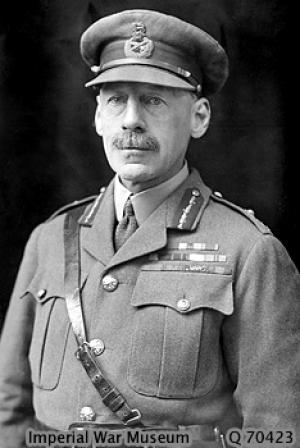
<span class="mw-page-title-main">G. F. Gorringe</span> British Army general

Lieutenant General Sir George Frederick Gorringe, served as an active field commander in the British Army during the Anglo-Boer War and the First World War, on the Palestine and Western Fronts.

<span class="mw-page-title-main">Felix Ready</span> British Army general (1872–1940)

General Sir Felix Fordati Ready, was a British Army officer who served as Quartermaster-General to the Forces from 1931 to 1935. He was considered an expert in military tactics.

Lieutenant-General Sir Alfred Edward Codrington,, was a British Army officer who served in colonial wars in Africa during the late nineteenth century, and later commanded a reserve army during the First World War.

<span class="mw-page-title-main">Frederick McCracken</span> British Army general (1859–1949)

Lieutenant-General Sir Frederick William Nicholas McCracken, was a British Army officer who saw regimental service in Africa during the late nineteenth century, and later held senior command during the First World War. He commanded an infantry brigade in the British Expeditionary Force (BEF) of 1914, was appointed to command 15th (Scottish) Division in the New Armies from 1915 to 1917, and then briefly commanded XIII Corps on the Western Front before being posted to a home command in the United Kingdom.

Lieutenant General Sir John Sharman Fowler, was a British Army engineer officer who specialised on telegraph on signals, and who was later Commander of British Forces in China.

<span class="mw-page-title-main">Henry Heath (British Army officer)</span> British Army general (1860–1915)

Major General Henry Newport Charles Heath was a British Army general during the First World War, who commanded the 48th Division from 1914 to 1915.
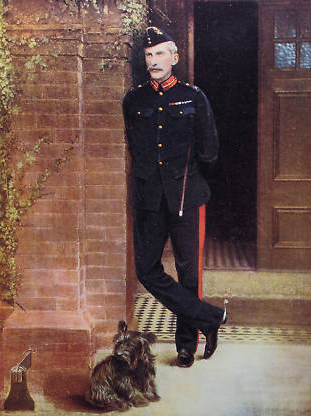
<span class="mw-page-title-main">Henry Hildyard</span> British Army general (1846–1916)

General Sir Henry John Thoroton Hildyard was a British Army officer who saw active service in the Anglo-Egyptian War of 1882 and the Second Boer War. He was General Officer Commanding-in-Chief, South Africa, from 1905 to 1908.

General Sir Reginald Byng Stephens, was a British Army general of the First World War and later Commandant of the Royal Military College, Sandhurst, from 1919 to 1923, Major-General commanding the 4th Division, 1923 to 1926, and Director-General of the Territorial Army, 1927 to 1931.

<span class="mw-page-title-main">Eyre Crabbe</span>

Brigadier General Eyre Macdonnell Stewart Crabbe, CB was a Grenadier Guards officer who fought in the Sudan campaign to rescue General Gordon and in the Second Boer War.

<span class="mw-page-title-main">Charles Kavanagh</span> British Army general (1864–1950)

Lieutenant General Sir Charles Toler MacMorrough Kavanagh, was a British Army officer who commanded the Cavalry Corps during the First World War, most notably at the Battle of Amiens in 1918.

<span class="mw-page-title-main">Edmond Townsend</span>

Surgeon-General Sir Edmond Townsend was an Anglo-Irish medical officer in the British Army. He joined the British Army in 1867 and in a career spanning 38 years rose to become surgeon-general, the most senior ranking medical officer in the British army.

<span class="mw-page-title-main">Arthur Sandbach</span> British Army general officer

Major General Arthur Edmund Sandbach, was a British Army officer who served in the Royal Engineers and on the General Staff, eventually rising to command the 68th and 59th Divisions during the First World War.

Major General The Honourable Sir Frederick Gordon, was a senior British Army officer, who additionally served as a major general in the early Royal Air Force.

Major-General Sir Layton John Blenkinsop was a British Army officer and veterinary surgeon.

References

  1. 1 2 3 4 5 WOOD, Sir Elliott’, Who Was Who, A & C Black, an imprint of Bloomsbury Publishing plc, 1920–2016
  2. Hart′s Army list, 1903
  3. "No. 27306". The London Gazette. 19 April 1901. p. 2695.
  4. "The Army in South Africa - Troops returning Home". The Times. No. 36867. London. 8 September 1902. p. 6.
  5. "Court Circular". The Times. No. 36908. London. 25 October 1902. p. 8.
  6. "Army Corps appointments". The Times. No. 36871. London. 12 September 1902. p. 6.
  7. "No. 27474". The London Gazette . 16 September 1902. p. 5964.
  8. "No. 27490". The London Gazette . 31 October 1902. p. 6897.