
Framlingham Castle is a castle in the market town of Framlingham, Suffolk, England. An early motte and bailey or ringwork Norman castle was built on the Framlingham site by 1148, but this was destroyed (slighted) by Henry II of England in the aftermath of the Revolt of 1173–1174. Its replacement, constructed by Roger Bigod, the Earl of Norfolk, was unusual for the time in having no central keep, but instead using a curtain wall with thirteen mural towers to defend the centre of the castle. Despite this, the castle was successfully taken by King John in 1216 after a short siege. By the end of the 13th century, Framlingham had become a luxurious home, surrounded by extensive parkland used for hunting.
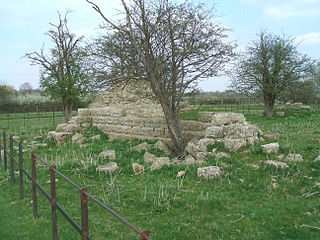
Quarrendon or Quarrendon Leas is a medieval English village near Aylesbury in Buckinghamshire, England, which has been depopulated since the 16th century and is now a scheduled monument.
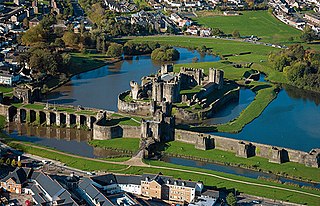
Caerphilly Castle is a medieval fortification in Caerphilly in South Wales. The castle was constructed by Gilbert de Clare in the 13th century as part of his campaign to maintain control of Glamorgan, and saw extensive fighting between Gilbert, his descendants, and the native Welsh rulers. Surrounded by extensive artificial lakes – considered by historian Allen Brown to be "the most elaborate water defences in all Britain" – it occupies around 30 acres (12 ha) and is the largest castle in Wales and the second-largest castle in the United Kingdom after Windsor Castle. It is famous for having introduced concentric castle defences to Britain and for its large gatehouses. Gilbert began work on the castle in 1268 following his occupation of the north of Glamorgan, with the majority of the construction occurring over the next three years at a considerable cost. The project was opposed by Gilbert's Welsh rival Llywelyn ap Gruffudd, leading to the site being burnt in 1270 and taken over by royal officials in 1271. Despite these interruptions, Gilbert successfully completed the castle and took control of the region. The core of Caerphilly Castle, including the castle's luxurious accommodation, was built on what became a central island, surrounding by several artificial lakes, a design Gilbert probably derived from that at Kenilworth. The dams for these lakes were further fortified, and an island to the west provided additional protection. The concentric rings of walls inspired Edward I's castles in North Wales, and proved what historian Norman Pounds has termed "a turning point in the history of the castle in Britain".

Oxburgh Hall is a moated country house in Oxborough, Norfolk, England. The hall was built for Sir Edmund Bedingfeld who obtained a licence to crenellate in 1482. The Bedingfelds gained the manor of Oxborough through marriage in the early 15th century, and the family has lived at the hall since its construction, although ownership passed to the National Trust in 1952. The house underwent extensive refurbishment in the mid 19th century under John Chessell Buckler and Augustus Pugin.
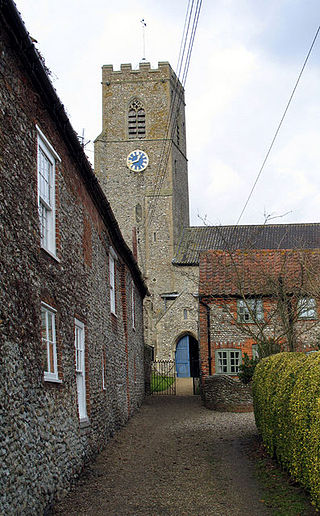
Hindringham is a village and a civil parish in the English county of Norfolk. The village is 8.5 miles (13.7 km) north east of the town of Fakenham, 16.4 miles (26.4 km) west of Cromer and 122 miles (196 km) north of London. The nearest railway station is at Sheringham for the Bittern Line which runs between Sheringham, Cromer and Norwich. The nearest airport is Norwich International Airport.

Gisleham is a village and civil parish in the English county of Suffolk. It is on the edge of Lowestoft, around 5 miles (8.0 km) south-west of the town centre. The parish is in the East Suffolk district, situated between Carlton Colville and Kessingland.

Weeting Castle is a ruined, medieval manor house near the village of Weeting in Norfolk, England. It was built around 1180 by Hugh de Plais, and comprised a three-storey tower, a substantial hall, and a service block, with a separate kitchen positioned near the house. A moat was later dug around the site in the 13th century. The house was not fortified, although it drew on architectural features typically found in castles of the period, and instead formed a very large, high-status domestic dwelling. It was probably intended to resemble the hall at Castle Acre Castle, owned by Hugh's feudal lord, Hamelin de Warenne.
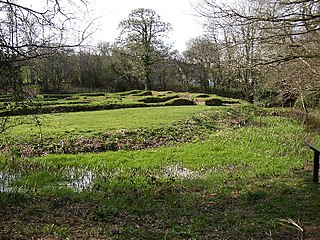
Penhallam is the site of a fortified manor house near Jacobstow in Cornwall, England. There was probably an earlier, 11th-century ringwork castle on the site, constructed by Tryold or his son, Richard fitz Turold in the years after the Norman invasion of 1066. Their descendants, in particular Andrew de Cardinham, created a substantial, sophisticated manor house at Penhallam between the 1180s and 1234, building a quadrangle of ranges facing onto an internal courtyard, surrounded by a moat and external buildings. The Cardinhams may have used the manor house for hunting expeditions in their nearby deer park. By the 14th century, the Cardinham male line had died out and the house was occupied by tenants. The surrounding manor was broken up and the house itself fell into decay and robbed for its stone. Archaeological investigations between 1968 and 1973 uncovered its foundations, unaltered since the medieval period, and the site is now managed by English Heritage and open to visitors.

Elsing is a village and civil parish in the English county of Norfolk. The village is located 4.2 miles (6.8 km) north-east of Dereham and 12 miles (19 km) north-west of Norwich, close to the River Wensum.

Lound is a village and civil parish in the north of the English county of Suffolk. It is 4.5 miles (7.2 km) north of Lowestoft, 5 miles (8.0 km) south of Great Yarmouth in the East Suffolk district. It is 2 miles (3.2 km) from the North Sea coast at Hopton-on-Sea and is on the border with the county of Norfolk.

Melbourne Castle was a medieval castle in Melbourne, Derbyshire. It was built on the site of an earlier royal manor house that had provided accommodation for noblemen hunting in a nearby royal park in the reign of King John. Construction of the castle was started in 1311 by Thomas, 2nd Earl of Lancaster, and continued until 1322, shortly before his execution, but the work was never fully completed.
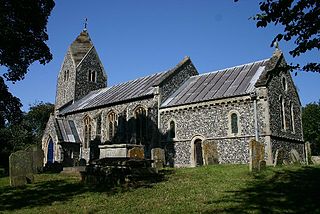
Flixton is a village and civil parish located in the north of the English county of Suffolk. It is around 2 miles (3.2 km) south-west of Bungay in the East Suffolk district and is one of the villages around Bungay which make up the area known as The Saints. The A143 road runs just to the north of the parish border linking Bungay with Harleston and Diss.
St Mary's is an Anglican parish church in Elsing, a small village and civil parish in the Breckland district of Norfolk, England. The 14th-century church was built to a single plan in Decorated Gothic style by a local knight and has remained largely unaltered to the present day. The church contains a brass monument of national importance, a tall medieval font cover and rood screen paintings. The chancel retains some stained glass contemporary with the construction of the building.

Hoo is a village and civil parish in the East Suffolk district of the English county of Suffolk. It is located 3 miles (4.8 km) north-west of the town of Wickham Market and 3 miles (4.8 km) south-west of Framlingham. The parish lies to the south of the River Deben - neighbouring villages include Kettleburgh, Charsfield and Letheringham. The parish council is combined with Cretingham and Monewden, with Hoo itself having one of the smallest populations in Suffolk with 86 residents recorded at the 2001 census. At the 2011 Census, the parish was recorded in combination with Letheringham giving a total population of 160.

Manor Farm is a 22-acre (8.9 ha) historic site in Ruislip, Greater London. It incorporates a medieval farm complex, with a main old barn dating from the 13th century and a farm house from the 16th. Nearby are the remains of a motte-and-bailey castle believed to date from shortly after the Norman conquest of England. Original groundwork on the site has been dated to the 9th century.

Caludon Castle is a Scheduled Ancient Monument and Grade I listed building in Coventry, in the West Midlands of England. A second moated site 190 metres (620 ft) to the south is a Scheduled Ancient Monument in its own right. The castle is now a ruin, and all that remains is a large fragment of sandstone wall. What remains of the estate is now an urban park, owned and run by Coventry City Council, but much of it was sold and developed into housing estates in the early 20th century.

The hall house is a type of vernacular house traditional in many parts of England, Wales, Ireland and lowland Scotland, as well as northern Europe, during the Middle Ages, centring on a hall. Usually timber-framed, some high status examples were built in stone.

Rainthorpe Hall is a Grade I listed Elizabethan country mansion and estate near Tasburgh in Norfolk, England, about 8 miles (13 km) south of Norwich.

Halghton is a dispersed settlement and former civil parish in the east of Wrexham County Borough, Wales. It is part of the community of Hanmer.

Thomas Jeckyll was an English architect who excelled in the creation of metalwork and furniture strongly influenced by Japanese design, and is best known for his planning in 1876 of the ‘Peacock Room’ at 49 Princes Gate, London.


