
Isopoda is an order of crustaceans. Members of this group are called Isopods and include both terrestrial and aquatic species such as woodlice. All have rigid, segmented exoskeletons, two pairs of antennae, seven pairs of jointed limbs on the thorax, and five pairs of branching appendages on the abdomen that are used in respiration. Females brood their young in a pouch under their thorax.
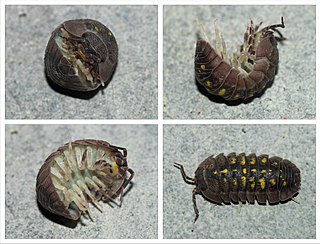
Armadillidiidae is a family of woodlice, a terrestrial crustacean group in the order Isopoda. Unlike members of some other woodlice families, members of this family can roll into a ball, an ability they share with the outwardly similar but unrelated pill millipedes and other animals. This ability gives woodlice in this family their common names of pill bugs or roly polies. Other common names include slaters, potato bugs, butchy boys, and doodle bugs. Most species are native to the Mediterranean Basin, while a few species have wider European distributions. The best-known species, Armadillidium vulgare, was introduced to New England in the early 19th century and has become widespread throughout North America.
Iais singaporensis is a species of marine isopod found in Singapore. It is found living commensally on sphaeromatid isopods.

Woodlice are terrestrial isopods in the suborder Oniscidea. Their name is derived from being often found in old wood, and from louse, a parasitic insect, although woodlice are neither parasitic nor insects.

Pentidotea wosnesenskii is a marine isopod which lives on seaweed on rocky shores along the British Columbia and Washington coastlines, as far south as San Francisco. It can often be found hiding under rockweed in the intertidal zone, and can be found in depths up to 919 metres (3,015 ft). It was described as Idotea wosnesenskii in 1851, by Johann Friedrich von Brandt, and is named after the Russian biologist Ilya G. Voznesensky. The isopod grows up to 4 centimetres (1.6 in) in length and is usually green in colour.

Ligidium japonicum is a species of woodlouse found in moist forests in Japan. Individuals may live for up to two years and reach a length of 8 millimetres (0.31 in).

Platyarthridae is a family of woodlice, containing the following genera:

Glyptonotus antarcticus is a benthic marine isopod crustacean in the suborder Valvifera. This relatively large isopod is found in the Southern Ocean around Antarctica. It was first described by James Eights in 1852 and the type locality is the South Shetland Islands.

Ligia cinerascens is a woodlouse in the family Ligiidae.
Ligia natalensis is a woodlouse-like isopod in the family Ligiidae.
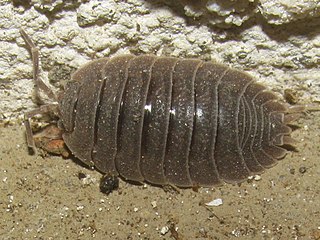
Porcellio dilatatus is a species of woodlouse in the genus Porcellio belonging to the family Porcellionidae. This species is widespread in Europe, and has also been introduced to North America from Western Europe. They are 15 millimetres (0.59 in) long, are brown coloured and striped. They can be found feeding on alder leaves, but mostly feeds on organic food substrates, such as lettuce in the wild. It also feeds on inorganic metal salts.
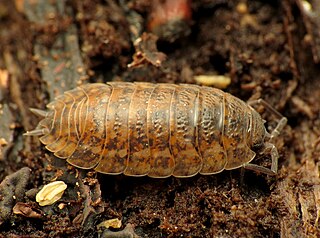
Trachelipodidae is a family of woodlice, containing the following genera:
Scleropactidae is a family of woodlice, with a predominantly Gondwanan distribution. It contains the following genera:
Suarezia is a genus of woodlice, in the family Scleropactidae, containing the two species Suarezia differens and Suarezia heterodoxa, both of which are endemic to Madagascar.
Idotea neglecta is a marine isopod in the family Idoteidae. It can be found on algae in the littoral and sublittoral zone of north-west European coasts.

Euidotea durvillei, known commonly as the red seaweed isopod, is a species of marine isopod found in New Zealand.
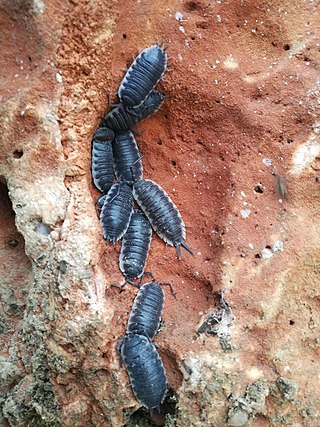
Porcellio hoffmannseggii, commonly called the titan isopod, is a species of woodlouse of the genus Porcellio described in 1833. This very large species is native to the southern Iberian Peninsula, Morocco and the Balearic Islands.

Eluma is a genus of woodlice in the family Armadillidiidae. The members of this genus are native to the Iberian Peninsula, Morocco, the Atlantic islands of the Azores, Canaries and Madeira, and from the west of France to the British Isles.
Eluma caelata is a species of woodlouse found throughout Western Europe and Northwestern Africa. It has been introduced to other regions, such as French Guiana. It was first described as Armadillidium caelatum.
Eluma matae is a species of woodlouse distributed throughout Portugal.
