EnerNOC

Last updated

EnerNOC
Industry
  • Demand Response
  • Energy as a Service
  • Energy Management Software
Predecessor EnerNOC, LLC
FoundedJune 5, 2003 (2003-06-05)
Founder Timothy Gregg Healy, David Benjamin Brewster
Headquarters,
Area served
Worldwide
Key people
Mike Storch, CEO and President [1]
Products demand response, energy management software, energy procurement services, distributed energy resources, energy storage, utility bill management
RevenueIncrease2.svg US$472 Million (2014) [2]
Number of employees
1,300+ (2014) [2]
Subsidiaries List of Subsidiaries

EnerNOC, is the largest provider of demand response worldwide, [3] serving a capacity of 6GW across 8,000 customers worldwide, and a provider of energy management advisory and technology services for commercial, institutional, and industrial customers, as well as electric power grid operators and utilities. In addition to demand response, Enel X's offerings include energy procurement advisory services, utility bill management, demand-side management, energy management software and services, and intelligent energy storage and microgrid. In August 2017, EnerNOC was acquired by the Enel Group. [4]

Contents

History

Founding

EnerNOC was first established by Timothy G. Healy and David Brewster, as EnerNOC, LLC in New Hampshire from December 2001 until June 2003. On 5 June 2003, EnerNOC was incorporated in Delaware. Its corporate headquarters is at One Marina Park Drive, Suite 400, Boston, Massachusetts 02210.

Initial Public Offering

EnerNOC went public in 2007 on the NASDAQ stock exchange at US$26 per share followed by a rally to US$50 per share in spite of reporting two consecutive annual losses. EnerNOC provided the strongest IPO by percentage increase in the green energy sector for the year. The offering included 3.75 million shares. US$98 million was raised with underwriters Credit Suisse and Morgan Stanley. [5] [6]

Expansion

EnerNOC owned numerous subsidiaries around the world. In 2009, EnerNOC bought Cogent Energy and acquired eQuilibrium Solutions, which provides carbon accounting. [7] In March 2010, EnerNOC bought SmallFoot, LLC, a company that makes wireless systems to manage demand for smaller facilities. Tim Healy, CEO of EnerNOC, said of the acquisition, "Going deeper into this underserved market represents a large growth opportunity for our company. SmallFoot gives us additional technology to unlock all forms of demand response and deploy our full suite of applications in this exciting market." [8]

In late 2010 and early 2011, respectively, EnerNOC announced agreements to acquire Global Energy Partners and M2M Communications. Global Energy Partners is "an industry leader in designing and implementing utility energy efficiency and demand response programs." [9] M2M Communications specializes in wireless technology for energy management and demand response.

Since early 2014, EnerNOC acquired five additional companies: Activation Energy, an Irish provider of demand response; Entelios, a German demand response provider; EnTech, a global utility bill management software provider; Pulse Energy, a Vancouver-based provider of utility customer engagement software; and World Energy, an energy procurement software company.

Acquisition

In August 2017, Enel Green Power North America acquired EnerNOC for over $300 million. [4] In January 2018, EnerNOC integrated Demand Energy, the provider of the DEN.OS platform for optimizing energy storage and on-site power generation for demand-side management and microgrid deployments, which had been acquired by the Enel Group in January 2017. [10]

Products

As of 31 March 2015, EnerNOC had over 70,000 sites using its services and software, including commercial buildings, supermarkets, industrial sites, and universities. [11] EIS for enterprise includes budgeting and procurement, utility bill management, facility optimization, visibility and reporting, project tracking, demand management, and demand response.

EnerNOC is a provider of demand response. [3] If a utility company or grid operator has a sudden increase in demand, EnerNOC communicates with customers connected to its network in order to reduce energy use. This can restore balance to the system and prevent the need for the utility to purchase more expensive electricity or even avoid blackouts or brownouts in some cases. During a demand response dispatch, a participating site might switch over to a generator, reduce air conditioning or lighting usage, or power down appliances or other equipment that are not being used. If a site reduces its energy usage during these dispatches, the utility company or grid operator will pay EnerNOC and the customer for this service. Customers are also paid for being on call to reduce demand, thereby providing a superficial, but accountable, capacity to the grid operator or utility. EnerNOC offers a web-based demand response software application that enables its customers to track their own individual energy reductions. [12]

Structure

Subsidiaries

ENOC Securities Corporation

ENOC Securities Corporation, was founded as a Massachusetts [13] securities corporation. Its purpose is to conduct short-term investment of temporary surpluses.

List of Subsidiaries

DateCompanyBusinessCountryValue (USD)References
UnknownCelerity Energy Partners San Diego LLC Energy Flag of the United States.svg  United States Unknown [13]
2009Cogent Energy, Inc. Green Building Flag of the United States.svg  United States Unknown [7] [13]
UnknownENOC Securities Corporation Securities Flag of the United States.svg  United States Unknown [1] [13]
UnknownEnerNOC Ltd.EnergyFlag of Canada (Pantone).svg  Canada Unknown [13]
UnknownEnerNOC UK LimitedEnergyFlag of the United Kingdom.svg  United Kingdom Unknown [13]
UnknownMdenergy, LLCEnergyFlag of the United States.svg  United States Unknown [13]
UnknownPinpoint Power DR LLCEnergyFlag of the United States.svg  United States Unknown [13]
UnknownSouth River Consulting, LLCEnergyFlag of the United States.svg  United States Unknown [13]
UnknownGlobal Energy Partners, Inc.EnergyFlag of the United States.svg  United States Unknown [13]
2011M2M Communications CorporationEnergyFlag of the United States.svg  United States Unknown [13]
2014EnerNOC EIS Pvt LtdEnergyFlag of India.svg  India Unknown [13]
UnknownEnerNOC Australia Pty LtdEnergyFlag of Australia (converted).svg  Australia Unknown [13]
UnknownDMT Energy Pty LtdEnergyFlag of Australia (converted).svg  Australia Unknown [13]
UnknownEnergy Response Holdings Pty LtdEnergyFlag of Australia (converted).svg  Australia Unknown [13]
UnknownEnerNOC Pty LtdEnergyFlag of Australia (converted).svg  Australia Unknown [13]
UnknownEnerNOC New Zealand LimitedEnergyFlag of New Zealand.svg  New Zealand Unknown [13]
UnknownHigh Street Corporation Pty LtdEnergyFlag of Australia (converted).svg  Australia Unknown [13]

Notable work

EnerNOC received a $10 million contract in 2010 to track how much energy state-owned facilities use in Massachusetts. The contract is funded with stimulus money through the United States Department of Energy. Massachusetts hopes to use the study to shave 5 to 15 percent of its annual energy expenses, as well as help shift to alternative energy sources. EnerNOC will be receiving metering information from 470 state-owned buildings, including schools, prisons, and municipal buildings. The information received will include how much energy is being used and where the energy is coming from (for example natural gas, oil, or renewable energy sources). [14] In the summer of 2010, EnerNOC contracted with the Tennessee Valley Authority, the nation's largest public power company, for a 10-year, 560 megawatt demand response contract that represented an addition of 400 MW to TVA's existing deployment of approximately 160 MW with EnerNOC. [15]

Related Research Articles

Distributed generation, also distributed energy, on-site generation (OSG), or district/decentralized energy, is electrical generation and storage performed by a variety of small, grid-connected or distribution system-connected devices referred to as distributed energy resources (DER).

An energy management system (EMS) is a system of computer-aided tools used by operators of electric utility grids to monitor, control, and optimize the performance of the generation or transmission system. Also, it can be used in small scale systems like microgrids. As electric vehicle (EV) charging becomes more popular smaller residential devices that manage when a EV can charge based on the total load vs total capacity of an electrical service are becoming popular.

National Grid plc is a British multinational electricity and gas utility company headquartered in London, England. Its principal activities are in the United Kingdom, where it owns and operates electricity and natural gas transmission networks, and in the Northeastern United States, where as well as operating transmission networks, the company produces and supplies electricity and gas, providing both to customers in New York, Massachusetts, and Rhode Island.
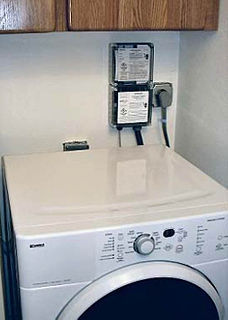
Demand response Techniques used to prevent power networks from being overwhelmed

Demand response is a change in the power consumption of an electric utility customer to better match the demand for power with the supply. Until recently electric energy could not be easily stored, so utilities have traditionally matched demand and supply by throttling the production rate of their power plants, taking generating units on or off line, or importing power from other utilities. There are limits to what can be achieved on the supply side, because some generating units can take a long time to come up to full power, some units may be very expensive to operate, and demand can at times be greater than the capacity of all the available power plants put together. Demand response seeks to adjust the demand for power instead of adjusting the supply.

Smart meter Online recorder of utility usage

A smart meter is an electronic device that records information such as consumption of electric energy, voltage levels, current, and power factor. Smart meters communicate the information to the consumer for greater clarity of consumption behavior, and electricity suppliers for system monitoring and customer billing. Smart meters typically record energy near real-time, and report regularly, short intervals throughout the day. Smart meters enable two-way communication between the meter and the central system. Such an advanced metering infrastructure (AMI) differs from automatic meter reading (AMR) in that it enables two-way communication between the meter and the supplier. Communications from the meter to the network may be wireless, or via fixed wired connections such as power line carrier (PLC). Wireless communication options in common use include cellular communications, Wi-Fi, wireless ad hoc networks over Wi-Fi, wireless mesh networks, low power long-range wireless (LoRa), Wize ZigBee, and Wi-SUN.

Jon Wellinghoff

Jon B. Wellinghoff is an American attorney who served as the chairman of the Federal Energy Regulatory Commission (FERC) from 2009 to 2013. The FERC is a U.S. government agency that regulates the interstate transmission of electricity, natural gas, and oil. The FERC also reviews proposals to build liquefied natural gas (LNG) terminals and interstate natural gas pipelines and licenses hydropower projects.

Enel X is the largest provider of demand response worldwide and products and services aimed at energy transformation at home, city and industrial level.
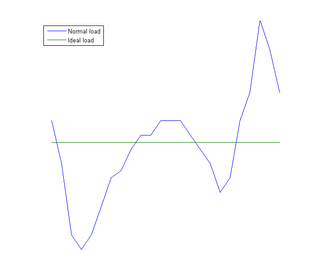
Load management Process of balancing the supply of electricity on a network

Load management, also known as demand-side management (DSM), is the process of balancing the supply of electricity on the network with the electrical load by adjusting or controlling the load rather than the power station output. This can be achieved by direct intervention of the utility in real time, by the use of frequency sensitive relays triggering the circuit breakers, by time clocks, or by using special tariffs to influence consumer behavior. Load management allows utilities to reduce demand for electricity during peak usage times, which can, in turn, reduce costs by eliminating the need for peaking power plants. In addition, some peaking power plants can take more than an hour to bring on-line which makes load management even more critical should a plant go off-line unexpectedly for example. Load management can also help reduce harmful emissions, since peaking plants or backup generators are often dirtier and less efficient than base load power plants. New load-management technologies are constantly under development — both by private industry and public entities.

Smart grid Type of electrical grid

A smart grid is an electrical grid which includes a variety of operation and energy measures including:

GridPoint is a cleantech company that provides energy management and sustainability services to enterprises and government agencies, such as electric utilities.

Electrical grid Interconnected network for delivering electricity from suppliers to consumers

An electrical grid is an interconnected network for electricity delivery from producers to consumers. Electrical grids vary in size and can cover whole countries or continents. It consists of:

Open Automated Demand Response (OpenADR) is a research and standards development effort for energy management led by North American research labs and companies. The typical use is to send information and signals to cause electrical power-using devices to be turned off during periods of high demand.

Silver Spring Networks Provider of smart grid products

Silver Spring Networks, a subsidiary of Itron, is a provider of smart grid products, headquartered in San Jose, California, with offices in Australia, Singapore, Brazil, and the United Kingdom. Besides communications devices, Silver Spring Networks develops software for utilities and customers to improve energy efficiency. Founded in 2002 backed by venture capital, Silver Spring Networks went public on the New York Stock Exchange on March 13, 2013. Itron acquired Silver Spring Networks in January 2018 for $830 million.

Advanced Energy Economy (AEE) is a national trade association representing the advanced energy industry. In 2021, AEE reported over 100 member companies.

The UCLA Smart Grid Energy Research Center (SMERC), located on the University of California Los Angeles (UCLA) campus, is an organization focused on developing the next generation of technologies and innovation for the SmartGrid. Partnerships with government, technology providers, DOE research labs and universities, utilities, policy makers, and electric vehicle and appliance manufacturers provide SMERC with diverse capabilities and exceptional, matured leadership.

Smart Grid Interoperability Panel or SGIP is an organization that defines requirements for a smarter electric grid by driving interoperability, the use of standard, and collaborating across organizations to address gaps and issue hindering the deployment of smart grid technologies.

Joule Assets is a provider of energy reduction market analysis, tools and financing. Joule Assets creates Energy Reduction Assets by accessing value from reduction measures such as demand response, energy efficiency, and energy storage.

HelioPower Energy corporation

HelioPower, Inc. is a US-based provider of integrated energy solutions for residential, commercial, industrial, public sector and non-profit organizations. Founded in 2001, HelioPower also develops proprietary projects with third-party offtakers and currently owns and operates more than 100 energy systems at facilities like the Tech Museum of Innovation in San Jose & Ronald McDonald House in San Diego.

EnerSys Stored energy systems and technology provider

EnerSys is a stored energy systems and technology provider for industrial applications. EnerSys manufactures and distributes reserve power and motive power batteries, battery chargers, power equipment, battery accessories and outdoor equipment enclosure systems to customers worldwide.

Energy storage as a service (ESaaS) allows a facility to benefit from the advantages of an energy storage system by entering into a service agreement without purchasing the system. Energy storage systems provide a range of services to generate revenue, create savings, and improve electricity resiliency. The operation of the ESaaS system is a unique combination of an advanced battery storage system, an energy management system, and a service contract which can deliver value to a business by providing reliable power more economically.

References

  1. 1 2 "EnerNOC 2018".
  2. 1 2 "EnerNoc annual report for FY (2014)" (PDF).
  3. 1 2 "Top Demand Response Providers Ranked by Navigant". Energy Manager Today. Retrieved 19 January 2018.
  4. 1 2 "Enel Group Completes Acquisition Of Leading Us-based Provider Of Smart Energy Management Services Enernoc". EnerNOC. 7 August 2017. Retrieved 19 January 2018.
  5. "Market Watch (EnerNOC IPO poers up 20%)". Archived from the original on 16 February 2013. Retrieved 26 June 2012.
  6. "GreenBiz (EnerNOC)" . Retrieved 26 June 2012.
  7. 1 2 Tweed, Katharine. "The Top Five Players in Demand Response". Greentech Media. Retrieved 27 August 2010.
  8. Associated Press (24 March 2010). "EnerNOC buys SmallFoot to expand customer base". BusinessWeek. Archived from the original on 25 October 2012. Retrieved 27 August 2010.
  9. "Archived copy". Archived from the original on 1 October 2011. Retrieved 8 July 2011.{{cite web}}: CS1 maint: archived copy as title (link)
  10. "ENEL ACQUIRES US-BASED ENERGY STORAGE SOFTWARE AND PROJECT DEVELOPER DEMAND ENERGY" . Retrieved 19 January 2018.
  11. http://files.shareholder.com/downloads/ENOC/3337157805x0x827716/4B9D174A-2D01-4966-874E-6D1D1F733774/Q1_2015_Financial_and_Operating_Statistics.pdf [ bare URL PDF ]
  12. Argersinger, Matthew (3 August 2010). "Today's Buy Opportunity: EnerNOC". The Motley Fool. Retrieved 27 August 2010.
  13. 1 2 3 4 5 6 7 8 9 10 11 12 13 14 15 16 17 18 "SEC records, list of subsidiaries" . Retrieved 26 June 2012.
  14. Ricketts, Camille (12 April 2010). "Massachusetts picks EnerNOC to crack down on energy use". VentureBeat. Archived from the original on 15 April 2010. Retrieved 27 August 2010.
  15. "EnerNOC, TVA expand energy program". The Boston Globe. 15 June 2010.