Relationship to minimization problems
Assume we have a difficult minimization problem

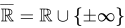
where  and
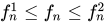
and  . We can attempt to approximate this problem by a sequence of easier problems

for functions  and sets
  .
.
Epi-convergence provides an answer to the question: In what sense should the approximations converge to the original problem in order to guarantee that approximate solutions converge to a solution of the original?
We can embed these optimization problems into the epi-convergence framework by defining extended real-valued functions
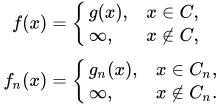
So that the problems  and
and  are equivalent to the original and approximate problems, respectively.
If  epi-converges to
  , then
 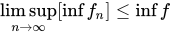 . Furthermore, if
  is a limit point of minimizers of
  , then is a minimizer of . In this sense,

Epi-convergence is the weakest notion of convergence for which this result holds.
This page is based on this
Wikipedia article Text is available under the
CC BY-SA 4.0 license; additional terms may apply.
Images, videos and audio are available under their respective licenses.