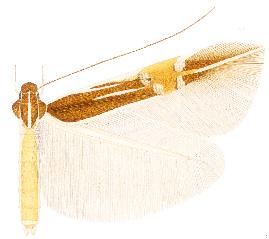
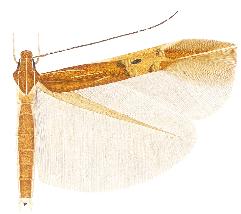
| Erithyma cyanoplecta | |
|---|---|
| Scientific classification | |
| Kingdom: | |
| Phylum: | |
| Class: | |
| Order: | |
| Family: | |
| Genus: | |
| Species: | E. cyanoplecta |
| Binomial name | |
| Erithyma cyanoplecta Meyrick, 1914 | |
Erithyma cyanoplecta is a moth in the family Depressariidae. It was described by Meyrick in 1914. It is found in Guyana. [1]

Moths comprise a group of insects related to butterflies, belonging to the order Lepidoptera. Most lepidopterans are moths, and there are thought to be approximately 160,000 species of moth, many of which have yet to be described. Most species of moth are nocturnal, but there are also crepuscular and diurnal species.
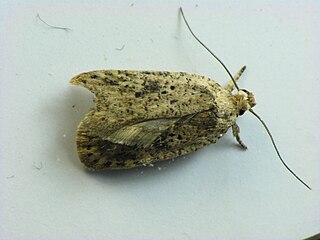
Depressariidae is a family of moths. It has formerly been treated as a subfamily of Gelechiidae, but is now recognised as a separate family, comprising about 2300 species worldwide.
Guyana, officially the Co-operative Republic of Guyana, is a country on the northern mainland of South America. It is the only English speaking country in South America, and is culturally considered part of the Anglophone-Caribbean sphere. In addition it is one of the founding member countries of the Caribbean Community organization, (CARICOM). Guyana is bordered by the Atlantic Ocean to the north, Brazil to the south and southwest, Venezuela to the west, and Suriname to the east. With an area of 215,000 square kilometres (83,000 sq mi), Guyana is the third-smallest sovereign state on mainland South America after Uruguay and Suriname.
The wingspan is 11–12 mm. The forewings are blackish with narrow indigo-blue-metallic transverse fasciae at one-fifth and before the middle, the second furcate towards the dorsum. There are two white dots on the costa at three-fifths and two-thirds, the first terminated beneath by a blue-metallic dot, a small ochreous subcostal spot between these. There is a transverse-linear white mark in the disc at three-fifths and the dorsum is tinged with ferruginous-ochreous towards two-thirds. There is a violet-leaden-metallic patch extending over the termen and tornus. The hindwings are dark fuscous. [2]
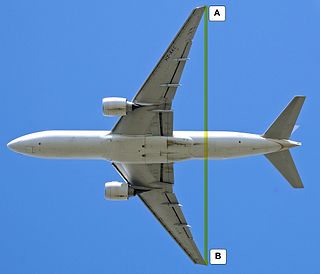
The wingspan of a bird or an airplane is the distance from one wingtip to the other wingtip. For example, the Boeing 777-200 has a wingspan of 60.93 metres, and a wandering albatross caught in 1965 had a wingspan of 3.63 metres, the official record for a living bird. The term wingspan, more technically extent, is also used for other winged animals such as pterosaurs, bats, insects, etc., and other fixed-wing aircraft such as ornithopters. In humans, the term wingspan also refers to the arm span, which is distance between the length from one end of an individual's arms to the other when raised parallel to the ground at shoulder height at a 90º angle. Former professional basketball player Manute Bol stands at 7 ft 7 in (2.31 m) and owns one of the largest wingspans at 8 ft 6 in (2.59 m).