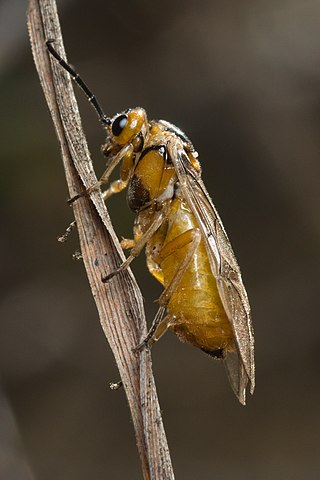
Euura is a genus of sawflies of the family Tenthredinidae, subfamily Nematinae. Some of the larvae feed externally on plants and some form plant galls on willows (Salix species). In the case of the gall-forming species, when the female lays her eggs she injects a stimulant and the gall start to form before the eggs hatch. Most sawfly galls are hard and individual larva tend to inhabit the gall, feeding on the tissue and leave the gall to pupate in the soil. Most of the species are monophages although the type species, Euura mucronata, is polyphagous feeding on over thirty species of willow.
Euura amerinae is a species of sawfly belonging to the family Tenthredinidae. The larvae form galls on bay willow. It was first described by Carl Linnaeus in 1758.

Euura atra is a species of sawfly belonging to the family Tenthredinidae. The larvae feed internally on the shoots of willows and do not usually form galls, although it is included in plant gall literature such as British Plant Galls. It was first described by Louis Jurine in 1807. E. atra is one of a number of closely related species known as the Euura atra subgroup.
Euura auritae is a species of sawfly belonging to the family Tenthredinidae. The larvae forms galls on willows. It was first described by Jens-Peter Kopelke in 2000. E. auritae is one of a number of closely related species which is known as the Euura atra subgroup.
Euura salicispurpureae is a species of sawfly belonging to the family Tenthredinidae. It was first described by Jens-Peter Kopelke in 2014. The larvae feed within galls on willows. E. salicispurpureae is one of a number of closely related species known as the Euura atra subgroup.
Euura myrtilloides is a species of sawfly belonging to the family Tenthredinidae and the larvae forms galls on swamp willow. It was first described by Jens-Peter Kopelke in 1996. E. myrtilloides is one of a number of closely related species which is known as the Euura atra subgroup.
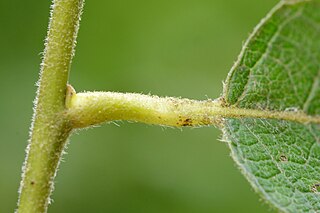
Euura venusta is a species of sawfly belonging to the family Tenthredinidae. The larvae feed within the leaf-stalk of willows forming a gall. The sawfly was first described by Carl Gustav Alexander Brischke in 1883.
Euura testaceipes is a species of sawfly belonging to the family Tenthredinidae. The larvae feed within the leaf-stalk (petiole), or midrib of a leaf, on willows forming a gall. The sawfly was first described by Carl Gustav Alexander Brischke in 1883. E. testaceipes is one of three closely related species known as the Euura amerinae species subgroup. The other members of the group are E. amerinae and E. venusta
Euura dolichura is a species of sawfly belonging to the family Tenthredinidae. It was first described by Carl Gustaf Thomson in 1871. The larvae feed within galls on the leaves of willow. Some of the Euura species of sawfly are closely related and placed in groups of similar species. E. dolichura is a member of the Euura dolichura species group.
Euura triandrae is a species of sawfly belonging to the family Tenthredinidae. The larvae feed on the leaves of almond willow and was first described in 1941.
Euura pustulator is a species of sawfly belonging to the family Tenthredinidae. The larvae feed internally in a gall formed on the leaves of tea-leaved willow and diamondleaf willow.
Euura herbaceae is a species of sawfly belonging to the family Tenthredinidae. The larvae feed internally in a gall formed on the leaves of dwarf willow and polar willow. Galls of E. aquilonis are similar and the larvae need to be examined to tell them apart.
Euura aquilonis is a species of sawfly belonging to the family Tenthredinidae. The larvae feed internally in a gall formed on the leaves of dwarf willow and polar willow. Galls of E. herbaceae are similar and the larvae need to be examined to tell them apart.
Euura arbusculae is a species of sawfly belonging to the family Tenthredinidae. The larvae feed internally in a gall formed on the leaves of mountain willow.
Euura myrsiniticola is a species of sawfly belonging to the family Tenthredinidae. The larvae feed internally in a gall formed on the leaves of whortle-leaved willow.
Euura crassipes is a species of sawfly belonging to the family Tenthredinidae and was first described by Carl Gustaf Thomson in 1871. The larvae feed internally in a gall formed on the leaves of downy willow.
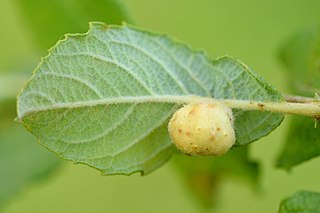
Euura pedunculi is a species of sawfly belonging to the family Tenthredinidae. The larva feed within galls on the leaves of sallows. It was first described by Theodor Hartig in 1837.

Euura viminalis is a species of sawfly belonging to the family Tenthredinidae. The larva feed within galls on the leaves of willows. It was first described by Carl Linnaeus in his landmark 1758 10th edition of Systema Naturae.
Euura collactanea is a species of sawfly belonging to the family Tenthredinidae. The larva feed within galls on the leaves of willows. It was first described by Arnold Förster in 1854.
Euura arcticornis is a species of sawfly belonging to the family Tenthredinidae. The larva feed within galls on the leaves of willows. It was first described by Friedrich Wilhelm Konow in 1904.

