
Bodhidharma was a semi-legendary Buddhist monk who lived during the 5th or 6th century CE. He is traditionally credited as the transmitter of Chan Buddhism to China,and is regarded as its first Chinese patriarch. According to a 17th-century apocryphal story found in a manual called Yijin Jing,he began the physical training of the monks of Shaolin Monastery that led to the creation of Shaolin kungfu. He is known as Dámó in China and as Daruma in Japan. His name means "dharma of awakening (bodhi)" in Sanskrit.

Dajian Huineng,also commonly known as the Sixth Patriarch or Sixth Ancestor of Chan,is a semi-legendary but central figure in the early history of Chinese Chan Buddhism. According to tradition he was an uneducated layman who suddenly attained awakening upon hearing the Diamond Sutra. Despite his lack of formal training,he demonstrated his understanding to the fifth patriarch,Daman Hongren,who then supposedly chose Huineng as his true successor instead of his publicly known selection of Yuquan Shenxiu.

The Platform Sutra of the Sixth Patriarch is a Chan Buddhist scripture that was composed in China during the 8th to 13th century. The "platform" (施法壇) refers to the podium on which a Buddhist teacher speaks. Its key themes are the direct perception of one's original nature,and the unity in essence of śīla (conduct),dhyāna (meditation) and prajñā (wisdom).
Kenshō is an East Asian Buddhist term from the Chan / Zen tradition which means "seeing" or "perceiving" "nature" or "essence",or 'true face'. It is usually translated as "seeing one's [true] nature," with "nature" referring to buddha-nature,ultimate reality,the Dharmadhatu. The term appears in one of the classic slogans which define Chan Buddhism:to see oneʼs own nature and accomplish Buddhahood (見性成佛).
The original face is a term in Zen Buddhism,pointing to one's real essence or Buddha-nature,one's 'real face'.
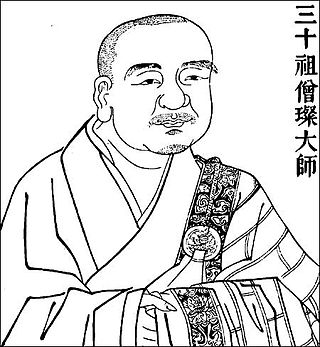
Jianzhi Sengcan is known as the Third Chinese Patriarch of Chán after Bodhidharma and thirtieth Patriarch after Siddhārtha Gautama Buddha.
Prajñātārā,also known as Keyura,Prajnadhara,or Hannyatara,was the twenty-seventh patriarch of Indian Buddhism according to Chan Buddhism,and the teacher of Bodhidharma.

Mazu Daoyi (709–788) was an influential abbot of Chan Buddhism during the Tang dynasty. He is known as the founder of the Hongzhou school of Zen. The earliest recorded use of the term "Chan school" is from his Extensive Records.
SōkōMorinaga was a Rinzai Zen roshi. He was head of Hanazono University and abbot of Daishu-in in Kyoto,one of the sub-temples of the Ryōan-ji temple complex.

Hongren,posthumous name Daman,was the 5th Patriarch of Chan Buddhism.

Yuquan Shenxiu was one of the most influential Chan masters of his day,a Patriarch of the East Mountain Teaching of Chan Buddhism. Shenxiu was Dharma heir of Daman Hongren (601–674),honoured by Wu Zetian of the Tang dynasty,and the putative author of the Guan Xin Lun,a text once attributed to Bodhidharma.

East Mountain Teaching denotes the teachings of the Fourth Ancestor Dayi Daoxin,his student and heir the Fifth Ancestor Daman Hongren,and their students and lineage of Chan Buddhism.
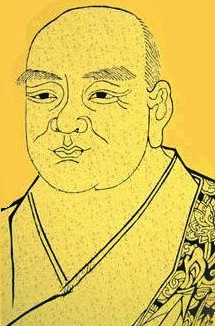
Heze Shenhui was a Chinese Buddhist monk of the so-called "Southern School" of Zen,who "claimed to have studied under Huineng."

Zen is a school of Mahayana Buddhism that originated in China during the Tang dynasty as the Chan School or the Buddha-mind school,and later developed into various sub-schools and branches. Zen was influenced by Taoism,especially Neo-Daoist thought,and developed as a distinguished school of Chinese Buddhism.From China,Chán spread south to Vietnam and became Vietnamese Thiền,northeast to Korea to become Seon Buddhism,and east to Japan,becoming Japanese Zen.
Chan,from Sanskrit dhyāna,is a Chinese school of Mahāyāna Buddhism. It developed in China from the 6th century CE onwards,becoming especially popular during the Tang and Song dynasties.
Though Zen is said to be based on a "special transmission outside scriptures" which "did not stand upon words",the Zen-tradition has a rich doctrinal and textual background. It has been influenced by sutras such as the Lankavatara Sutra,the Vimalakirti Sutra,the Avatamsaka Sutra,and the Lotus Sutra.
Zen lineage charts depict the transmission of the dharma from one generation to another. They developed during the Tang dynasty,incorporating elements from Indian Buddhism and East Asian Mahayana Buddhism,but were first published at the end of the Tang.
Zen has a rich doctrinal background,despite the traditional Zen narrative which states that it is a "special transmission outside scriptures" which "did not stand upon words."
The Zen tradition is maintained and transferred by a high degree of institutionalisation,despite the emphasis on individual experience and the iconoclastic picture of Zen.
Modern scientific research on the history of Zen discerns three main narratives concerning Zen,its history and its teachings:Traditional Zen Narrative (TZN),Buddhist Modernism (BM),Historical and Cultural Criticism (HCC). An external narrative is Nondualism,which claims Zen to be a token of a universal nondualist essence of religions.

