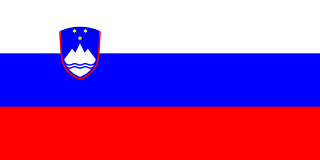
The national flag of Slovenia features three equal horizontal bands of white (top), blue, and red, with the Slovenian coat of arms located in the upper hoist side of the flag centred in the white and blue bands. The coat of arms is a shield with the image of Mount Triglav, Slovenia's highest peak, in white against a blue background at the centre; beneath it are two wavy blue lines representing the Adriatic Sea and local rivers, and above it are three six-pointed golden stars arranged in an inverted triangle which are taken from the coat of arms of the Counts of Celje, the great Slovenian dynastic house of the late 14th and early 15th centuries.

The flag of the Republic of Turkey, often referred to as the Turkish flag is a red flag featuring a white star and crescent. The flag is often called al bayrak, and is referred to as al sancak in the Turkish national anthem. The current design of the Turkish flag is directly derived from the late Ottoman flag, which had been adopted in the late 18th century and acquired its final form in 1844. The measures, geometric proportions, and exact tone of red of the flag of Turkey were legally standardized with the Turkish Flag Law on 29 May 1936.

The national flag of Algeria consists of two equal vertical bars, green and white, charged in the center with a red star and crescent, a symbol of Islam as the nation's prominent faith. The flag was adopted on 3 July 1962. A similar version was used by the Algerian government in exile from 1958–1962. The Western blazon is per pale vert and argent; a crescent and star gules.

The flag of Bosnia and Herzegovina contains a wide medium blue vertical band on the fly side with a yellow right triangle abutting the band and the top of the flag. The remainder of the flag is medium blue with seven full five-pointed white stars and two half stars top and bottom along the hypotenuse of the triangle.

The flag of Brunei has a centered crest of Brunei on a yellow field cut by black and white diagonal stripes. The yellow field represents the sultan of Brunei. The red crest consists of a crescent facing upwards, joined with a parasol, with hands on the sides. Black and white stripes run across the flag.
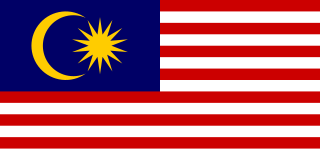
A canton in a flag is a rectangular area at the top hoist corner of a flag, occupying up to a quarter of the flag's area. The canton of a flag may be a flag in its own right. For instance, British ensigns have the Union Jack as their canton, as do their derivatives such as the national flags of Australia and New Zealand.
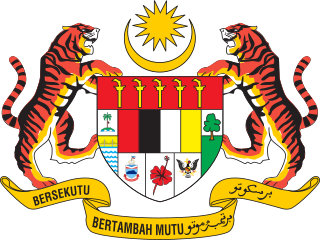
The coat of arms of Malaysia is a coat of arms comprising a shield or escutcheon, two tigers for supporters, a crescent and fourteen-pointed star for a crest and a motto. As the Malaysian coat of arms descended from that of the Federated Malay States under British colonial rule, it resembles European heraldic designs.

The flag of the Malaysian state of Sarawak is based on the flag of the Kingdom of Sarawak of the White Rajah, and includes the yellow of Southeast Asian royalty — a similar yellow and diagonal black are in the flag of Brunei, although Brunei's yellow is of a brighter shade.
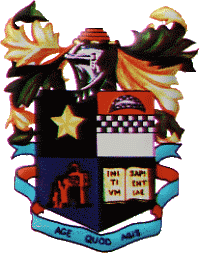
Saint Francis' Institution is a public all-boys school in Malacca, Malaysia with La Sallian tradition. It is called 'SFI' by the local population. Alumni, or Old Boys, are known as 'Franciscans' or 'Lasallians'.
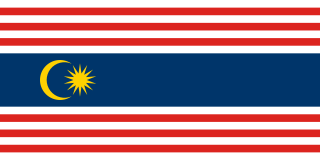
The flag of Kuala Lumpur, Malaysia was officially adopted on 14 May 1990 to commemorate the Dewan Bandaraya Kuala Lumpur (DBKL) or Kuala Lumpur City Hall's 100 years as the local authority of Kuala Lumpur. The flag was designed as a variant to Jalur Gemilang, the Flag of Malaysia, incorporating design elements with its own identity as one of the Federal Territories of the nation. The flag is flown annually on the first day of February, commemorating the day when Kuala Lumpur became a Federal Territory on 1 February 1974.
The flag and coat of arms of Kedah are the state symbols of Kedah, Malaysia. Very little distinction is present between the flag and coat of arms of the state, as the flag consists of only a red field with the state arms on the upper hoist.
The flag and the coat of arms of Johor are state symbols of Johor, Malaysia. Like other states of Malaysia with Malay royalties, the state symbols of Johor are influenced by Johor's royalties, as well as Islam and the political and natural features of the state.

The flag and the coat of arms of Kelantan are state symbols of Kelantan, Malaysia. Like the flag of Kedah, the Kelantanese flag is red with a single charge from Kelantan's coat of arms, albeit partially.
The flag and the coat of arms of Terengganu are state symbols of Terengganu, a state in Malaysia. Like the majority of state symbols for states with Malay royalties, the flag and the arms of Terengganu centre on its royalty, as well as Islam, the state's traditional religion.
The flag and emblem of Selangor are state symbols of Selangor, Malaysia. These two symbols are distinct from each other in style. Similar to other states of Malaysia with Malay royalties, both the flag and arms of Selangor are influenced by royalties, Islam, and political symbols of the state.
Mohamed Hamzah was the creator of the Jalur Gemilang, the Flag of Malaysia. He was from Kampung Melayu Majidee, Johor Bahru, Johor.

The coat of arms of the Chechen Republic is the official symbol of the Chechen Republic. Approved by acting President of Chechnya Sergey Abramov on 22 June 2004.