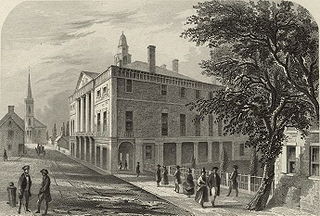
The First United States Congress, consisting of the United States Senate and the United States House of Representatives, met from March 4, 1789, to March 4, 1791, during the first two years of George Washington's presidency, first at Federal Hall in New York City and later at Congress Hall in Philadelphia. With the initial meeting of the First Congress, the United States federal government officially began operations under the new frame of government established by the 1787 Constitution. The apportionment of seats in the House of Representatives was based on the provisions of Article I, Section 2, Clause 3 of the Constitution. Both chambers had a Pro-Administration majority. Twelve articles of amendment to the Constitution were passed by this Congress and sent to the states for ratification; the ten ratified as additions to the Constitution on December 15, 1791, are collectively known as the Bill of Rights.
The three classes of United States Senators are made up of 33 or 34 Senate seats each. The purpose of the classes is to determine which Senate seats will be up for election in a given year. The three groups are staggered so that senators in one of the groups are up for election every two years, rather than having all 100 seats up for election at once. For example, the 33 Senate seats of class 1 were up for election in 2018, the elections for the 33 seats of class 2 will take place in 2020, and the elections for the 34 seats of class 3 will be held in 2022.

The 1972 United States Senate elections coincided with the landslide re-election of Republican President Richard Nixon. Despite Nixon's victory, Democrats increased their majority by two seats. After the elections, Democrats held 56 seats and Republicans held 42 seats, with 1 Conservative and 1 independent Senator. These were the first elections in which all citizens at least 18 years of age could vote due to the 1971 passage of the 26th Amendment.
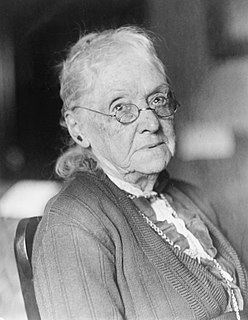
There have been 56 total women in the United States Senate since its establishment in 1789. The first woman who served as a U.S. Senator, Rebecca Latimer Felton, represented Georgia for a single day in 1922. The first woman elected to the Senate was Hattie Caraway from Arkansas in 1932. Seventeen of the women who have served were appointed; seven of those were appointed to succeed their deceased husbands. The 116th Congress has 25 female senators, meaning for the first time in history, one-fourth of the members of the U.S. Senate are female.
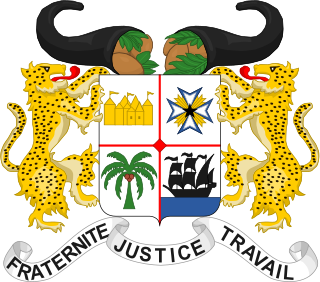
Elections in Benin take place within the framework of a multi-party democracy and a presidential system. Both the President and the National Assembly are directly elected by voters, with elections organised by the Autonomous National Electoral Commission (CENA).

The New York State Senate is the upper house of the New York State Legislature. There are 63 seats in the Senate, and its members are elected to two-year terms. There are no term limits.

The 2008 United States elections were held on November 4. The result was a significant victory for the Democratic Party on the national level, as they increased majorities in both houses of Congress and won the Presidency. Democratic Senator Barack Obama of Illinois defeated Republican Senator John McCain of Arizona in the presidential election. Riding Obama's coattails, the Democrats also picked up net gains of 8 Senate seats and 21 House seats.

Indirect Senate elections were held for 114 of the 343 seats in the French Senate on 21 September 2008. With this election, the number of senators was increased from 331 to 343; Saint Barthélemy and Saint Martin elected two senators each for the first time. Furthermore, this election was the last to be held under the old system: prior to this election, senators were elected in three classes for nine-year terms. Under the new system instituted in 2011, senators are elected for six-year terms in two classes.

The 2010 United States elections were held on Tuesday, November 2, 2010, in the middle of Democratic President Barack Obama's first term. During this midterm election year, all 435 seats in the United States House of Representatives and 37 of the 100 seats in the United States Senate were contested, along with 39 state and territorial governorships, 46 state legislatures, four territorial legislatures and numerous state and local offices. Approximately 82.5 million people voted.

The 2001 United States elections were held on November 5 of that year. The 2001 recession was a dominant issue throughout the year as well as to a lesser extent the September 11 attacks and subsequent War on Terror, the latter of which would become especially important issue in the next year.
The United States Senate elections of 1890 and 1891 were elections in which the Republican Party lost four seats in the United States Senate, though still retaining a slim majority. That majority was increased, however, upon the admission of two more states with Republican senators.
The United States Senate elections of 1792 and 1793 were elections of United States Senators that coincided with President George Washington's unanimous re-election. In these elections, terms were up for the ten senators in class 2.
The United States Senate elections of 1862 and 1863 were elections during the American Civil War in which Republicans increased their control of the U.S. Senate. The Republican Party gained three seats, bringing their majority to 66% of the body. Also caucusing with them were Unionists and Unconditional Unionists. As many Southern states seceded in 1860 and 1861, and members left the Senate to join the Confederacy, or were expelled for supporting the rebellion, seats were declared vacant. To establish a quorum with fewer members, a lower total seat number was taken into account.

The 31st New York State Legislature, consisting of the New York State Senate and the New York State Assembly, met from January 26 to April 11, 1808, during the first year of Daniel D. Tompkins's governorship, in Albany.
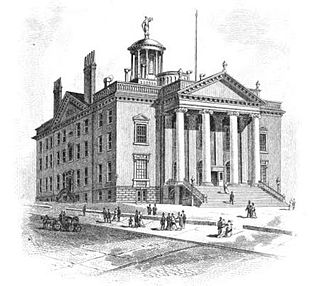
The 65th New York State Legislature, consisting of the New York State Senate and the New York State Assembly, met from January 4 to September 7, 1842, during the fourth year of William H. Seward's governorship, in Albany.

The 2016 United States elections were held on Tuesday, November 8, 2016. During this presidential election year, the President of the United States and Vice President were elected. In addition, elections were held for all 435 voting-member seats in the United States House of Representatives and 34 of the 100 seats in the United States Senate to determine the 115th Congress.

The 2020 United States elections will be held on Tuesday, November 3, 2020. All 435 seats in the United States House of Representatives, 34 of the 100 seats in the United States Senate, and the office of President of the United States will be contested. Thirteen state and territorial governorships, as well as numerous other state and local elections, will also be contested.
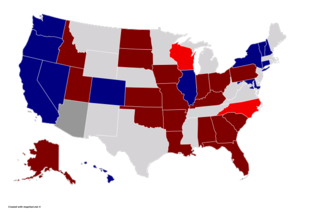
Elections to the United States Senate will be held on November 8, 2022 with 34 of the 100 seats in the Senate being contested in regular elections, the winners of which will serve six-year terms in the United States Congress from January 3, 2023 to January 3, 2029. Senators are divided into three groups, or Classes, whose terms are staggered so that a different class is elected every two years. Class 3 Senators were last elected in 2016, and will be up for election again in 2022.
The 2022 United States elections will be held on Tuesday, November 8, 2022 in the middle of the term of the President elected in 2020. During this mid-term election year, all 435 seats in the United States House of Representatives and 34 of the 100 seats in the United States Senate will be contested. 39 state and territorial governorships and numerous other state and local elections will also be contested. This will be the first election affected by the redistricting that will follow the 2020 United States Census.

Elections to the United States Senate will be held on November 5, 2024 with 33 of the 100 seats in the Senate being contested in regular elections, the winners of which will serve six-year terms in the United States Congress from January 3, 2025 to January 3, 2031. Senators are divided into three groups, or Classes, whose terms are staggered so that a different class is elected every two years. Class 1 Senators were last elected in 2018, and will be up for election again in 2024.