Lillie Glacier is a large glacier in Antarctica, about 100 nautical miles (190 km) long and 10 nautical miles (19 km) wide. It lies between the Bowers Mountains on the west and the Concord Mountains and Anare Mountains on the east, flowing to Ob' Bay on the coast and forming the Lillie Glacier Tongue.

Denman Glacier is a glacier 7 to 10 nautical miles wide, descending north some 70 nautical miles, which debouches into the Shackleton Ice Shelf east of David Island, Queen Mary Land. It was discovered in November 1912 by the Western Base party of the Australasian Antarctic Expedition under Sir Douglas Mawson. Mawson named the glacier for Lord Denman, Governor-General of Australia in 1911, a patron of the expedition.
Explorers Range is a large mountain range in the Bowers Mountains of Victoria Land, Antarctica, extending from Mount Bruce in the north to Carryer Glacier and McLin Glacier in the south. Named by the New Zealand Antarctic Place-Names Committee (NZ-APC) for the northern party of New Zealand Geological Survey Antarctic Expedition (NZGSAE), 1963–64, whose members carried out a topographical and geological survey of the area. The names of several party members are assigned to features in and about this range. All of the geographical features listed below lie situated on the Pennell Coast, a portion of Antarctica lying between Cape Williams and Cape Adare.
Daspit Glacier is a glacier 6 nautical miles (11 km) long, flowing east-northeast along the south side of Mount Shelby to the head of Trail Inlet, on the east coast of Graham Land, Antarctica. It was discovered by members of the East Base of the United States Antarctic Service, 1939–41, and was originally named Fleming Glacier after Rev. W.L.S. Fleming. It was photographed from the air in 1947 by the Ronne Antarctic Research Expedition under Finn Ronne, and charted in 1948 by the Falkland Islands Dependencies Survey. It was renamed by Ronne for Captain Lawrence R. Daspit, U.S. Navy, who assisted in obtaining Navy support for the Ronne expedition, the original name being transferred to Fleming Glacier on the Rymill Coast.
Apollo Glacier is a glacier, 9 nautical miles (17 km) long, flowing northeast and joining the lower part of Aphrodite Glacier 2 nautical miles (4 km) from the east coast of the Antarctic Peninsula. The lower part of this glacier was first plotted by W.L.G. Joerg, from aerial photographs taken by Sir Hubert Wilkins in December 1928 and by Lincoln Ellsworth in November 1935. The glacier was subsequently photographed by the Ronne Antarctic Research Expedition in December 1947 and roughly surveyed by the Falkland Islands Dependencies Survey in November 1960. It was named by the UK Antarctic Place-Names Committee after Apollo, the god of manly youth and beauty in Greek mythology.
Cronus Glacier is a glacier 6 nautical miles (11 km) long and 3 nautical miles (6 km) wide flowing northwest into Bowman Inlet between the Calypso Cliffs and Crabeater Point on the east coast of the Antarctic Peninsula. It was photographed by the Ronne Antarctic Research Expedition on December 22, 1947, and roughly surveyed by the Falkland Islands Dependencies Survey in December 1958. It was named by the UK Antarctic Place-Names Committee after Cronus, the god of agriculture in Greek mythology.
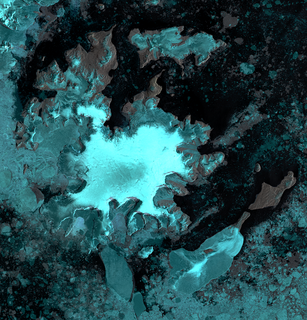
Swift Glacier is a steep glacier about 2 nautical miles (3.7 km) long, close west of Jefford Point, James Ross Island. Named by United Kingdom Antarctic Place-Names Committee (UK-APC) following Falkland Islands Dependencies Survey (FIDS) surveys, 1958-61. The name is descriptive, this being one of the most active glaciers on the island.
Pluto Glacier is a glacier on the east coast of Alexander Island, Antarctica, 10 nautical miles (18 km) long and 4 nautical miles (7 km) wide, which flows east into George VI Sound to the north of Succession Cliffs. Although Pluto Glacier is not located within nearby Planet Heights, the glacier was named in association with the mountain range along with many other nearby glaciers that are named after planets of the Solar System. The glacier was first photographed from the air on November 23, 1935, by Lincoln Ellsworth and mapped from these photos by W.L.G. Joerg. Roughly surveyed in 1936 by the British Graham Land Expedition (BGLE). Named by the United Kingdom Antarctic Place-Names Committee (UK-APC) for Pluto, then considered the ninth planet of the Solar System, following Falkland Islands Dependencies Survey (FIDS) surveys in 1948 and 1949.
Earnshaw Glacier is a glacier 10 nautical miles (19 km) long, flowing northward to the east of Norwood Scarp and entering Maitland Glacier to the south of Werner Peak, in the eastern Antarctic Peninsula. It was photographed from the air by the United States Antarctic Service on September 28, 1940. It was surveyed by the Falkland Islands Dependencies Survey in January 1961, and was named by the UK Antarctic Place-Names Committee after Thomas Earnshaw, an English watchmaker who made innovations leading to the modern marine chronometer.
The Europa Cliffs are a group of interconnected hills and rock ridges on the west side of Jupiter Glacier in eastern Alexander Island, Antarctica. They were mapped from trimetrogon air photography taken by the Ronne Antarctic Research Expedition, 1947–48, and from survey by the Falkland Islands Dependencies Survey, 1948–50. They were named by the UK Antarctic Place-Names Committee from association with Jupiter Glacier after Europa, one of the satellites of the planet Jupiter.
The Ganymede Heights consist of rounded ridges with extensive rock outcrops rising to about 600 m (2,000 ft), between Jupiter Glacier and Ablation Valley on the eastern side of Alexander Island, Antarctica. They were mapped by the Directorate of Overseas Surveys from satellite imagery supplied by the US National Aeronautics and Space Administration in cooperation with the US Geological Survey. They were named by the UK Antarctic Place-Names Committee from association with Jupiter Glacier after Ganymede, one of the satellites of the planet Jupiter. The feature also lies close to the Galileo Cliffs, which were named for the moon's discoverer, Galileo Galilei (1564-1642). The site lies within Antarctic Specially Protected Area (ASPA) No.147.
Gipps Ice Rise is a roughly elliptical ice rise, 10 nautical miles (19 km) long and bounded by an ice cliff on all sides, lying at the edge of the Larsen Ice Shelf about 35 nautical miles (65 km) northeast of Hearst Island. The feature was discovered by William R. MacDonald of the United States Geological Survey (USGS), December 18, 1966, while on a photographic mapping mission of this area aboard a Super Constellation aircraft crewed by the U.S. Navy VXE-6 Squadron. The ice rise was first mapped from these photos by the USGS. The name was proposed by the UK Antarctic Place-Names Committee for Derek R. Gipps, a Senior Executive Officer with the British Antarctic Survey, 1961–73.
Meridian Glacier is a broad glacier, 9 nautical miles (17 km) long, which flows south along the west side of Godfrey Upland and joins Clarke Glacier between Behaim Peak and Elton Hill, in southern Graham Land, Antarctica. Finn Ronne and Carl R. Eklund of the United States Antarctic Service travelled along this glacier in January 1941. It was photographed from the air by the Ronne Antarctic Research Expedition in November 1947, and was surveyed by the Falkland Islands Dependencies Survey in December 1958. The glacier was so named by the UK Antarctic Place-Names Committee because the glacier flows from north to south along the meridian.
Mercury Glacier is a glacier on the east coast of Alexander Island, Antarctica, 5 nautical miles (9 km) long and 2 nautical miles (4 km) wide, flowing east into George VI Sound between the Waitabit Cliffs and Keystone Cliffs. The glacier was probably first sighted from a distance by Lincoln Ellsworth, who flew near it and photographed segments of this coast on November 23, 1935. It was named by the UK Antarctic Place-Names Committee for the planet Mercury following rough surveys from George VI Sound by the Falkland Islands Dependencies Survey (FIDS) in 1948 and 1949. The glacier was mapped in detail from air photos taken by the Ronne Antarctic Research Expedition, 1947–48, by D. Searle of the FIDS in 1960. Although Mercury Glacier is not located within the Planet Heights, it is named in association with the heights along with many other nearby glaciers named after planets of the Solar System.
Mount Kizaki is a mountain 4 nautical miles (7 km) southwest of Mount Dowie in the Aramis Range, Prince Charles Mountains, Antarctica. It was plotted from Australian National Antarctic Research Expeditions air photos, and was named by the Antarctic Names Committee of Australia after Koshiro Kizaki, a glaciologist at Mawson Station in 1966, and later Professor of Geology, Ryukyu University, Okinawa.
Saturn Glacier is a glacier lying in southeast Alexander Island, Antarctica. The glacier is 15 nautical miles (28 km) long and 6 nautical miles (11 km) wide, flowing southeast into the George VI Ice Shelf of George VI Sound north of Corner Cliffs. Although the glacier is not situated within Planet Heights, its name derives from the nearby mountain range along with many other glaciers named after planets of the Solar System. The nunataks at the head of the glacier are also named after solar system features, for example the Enceladus Nunataks named for a moon of Saturn. The coast in this vicinity was first seen from the air by Lincoln Ellsworth on November 23, 1935, and roughly mapped from photos obtained on that flight by W.L.G. Joerg. The glacier was surveyed in 1949 by the Falkland Islands Dependencies Survey (FIDS) and named by the United Kingdom Antarctic Place-Names Committee (UK-APC) for the planet Saturn, the sixth planet of the Solar System.

Tierney Peninsula is an ice-covered peninsula about 14 nautical miles (26 km) long, between Savage Glacier and Morgan Inlet in the east end of Thurston Island. The east extremity of the peninsula is Cape Annawan. These features were discovered on helicopter flights from the USS Burton Island and Glacier of the U.S. Navy Bellingshausen Sea Expedition in February 1960 and named by the Advisory Committee on Antarctic Names (US-ACAN). The peninsula was named for J.Q. Tierney, oceanographer aboard the Burton Island on this expedition. The cape was named for the ship Annawan of the United States Expedition of 1829-31, which with the Penguin sailed west from the South Shetland Islands in February 1830, holding a course between 62S and 58S and exploring as far as 103W, northward of this cape.
Venus Glacier is a glacier on the east coast of Alexander Island, Antarctica, 10 nautical miles (18 km) long and 6 nautical miles (11 km) wide at its mouth flowing east into George VI Sound lying between Keystone Cliffs and Triton Point. The coast in this vicinity was first seen from the air by Lincoln Ellsworth on November 23, 1935 and roughly mapped from photos obtained on that flight by W.L.G. Joerg. The glacier was first surveyed in 1949 by the Falkland Islands Dependencies Survey and named by the United Kingdom Antarctic Place-Names Committee for the planet Venus, the second planet of the Solar System.