
Pavia is a town and comune of south-western Lombardy, in Northern Italy, 35 kilometres south of Milan on the lower Ticino near its confluence with the Po. It has a population of c. 73,086. The city was the capital of the Ostrogothic Kingdom from 540 to 553, of the Kingdom of the Lombards from 572 to 774, of the Kingdom of Italy from 774 to 1024 and seat of the Visconti court from 1365 to 1413.

The Galleria Vittorio Emanuele II is Italy's oldest active shopping gallery and a major landmark of Milan. Housed within a four-story double arcade in the centre of town, the Galleria is named after Victor Emmanuel II, the first king of the Kingdom of Italy. It was designed in 1861 and built by architect Giuseppe Mengoni between 1865 and 1877.
Giacomo Benevelli was an Italian and French sculptor. He was brought up in France. He lived and studied in Nice, Paris, Rome, Aix-en-Provence, Munich. He mainly lived and worked for over forty years in Milan.

The Towers of Bologna are a group of medieval structures in Bologna, Italy. The two most prominent ones remaining, known as the Two Towers, are a landmark of the city.

Luigi De Giudici was an Italian painter of the Venetian anti-academic movement in the first years of the twentieth century. His works were exhibited at Ca' Pesaro between 1912 and 1920 and at the International Exposition of Paris (1937).

Piazza De Ferrari is the main square of Genoa. Situated in the heart of the city between the historical and the modern center, Piazza De Ferrari is renowned for its fountain, which was restored in recent years along with a major restyling of the square.

Pavia Cathedral is a church in Pavia, Italy, the largest in the city and seat of the Diocese of Pavia. The construction was begun in the 15th century on the site of two pre-existing Romanesque, "twin" cathedrals. The cathedral houses the remains of St. Sirus, first Bishop of Pavia, and a thorn purported to be from the Crown of Thorns worn by Christ. The marble facing of the exterior was never completed.
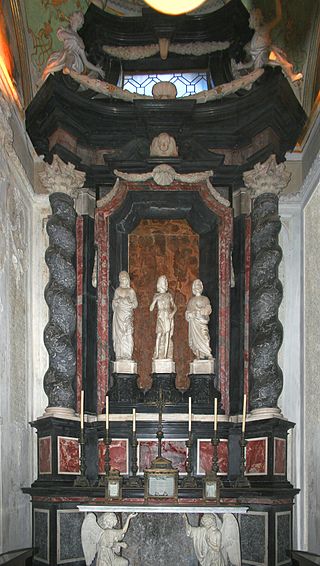
Grazioso Rusca was a Swiss sculptor who was also active in northern Italy.

Giuseppe Amisani was an Italian portrait painter of the Belle Époque.
Bruno Chersicla was an Italian painter and sculptor.
Giuseppe Riccardo "Beppe" Devalle was an Italian painter and collagist, acknowledged as one of the most interesting and highly appreciated artists of the last few decades of Italian painting. He always refuted the prevailing trends of the day so as to create and distinguish his own individual style: this may explain why Devalle has often been overlooked and placed as something of an outsider. He has been known as a master of photomontage and defined as a creator of the 'New Epic Italian style'.
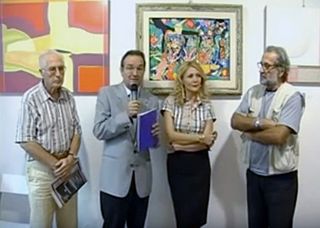
Mauro Marrucci was an Italian artist born in Volterra, Italy on December 18, 1937, by artisans parents and he died November 15, 2014, in Grosseto. Since 1950 he is acting as the Alabaster craftsman and wood and began his artistic research, released by academic schemes, as a graphic designer and painter and makes experiences in the field of sculpture. In 1861 he won first teaching assignment in Tuscany where he continues to practice as a graphic designer, painter and designer. Since 1973, public writings of artistic teaching and non-fiction. In December 1974 on Public Education of drawing the essay "The educational dialogue through the work of art." He also collaborates with the magazine School and cities. In 1982 he moved to Milan to teach Design and Art History at the XIII High School. In 1986 he held the chair of architecture at the Art School "Pietro Aldi" in Grosseto until retirement. From 1957 to 2011 he took part in demonstrations in graphics and painting in Italy and abroad, receiving reports from the most qualified critics and several awards.

Eugenio Soncini was an Italian architect.

The Galleria del Corso is a major shopping arcade in the historic center of Milan, Italy, one of five built in the city in the interwar period (1919–39), along with the Galleria del Toro, Galleria Mazzini, Galleria Meravigli and the Galleria Gonzaga.

Characteristic of the historic center of Pavia is the presence of medieval noble towers that survive in its urban fabric, despite having once been more numerous, as evidenced by the sixteenth-century representation of the city frescoed in the church of San Teodoro. They were mostly built between the 11th and 13th centuries when the Ghibelline city was at the height of its Romanesque flowering.

The Teatro Fraschini is an opera house in Pavia, Italy.

The Old Campus of the University of Pavia is a complex located in Pavia, in Lombardy, home to the rectorate and some university faculties and the University History Museum of the University of Pavia.

Palazzo Cornazzani is a palace in Pavia, in Lombardy, where, between 1895 and 1896, Albert Einstein lived.
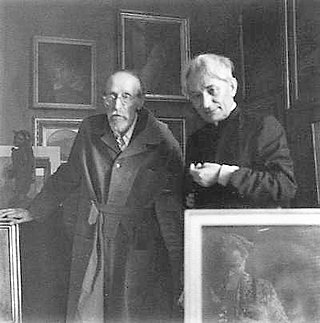
Cesare Angelini was an Italian presbyter, writer and literary critic.

