
Spanish cuisine consists of the traditions and practices of Spanish cooking. It features considerable regional diversity, with significant differences among the traditions of each of Spain's regional cuisines.

A taco is a traditional Mexican dish consisting of a small hand-sized corn- or wheat-based tortilla topped with a filling. The tortilla is then folded around the filling and eaten by hand. A taco can be made with a variety of fillings, including beef, pork, chicken, seafood, beans, vegetables, and cheese, and garnished with various condiments, such as salsa, guacamole, or sour cream, and vegetables, such as lettuce, coriander, onion, tomatoes, and chiles. Tacos are a common form of antojitos, or Mexican street food, which have spread around the world.
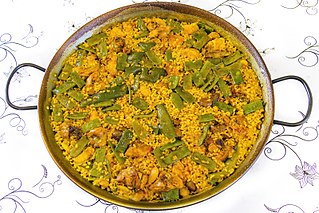
Paella is a rice dish originally from the Valencian Community. Paella is regarded as one of the community's identifying symbols. It is one of the best-known dishes in Spanish cuisine. In Spain, it is traditionally included in restaurant menus on Thursdays.

Ceviche, cebiche, sebiche, or seviche is a dish consisting of fish or shellfish marinated in citrus and seasonings, and is recognized by UNESCO as an expression of Peruvian traditional cuisine and Intangible Cultural Heritage of Humanity. Different versions of ceviche are part of the culinary culture of various Spanish-American countries along the Pacific Ocean where each one is native: Chile, Colombia, Costa Rica, Ecuador, El Salvador, Guatemala, Honduras, Mexico, Nicaragua, Panama and Peru. In Peru it is also considered a flagship dish and cultural heritage.

Puerto Rican cuisine consists of the cooking style and traditional dishes original to Puerto Rico. It has been primarily a fusion influenced by the ancestors of the Puerto Rican people: the indigenous Taínos, Spanish Criollos and sub-Saharan African slaves. As a territory of the United States, the culinary scene of Puerto Rico has also been moderately influenced by American cuisine.
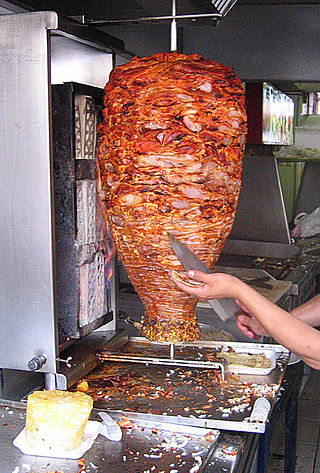
Al pastor, tacos al pastor, or tacos de trompo is a preparation of spit-grilled slices of pork originating in the Central Mexican region of Puebla and Mexico City, where they remain most prominent; although today it is a common menu item found in taquerías throughout Mexico. The method of preparing and cooking al pastor is based on the lamb shawarma brought by Lebanese immigrants to the region. Al pastor features a flavor palate that uses traditional Mexican adobada (marinade). It is a popular street food that has spread to the United States. In some places of northern Mexico and coastal Mexico, such as in Baja California, taco al pastor is known as taco de trompo or taco de adobada.

Pancit, also spelled pansít, is a general term referring to various traditional noodle dishes in Filipino cuisine. There are numerous types of pancit, often named based on the noodles used, method of cooking, place of origin or the ingredients. Most pancit dishes are characteristically served with calamansi, which adds a citrusy flavor profile.
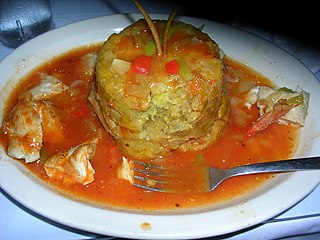
Mofongo is a dish from Puerto Rico with plantains as its main ingredient. Plantains are picked green, cut into pieces and typically fried in more modern versions but can be boiled in broth or roasted, then mashed with salt, garlic, broth, and cooking oil in a wooden pilón. The goal is to produce a tight ball of mashed plantains that will absorb the attending condiments and have either pork cracklings (chicharrón) or bits of bacon inside. It is traditionally served with fried meat and chicken broth soup. Particular flavors result from variations that include vegetables, chicken, shrimp, beef, or octopus packed inside or around the plantain orb.

Sofrito, sofregit, soffritto, or refogado, is a basic preparation in Mediterranean, Latin American, Spanish, Italian and Portuguese cooking. It typically consists of aromatic ingredients cut into small pieces and sautéed or braised in cooking oil for a long period of time over a low heat.

Colombian cuisine is a culinary tradition of the six main regions within Colombia. Colombian cuisine varies regionally and is influenced by Indigenous Colombian, Spanish, and African cuisines, with a slight Arab influence in some regions.

Arroz a la valenciana or Valencian rice is a name for a multitude of rice dishes from diverse cuisines of the world, which originate from the rice-cooking tradition of the Valencian Community, in eastern Spain.

Uruguayan cuisine is a fusion of cuisines from several European countries, especially of Mediterranean foods from Spain, Italy, Portugal and France. Other influences on the cuisine resulted from immigration from countries such as Germany and Scotland. Uruguayan gastronomy is a result of immigration, rather than local Amerindian cuisine, because of late-19th and early 20th century immigration waves of, mostly, Italians. Spanish influences are abundant: desserts like churros, flan, ensaimadas yoo (Catalan sweet bread), and alfajores were all brought from Spain. There are also various kinds of stews known as guisos or estofados, arroces, and fabada. All of the guisos and traditional pucheros (stews) are also of Spanish origin. Uruguayan preparations of fish, such as dried salt cod (bacalao), calamari, and octopus, originate from the Basque and Galician regions, and also Portugal. Due to its strong Italian tradition, all of the famous Italian pasta dishes are present in Uruguay including ravioli, lasagne, tortellini, fettuccine, and the traditional gnocchi. Although the pasta can be served with many sauces, there is one special sauce that was created by Uruguayans. Caruso sauce is a pasta sauce made from double cream, meat, onions, ham and mushrooms. It is very popular with sorrentinos and agnolotti. Additionally, there is Germanic influence in Uruguayan cuisine as well, particularly in sweet dishes. The pastries known as bizcochos are Germanic in origin: croissants, known as medialunas, are the most popular of these, and can be found in two varieties: butter- and lard-based. Also German in origin are the Berlinese known as bolas de fraile, and the rolls called piononos. The Biscochos were re-christened with local names given the difficult German phonology, and usually Uruguayanized by the addition of a dulce de leche filling. Even dishes like chucrut (sauerkraut) have also made it into mainstream Uruguayan dishes.

Mole, meaning 'sauce', is a traditional sauce and marinade originally used in Mexican cuisine. In contemporary Mexico the term is used for a number of sauces, some quite dissimilar, including mole amarillo or amarillito, mole chichilo, mole colorado or coloradito, mole manchamantel or manchamanteles, mole negro, mole rojo, mole verde, mole poblano, mole almendrado, mole michoacano, mole prieto, mole ranchero, mole tamaulipeco, mole xiqueno, pipián, mole rosa, mole blanco, mole estofado, tezmole, clemole, mole de olla, chimole, guacamole and huaxmole.
The seco is a stew typical of Ecuadorian and Peruvian cuisine. It can be made with any type of meat. According to an Ecuadorian popular etymology, the name of seco comes from the Península de Santa Elena in Ecuador, where at the beginning of the 20th century a camp English did oil work in Ancón, when referring to the second course of food, in English "second", the Ecuadorians repeated deforming the word until they reached the current "seco", which has been widely disseminated, despite being a myth, since records of this dish have been found since 1820, almost a century before the English presence in the Santa Elena Peninsula. At that time, deer and Creole goats abounded. According to the Dictionary of Peruvianisms of the Peruvian Wings University, seco is a «stew of beef, kid or another animal, macerated in vinegar, which is served accompanied by rice and a sauce of ají, huacatay and cilantro". Thus, its main characteristic is to marinate and cook the chosen meat with some type of sauce acid, such as chicha, beer, naranjilla or vinegar.

Arroz chaufa, also known as chaufa, is a fried rice dish from Peru. It is part of the Chinese Peruvian cuisine, which is called chifa.
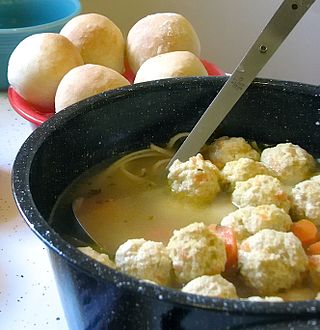
A meatball is ground meat (mince) rolled into a ball, sometimes along with other ingredients, such as bread crumbs, minced onion, eggs, butter, and seasoning. Meatballs are cooked by frying, baking, steaming, or braising in sauce. There are many types of meatballs using different types of meats and spices. The term is sometimes extended to meatless versions based on legumes, vegetables, mushrooms, fish or other seafood.


