Related Research Articles
The Haijin (海禁) or sea ban were a series of related isolationist policies in China restricting private maritime trading and coastal settlement during most of the Ming dynasty and early Qing dynasty.

Fujian,previously romanized as Fukien,is a province located in South China. Fujian is bordered by Zhejiang to the north,Jiangxi to the west,Guangdong to the south,and the Taiwan Strait to the east. Its capital is Fuzhou and its largest city by population is Quanzhou,other notable cities include the port city of Xiamen and Zhangzhou. Fujian is located on the west coast of the Taiwan Strait as the closest geographically and culturally to Taiwan. Certain islands such as Kinmen are only approximately 10 km (6.2 mi) east of Xiamen in Fujian.

Fuzhou is the capital of Fujian,China. The city lies between the Min River estuary to the south and the city of Ningde to the north. Together,Fuzhou and Ningde make up the Mindong linguistic and cultural region.

Quanzhou is a prefecture-level port city on the north bank of the Jin River,beside the Taiwan Strait in southern Fujian,People's Republic of China. It is Fujian's largest most populous metropolitan region,with an area of 11,245 square kilometers (4,342 sq mi) and a population of 8,782,285 as of the 2020 census. Its built-up area is home to 6,669,711 inhabitants,encompassing the Licheng,Fengze,and Luojiang urban districts;Jinjiang,Nan'an,and Shishi cities;Hui'an County;and the Quanzhou District for Taiwanese Investment. Quanzhou was China's 12th-largest extended metropolitan area in 2010.

Lin Zexu,courtesy name Yuanfu,was a Chinese political philosopher and politician. He was a head of state (Viceroy),Governor General,scholar-official,and under the Daoguang Emperor of the Qing dynasty best known for his role in the First Opium War of 1839–42. He was from Fuzhou,Fujian Province. Lin's forceful opposition to the opium trade was a primary catalyst for the First Opium War. He is praised for his constant position on the "moral high ground" in his fight,but he is also blamed for a rigid approach which failed to account for the domestic and international complexities of the problem. The Emperor endorsed the hardline policies and anti-drugs movement advocated by Lin,but placed all responsibility for the resulting disastrous Opium War onto Lin.

The Kingdom of Tungning,also known as Tywan by the English at the time,was a dynastic maritime state that ruled part of southwestern Taiwan and the Penghu islands between 1661 and 1683. It is the first predominantly ethnic Han state in Taiwanese history. At its zenith,the kingdom's maritime power dominated varying extents of coastal regions of southeastern China and controlled the major sea lanes across both China Seas,and its vast trade network stretched from Japan to Southeast Asia.

Fuchien Province,also romanized as Fujian and rendered as Fukien,is a nominal province of the Republic of China without formal administrative function. It includes three small archipelagos off the coast of the Fujian Province of the People's Republic of China,namely the Matsu Islands,which make up Lienchiang County,and the Wuqiu Islands and Kinmen Islands,which make up Kinmen County. The seat of the administrative centre is Jincheng Township of Kinmen County which serves as its de facto capital. The province is also known as the Golden Horse,after the literal reading of the Chinese character abbreviation for "Kinmen-Matsu".
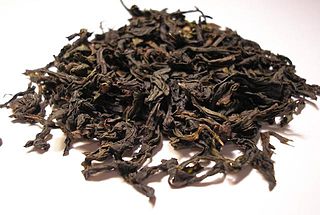
Wuyi tea,also known by the trade name Bohea in English,is a category of black and oolong teas grown in the Wuyi Mountains of northern Fujian,China. The Wuyi region produces a number of well-known teas,including Lapsang souchong and Da Hong Pao. It has historically been one of the major centers of tea production in Fujian province and globally. Both black tea and oolong tea were likely invented in the Wuyi region,which continues to produce both styles today.
Zheng Zhilong,Marquis of Tong'an,baptismal name Nicholas Iquan Gaspard,was a Fujianese (Hokkien) admiral,pirate leader,merchant,translator,military general,and politician of the late Ming dynasty who later defected to the Manchu Qing. He was the founder of the Zheng Dynasty,the father of Koxinga,the founder of the pro-Ming Kingdom of Tungning in Taiwan,and as such an ancestor of the House of Koxinga.
Zhao Rukuo,also romanised as Zhao Rugua,Chau Ju-kua,or misread as Zhao Rushi,was a Chinese government official and writer during the Song dynasty. He wrote a two-volume book titled Zhu Fan Zhi. The book deals with the world known to the Chinese in the twelfth and thirteenth centuries;the first volume is a list of foreign places with descriptions of each place and the customs of its local people. The second volume is a catalog of trade goods.
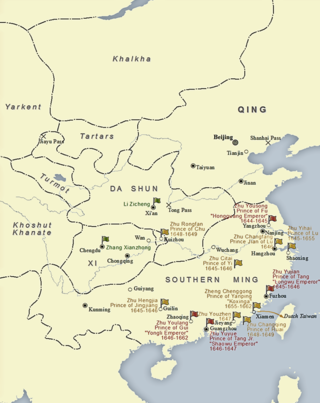
The Southern Ming,also known in historiography as the Later Ming,officially the Great Ming,was an imperial dynasty of China and a series of rump states of the Ming dynasty that came into existence following the Jiashen Incident of 1644. Peasant rebels led by Li Zicheng who founded the short-lived Shun dynasty captured Beijing and the Chongzhen Emperor committed suicide. The Ming general Wu Sangui then opened the gates of the Shanhai Pass in the eastern section of the Great Wall to the Qing banners,in hope of using them to annihilate the Shun forces. Ming loyalists fled to Nanjing,where they enthroned Zhu Yousong as the Hongguang Emperor,marking the start of the Southern Ming. The Nanjing regime lasted until 1645,when Qing forces captured Nanjing. Zhu fled before the city fell,but was captured and executed shortly thereafter. Later figures continued to hold court in various southern Chinese cities,although the Qing considered them to be pretenders.
Lu Zhangong is a Chinese politician. He is,since 2013,a Vice Chairman of the Chinese People's Political Consultative Conference,and previously served as the Communist Party Secretary of Fujian and Henan provinces,and Governor of Fujian.

The Sangley Rebellion was a series of armed confrontations between overseas Chinese,known as the Sangley,and the Spanish and their allied forces in Manila under the Captaincy General of the Philippines,in October 1603. The local ethnic Chinese residents dominated trade and outnumbered Spanish residents in Manila by a five-to-one ratio,although both were minorities to the indigenous Tagalog population. The ruling Spaniards feared and resented the rival Chinese minority. Policies of persecution were enacted against the local Chinese residents and they were expelled from the city to an undesirable swamp area in 1586,which the local Chinese turned into a thriving town. The local Chinese planned a strike due to worsening relations,but it resulted in the execution of their mayor,and became a rebellion. It ended in the massacre of more than 20,000 ethnic Chinese in Manila at the hands of the Spaniards,local Japanese,and indigenous Tagalog forces.
The Battle of Liaoluo Bay took place in 1633 off the coast of Fujian,China;involving the Dutch East India Company (VOC) and the Chinese Ming dynasty's navies. The battle was fought at the crescent-shaped Liaoluo Bay that forms the southern coast of the island of Kinmen. A Dutch fleet under Admiral Hans Putmans was attempting to control shipping in the Taiwan Strait,while the southern Fujian sea traffic and trade was protected by a fleet under Brigadier General Zheng Zhilong. This was the largest naval encounter between Chinese and European forces before the Opium Wars two hundred years later.
Cai Qian was a Chinese sea merchant,considered by some a pirate during the Qing dynasty era.

Western Taiwan Straits Economic Zone or West Coast Economic Zone is the proposed economic development zone for the economic region west of the Taiwan Straits by the Fujian government and the Chinese central government. This include the coastal cities of Xiamen,Zhangzhou,Quanzhou and Fuzhou along Fujian province.

The Sino-Dutch conflicts were a series of conflicts between the Ming dynasty of China and the Dutch East India Company over trade and land throughout the 1620s,1630s,and 1662. The Dutch were attempting to compel China to accede to their trade demands,but the Chinese defeated the Dutch forces.

Kaiyuan Temple is a Buddhist temple located in West Street,Quanzhou,China,and is considered as the largest Buddhist temple in Fujian province with an area of 78,000 square metres (840,000 sq ft). The central figures of veneration in the temple are the Five Tathāgathas from Chinese Esoteric Buddhism who are enshrined in the temple's Mahavira Hall. In 2021,the temple was inscribed on the UNESCO World Heritage List along with other sites near Quanzhou because of its importance during the medieval global maritime trade based in Quanzhou and its testimony to the global exchange of ideas and cultures. The temple is also one of few in China to contain Hindu monuments,left there by traders from Southern India. It is of Buddhist Dense-Eaves architecture and is most famous for the largest stone pagodas in the world,the twin pagodas of Zhenguo and Renshou,which were completed using stone during the Song Dynasty.
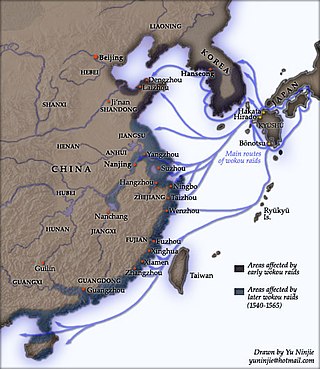
The Jiajing wokou raids caused extensive damage to the coast of China in the 16th century,during the reign of the Jiajing Emperor in the Ming dynasty. The term "wokou" originally referred to Japanese pirates who crossed the sea and raided Korea and China;however,by the mid-Ming,the wokou consisted of multinational crewmen that included the Japanese and the Portuguese,but a great majority of them were Chinese instead. Mid-Ming wokou activity began to pose a serious problem in the 1540s,reached its peak in 1555,and subsided by 1567,with the extent of the destruction spreading across the coastal regions of Jiangnan,Zhejiang,Fujian,and Guangdong.
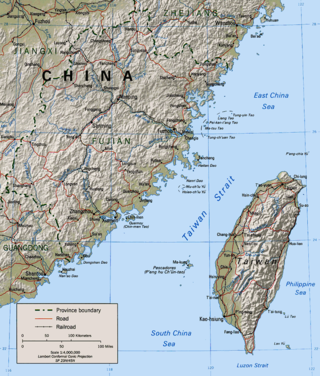
The Fujian–Taiwan relations,also known as the Min–Tai relations,refers to the relationship between Fujian,which is located in mainland China,and Taiwan,which is across the Taiwan Strait. Since the average width of the Taiwan Strait is 180 kilometers,Fujian and Taiwan are adjacent,similar in both climate and environment. Although the relationship between Taiwan and Fujian has changed with the development of history,the two places have maintained close relations in terms of personnel,economy,military,culture and other aspects. At present,Taiwan residents are mostly descendants of immigrants from mainland China,of which the southern Fujian ethnic group is the main group,accounting for 73.5% of Taiwan's total population. In terms of culture,language,religion,and customs,Fujian and Taiwan also share similarities.
References
- ↑ Richard von Glahn (1996). Fountain of Fortune: Money and Monetary Policy in China, 1000-1700. University of California Press. p. 127. ISBN 9780520917453.
- ↑ Xisha Ma; Huiying Meng (2011). Popular Religion and Shamanism. Brill. p. 57. ISBN 9789047428015.
| International | |
|---|---|
| National | |
| Academics | |
| People | |

 | This Chinese biographical article is a stub. You can help Wikipedia by expanding it. |