| ||||||||||||||||||||||||||||||||||||||||||||||||||||||||||||||||||||
All 118 seats of the Landtag of Hesse 60 seats needed for a majority | ||||||||||||||||||||||||||||||||||||||||||||||||||||||||||||||||||||
| ||||||||||||||||||||||||||||||||||||||||||||||||||||||||||||||||||||
| ||||||||||||||||||||||||||||||||||||||||||||||||||||||||||||||||||||
Early state elections for the Landtag of Hesse were held in Hesse on 18 January 2009. The reason for the early elections was the inability of the parties to form a government after the inconclusive 2008 Hessian election.
The Landtag of Hesse is the Parliament of the State of Hesse in the Federal Republic of Germany. It convenes in the Stadtschloss, Wiesbaden. As a Legislature it is responsible for passing laws at the state level and enacting the budget. Its most important function is to elect and control the state government. The constitution of the State of Hesse describes the role of the Landtag in §§ 75 to 99.
Hesse or Hessia, officially the State of Hesse, is a federal state (Land) of the Federal Republic of Germany, with just over six million inhabitants. The state capital is Wiesbaden; the largest city is Frankfurt am Main.
Hesse had been in the midst of political deadlock since January 2008, as a new government was still not formed by the Fall of 2008. The reason that ideologically-allied parties could not form a government was the existence of a bloc of far-left Linke party delegates in the Landtag. The CDU/FDP did not have a majority, nor did the SPD/Greens. Both the Linke party and the Greens pushed hard for a "red-green-red" (SPD-Greens-Linke) coalition, but the SPD initially refused this. The only other option was a grand coalition along the model in the Bundestag after the 2005 election, but this was also very unpopular. [1]
Linke is a German surname deriving from the German word meaning "left". It can refer to:
A grand coalition is an arrangement in a multi-party parliamentary system in which the two largest political parties of opposing political ideologies unite in a coalition government. The term is most commonly used in countries where there are two dominant parties with different ideological orientations, and a number of smaller parties that have passed the election threshold to secure representation in the parliament. The two large parties will each try to secure enough seats in any election to have a majority government alone, and if this fails each will attempt to form a coalition with smaller parties that have a similar ideological orientation. Because the two large parties will tend to differ on major ideological issues, and portray themselves as rivals, or even sometimes enemies, they will usually find it more difficult to agree on a common direction for a combined government with each other than with smaller parties.
SPD leader Andrea Ypsilanti finally gave in and attempted to negotiate with the Linke party to form a red-green-red coalition, reneging on a promise she had made earlier in the year to never negotiate with the far-left. [2] This action caused an internal revolt among Hesse's SPD Landtag members, resulting in Ypsilanti being cast out as leader and new elections being called. [3]
Andrea Ypsilanti is a German politician.
This election became in effect a referendum on the SPD; although the CDU remained unpopular, the SPD was now much less popular after recent events.
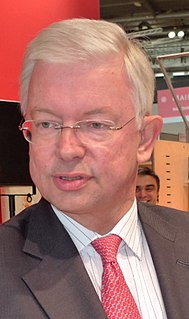
Roland Koch, the CDU party leader in Hesse and minister-president of Hesse before the 2008 elections, also acted as interim minister-president until 31 August 2010. And so even though the CDU had suffered a stinging electoral defeat in 2008, Roland Koch had not been unseated due to the inability of the SPD to form a new government.
Roland Koch is a German jurist and former conservative politician of the CDU. He was the 7th Minister President of Hesse from 7 April 1999, immediately becoming the 53rd President of the Bundesrat, completing the term begun by his predecessor as Minister President, Hans Eichel, until his resignation on 31 August 2010. During his time in office, Koch was widely regarded as one of Chancellor Angela Merkel's main rivals within the CDU.
The candidates for the office of minister-president in 2009 were the incumbent Roland Koch of the CDU; the new Hesse SPD party leader, Thorsten Schäfer-Gümbel; Tarek Al-Wazir for the Greens; Jörg-Uwe Hahn for the FDP; and Willi van Ooyen for the Linke.
Thorsten Schäfer-Gümbel is a German politician of the SPD.
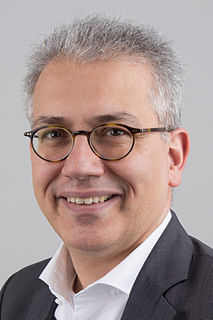
Tarek Mohammed Al-Wazir is a politician in the German Green Party. Since January 2014 he has been deputy to the Hessian prime minister Volker Bouffier, and Hessian Minister of Economics, Energy, Transport and Regional Development. He is a member of the Landtag of Hesse and was co-chair of the Hessian Green Party.
Jörg-Uwe Hahn is a German politician of the FDP.
Popular anger at the SPD over the political crisis and deadlock, and anger among some of its centrist supporters that the SPD leadership would negotiate with the far-left, led to a collapse in the SPD's support; [4] it received its lowest vote share in Hessian history. The SPD won less than 25% of the total seats in 2009, down from 38% in 2008. The former-SPD voters split evenly between the FDP and the Greens. The Greens received their highest vote share ever as a result of this.
The 2008-2009 Hesse Landtag saga is seen as a black eye and an embarrassment for the political left in Germany. Despite the CDU's weakest support in decades, the left bungled its opportunity to unseat the CDU, which now remained in power. A CDU-FDP government was formed after the election.
| Party | Ideology | Vote % (change) | Seats (change) | Seat % | |||
|---|---|---|---|---|---|---|---|
| Christian Democratic Union (CDU) | Christian Democracy | 37.2% | +0.4% | 46 | +4 | 39.0% | |
| Social Democratic Party (SPD) | Social Democracy | 23.7% | −13.0% | 29 | −13 | 24.6% | |
| Free Democratic Party (FDP) | Classical liberalism | 16.2% | +6.8% | 20 | +9 | 17.0% | |
| Alliance '90/The Greens (GRÜNE) | Green politics | 13.7% | +6.2% | 17 | +8 | 14.4% | |
| The Left (Die Linke) | Democratic socialism | 5.4% | +0.3% | 6 | 0 | 5.1% | |
| Free Voters (FW) | Various, lean right | 1.6% | +0.7% | ||||
| National Democratic Party (NPD) | Ethnic nationalism | 0.9% | 0 | ||||
| The Republicans (REP) | National conservatism | 0.6% | −0.4% | ||||
| Pirate Party (PIRATEN) | Pirate politics | 0.5% | +0.2% | ||||
| Civil Rights Movement Solidarity (BüSo) | LaRouche movement | 0.2% | +0.2% | ||||
| All Others | -- | 0% | −1.4% | ||||
| Total | 100.0% | 118 | +8 | 100.0% | |||
Turnout was at 61.0%, down from 64.3% in 2008. 61.0% marks the lowest turnout for a Landtag election in Hesse's history. Only the non-binding 1946 election (while Hesse was still under military occupation) had a lower turnout.
The Saxony state election of 2004, was conducted on 19 September 2004, to elect members to the Landtag of Saxony.
The North Rhine-Westphalia state election, 2005, was conducted on 22 May 2005, to elect members to the Landtag of North Rhine-Westphalia in Germany. It was a victory for the Christian Democratic Union, who received enough seats to form a coalition with their preferred partner, the FDP, and end the previous government formed by the Social Democratic Party and the Greens, who also ruled at the federal level.
The Hesse state election, 1999, was conducted on 7 February 1999, to elect members to the Landtag of Hesse.
Federal elections were held in Germany on 18 September 2005 to elect the members of the 16th Bundestag. This became necessary after a motion of confidence in Chancellor Gerhard Schröder failed on 1 July. Following the defeat of Schröder's Social Democratic Party (SPD) in a state election, Schröder asked his supporters to abstain from the Bundestag motion, knowing the motion would fail and thus triggering an early federal election.
Jamaica coalition is a term in German politics describing a coalition among the parties of the Christian Democratic Union/Christian Social Union (CDU/CSU), Free Democratic Party (FDP), and the Green Party.
The state election to elect members of the Landtag of Hesse was held in the German state of Hesse on 27 January 2008.
The 2008 Bavarian state election was held on 28 September 2008. Voters of the German state of Bavaria elected members to the Bavarian Landtag.
The Politics of Hesse takes place within a framework of a federal parliamentary representative democratic republic, where the Federal Government of Germany exercises sovereign rights with certain powers reserved to the states of Germany including Hesse. The state has a multi-party system where, as in most other states of former Western Germany and the federal level, the two main parties are the centre-right Christian Democratic Union (CDU) and the centre-left Social Democratic Party of Germany (SPD).
Carmen Everts is a German politician, political scientist and civil servant, a former member of the Parliament of Hesse for the Social Democratic Party of Germany, and an expert on political extremism. In 2009, she was appointed by the government of Hesse as head of department at the Hessian State Agency for Civic Education, responsible for research on the communist dictatorship in East Germany and demographic research.

Willi van Ooyen is a German politician of the socialist Linke Party, and current leader of the Linke party's bloc in the Hessian Landtag. He is a self-described "Marxist".
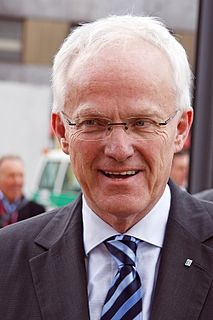
The North Rhine-Westphalia state election, 2010, was an election held on 9 May 2010, to elect members to the Landtag of the German state of North Rhine-Westphalia. The incumbent government at the election was the Christian Democrat (CDU)–FDP administration of Minister-President Jürgen Rüttgers. The biggest opposition party was the Social Democratic Party, led by Hannelore Kraft since 2005.
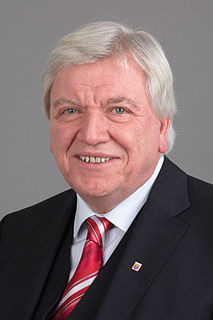
Volker Bouffier is a German politician of the Christian Democratic Union (CDU). Since 31 August 2010 he has been Minister President of the German state of Hesse. From 1 November 2014 until 31 October 2015 he was President of the Bundesrat and ex officio deputy to the President of Germany. He has been chairman of CDU in Hesse since July 2010. From 1999 to 2010, he was minister of interior and sports in the state of Hesse. Bouffier is a lawyer by profession.
The 2016 Rhineland-Palatinate state election was held on 13 March 2016 to elect all 101 members to the Landtag of Rhineland-Palatinate. Seats are allotted by proportional representation with a 5% threshold. State elections were held on the same day in Baden-Württemberg and Saxony-Anhalt.
An election was held on 14 May 2017 to elect members to the Landtag of the German state of North Rhine-Westphalia.
A state election was held in Hesse on 28 October 2018.