The Free Democratic Party is a liberal and classical liberal political party in Germany. The FDP is led by Christian Lindner.

Germany is a democratic, federal parliamentary republic, where federal legislative power is vested in the Bundestag and the Bundesrat.
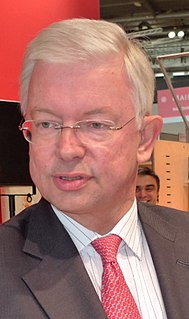
Roland Koch is a German jurist and former conservative politician of the CDU. He was the 7th Minister President of Hesse from 7 April 1999, immediately becoming the 53rd President of the Bundesrat, completing the term begun by his predecessor as Minister President, Hans Eichel, until his resignation on 31 August 2010. During his time in office, Koch was widely regarded as one of Chancellor Angela Merkel's main rivals within the CDU.

Federal elections were held in Germany on 18 September 2005 to elect the members of the 16th Bundestag. This became necessary after a motion of confidence in Chancellor Gerhard Schröder failed on 1 July. Following the defeat of Schröder's Social Democratic Party (SPD) in a state election, Schröder asked his supporters to abstain from the Bundestag motion, knowing the motion would fail and thus triggering an early federal election.
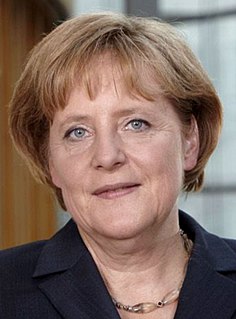
Federal elections took place on 27 September 2009 to elect the members of the 17th Bundestag (parliament) of Germany. Preliminary results showed that the Christian Democratic Union (CDU), its Bavarian sister party, the Christian Social Union (CSU), and the Free Democratic Party (FDP) won the election, and the three parties announced their intention to form a new centre-right government with Angela Merkel as Chancellor. Their main opponent, Frank-Walter Steinmeier's Social Democratic Party (SPD), conceded defeat. The Christian Democrats previously governed in coalition with the FDP in most of the 1949–1966 governments of Konrad Adenauer and Ludwig Erhard and the 1982–1998 governments of Helmut Kohl.
The Politics of Hesse takes place within a framework of a federal parliamentary representative democratic republic, where the Federal Government of Germany exercises sovereign rights with certain powers reserved to the states of Germany including Hesse. The state has a multi-party system where, as in most other states of former Western Germany and the federal level, the two main parties are the centre-right Christian Democratic Union (CDU) and the centre-left Social Democratic Party of Germany (SPD).

The Landtag of Hesse is the Parliament of the State of Hesse in the Federal Republic of Germany. It convenes in the Stadtschloss, Wiesbaden. As a Legislature it is responsible for passing laws at the state level and enacting the budget. Its most important function is to elect and control the state government. The constitution of the State of Hesse describes the role of the Landtag in §§ 75 to 99.

Federal elections were held on 22 September to elect the members of the 18th Bundestag of Germany. At stake were all 598 seats to the Bundestag, plus 33 overhang seats determined thereafter. The Christian Democratic Union/Christian Social Union (CDU/CSU) of Chancellor Angela Merkel won their best result since 1990, with nearly 42% of the vote and nearly 50% of the seats. However, their coalition partner, the Free Democrats (FDP), failed to meet the 5% vote threshold in what was their worst showing ever in a federal election, thus denying them seats in the Bundestag for the first time in their history.
In modern Germany with its parliamentary system of government on federal and on state level, grand coalition describes a governing coalition of the two biggest parties in one parliament. In most cases this means a coalition of the Union and the Social Democrats (SPD).

The history of Germany since 1990 spans the period following the Reunification of Germany, when West Germany and East Germany were reunited after being divided during the Cold War. Germany after 1990 is referred to by historians as the Berlin Republic. This time period is also determined by the ongoing process of the "inner reunification" of the formerly divided country.
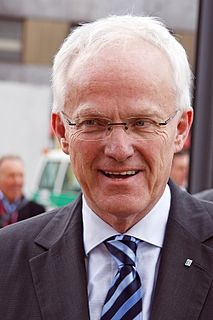
The North Rhine-Westphalia state election, 2010, was an election held on 9 May 2010, to elect members to the Landtag of the German state of North Rhine-Westphalia. The incumbent government at the election was the Christian Democrat (CDU)–FDP administration of Minister-President Jürgen Rüttgers. The biggest opposition party was the Social Democratic Party, led by Hannelore Kraft since 2005.

The 2011 Baden-Württemberg state election was held on 27 March 2011 to elect members to Baden-Württemberg's state diet, the Landtag of Baden-Württemberg in Stuttgart. It was the 14th state election since the foundation of Baden-Württemberg in 1952. Prior to the election, Stefan Mappus of the Christian Democratic Union had led a coalition government between his party and the Free Democratic Party. His government was defeated in the election. Alliance '90/The Greens, who achieved their best result in a state election up to this point, formed a coalition with the Social Democratic Party.

Winfried Kretschmann is a German politician of the Alliance '90/Greens. He has been Minister President of the state of Baden-Württemberg since 12 May 2011. From 1 November 2012 until 31 October 2013 he was President of the Bundesrat and ex officio deputy to the President of Germany. He is the first member of the Greens to serve in these offices. Himself identifying as a green conservative, Kretschmann has been associated with both socially and economically liberal policies.

Annegret Kramp-Karrenbauer, sometimes referred to by her initials AKK, is a German politician serving as Leader of the Christian Democratic Union (CDU) since her election at the party conference of 2018, succeeding Angela Merkel. She previously served as secretary general of the party and as Minister-President of Saarland from 2011 to 2018, the first woman to lead the Government of Saarland and fourth woman to head a German state government. Kramp-Karrenbauer is regarded as socially conservative, but on the CDU's left-wing in economic policy and has been described as a centrist. She is an active Catholic and has served on the Central Committee of German Catholics.

Federal elections were held in Germany on 24 September 2017 to elect the members of the 19th Bundestag. At stake were all 598 seats in the Bundestag, as well as 111 overhang and leveling seats determined thereafter.

The third cabinet of Federal Chancellor Angela Merkel was sworn in on 17 December 2013. Led by Merkel, the government was supported by a coalition of the Christian Democratic Union (CDU), the Christian Social Union of Bavaria (CSU), and the Social Democrats (SPD).

The Baden-Württemberg state election 2016 was held on 13 March 2016 to elect members to Baden-Württemberg's State diet, the Landtag of Baden-Württemberg in Stuttgart. It was the 15th state election since the foundation of Baden-Württemberg in 1952. Going into the election, Winfried Kretschmann of Alliance '90/The Greens led a coalition government of his party with the Social Democrats. After the election, Kretschman was confirmed in May 2016 leading a coalition with the CDU, the first time the Greens have led such a coalition in Germany.
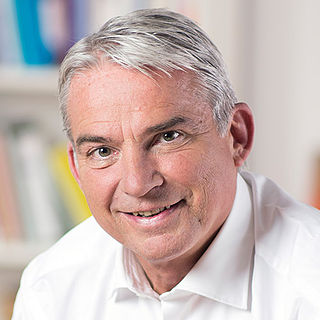
Thomas Strobl is a German politician. He is a member of the CDU party. Since 1998 he has been a member of the German Bundestag. In 2011 he was elected chairman of the CDU Baden-Württemberg, succeeding Stefan Mappus. In 2012 he was elected one of five vice federal chairmen of the CDU party in Germany.
A state election was held in Hesse on 28 October 2018.