This article may be expanded with text translated from the corresponding article in German. (March 2018)Click [show] for important translation instructions.
|
| |||||||||||||||||||||||||||||||||||||||||||||||||||||||||||||||||||||||||||||||||||||
All 110 seats of the Landtag of Hesse, as well as 8 overhang and 19 leveling seats 69 seats needed for a majority | |||||||||||||||||||||||||||||||||||||||||||||||||||||||||||||||||||||||||||||||||||||
|---|---|---|---|---|---|---|---|---|---|---|---|---|---|---|---|---|---|---|---|---|---|---|---|---|---|---|---|---|---|---|---|---|---|---|---|---|---|---|---|---|---|---|---|---|---|---|---|---|---|---|---|---|---|---|---|---|---|---|---|---|---|---|---|---|---|---|---|---|---|---|---|---|---|---|---|---|---|---|---|---|---|---|---|---|---|
| |||||||||||||||||||||||||||||||||||||||||||||||||||||||||||||||||||||||||||||||||||||
| |||||||||||||||||||||||||||||||||||||||||||||||||||||||||||||||||||||||||||||||||||||
A state election was held in Hesse on 28 October 2018. [1]
Hesse or Hessia, officially the State of Hesse, is a federal state (Land) of the Federal Republic of Germany, with just over six million inhabitants. The state capital is Wiesbaden; the largest city is Frankfurt am Main.
It followed the vote in Bavaria two weeks earlier. Like in Bavaria, the parties of Chancellor Angela Merkel's federal government coalition − CDU and SPD − lost more than 20 percentage points combined (CDU -11.3%, SPD -10.9%), while the Hessian CDU's coalition partner The Greens and the opposition party Alternative for Germany (AfD) won the biggest increases in votes compared to the last election in 2013. The AfD's gains (+9%) were slightly larger than those of The Greens (+8.7%), making it the greatest net winner by additional votes and seats. Smaller parties also made gains. Turn-out decreased by 5.9 points to 67.3%. [2]
The title Chancellor has designated different offices in the history of Germany. It is currently used for the Chancellor of the Federal Republic of Germany, the head of government of Germany.
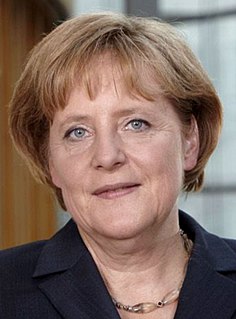
Angela Dorothea Merkel is a German politician serving as Chancellor of Germany since 2005. She served as the leader of the centre-right Christian Democratic Union (CDU) from 2000 to 2018. Merkel has been widely described as the de facto leader of the European Union, the most powerful woman in the world, and by many commentators as the leader of the Free World.
Despite suffering the biggest net loss of votes, the Christian Democratic Union maintained its leading position. The Greens and the Social Democrats finished with equal numbers of seats, although the Greens beat the Social Democrats by 66 votes. AfD, which ran for the first time for a state legislature in Hesse in 2013 and failed to win any seats, was the only new addition to the Hessian Landtag, and, by entering it, became present in all German state legislatures, a trait shared only by SPD and CDU/CSU, though the latter are technically two separate parties.
Germany is a federal republic consisting of sixteen states. Since today's Germany was formed from an earlier collection of several states, it has a federal constitution, and the constituent states retain a measure of sovereignty. With an emphasis on geographical conditions, Berlin and Hamburg are frequently called Stadtstaaten (city-states), as is the Free Hanseatic City of Bremen, which in fact includes the cities of Bremen and Bremerhaven. The remaining 13 states are called Flächenländer.
Like the preceding Bavarian election, the election in Hesse was overshadowed by federal politics and the poor condition of the German coalition government after two government crises, the "asylum quarrel" in June/July and the crisis around Hans-Georg Maaßen in September. [3] [4] As a consequence of the severe losses, the day after the election, chancellor Angela Merkel announced that that she will not seek re-election as party head at the party convention in Hamburg in early December and as German chancellor in 2021. [5]
The 2018 German government crisis, sometimes referred to as Asylstreit, was a government crisis affecting the Fourth Merkel cabinet, which began in June 2018 and effectively ended in July 2018.
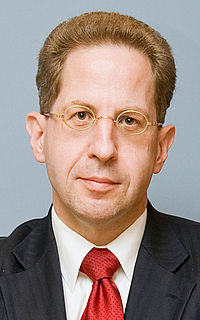
Hans-Georg Maaßen is a German civil servant and lawyer. From 1 August 2012 to 8 November 2018, he served as the President of the Federal Office for the Protection of the Constitution, Germany's domestic security agency and one of three agencies in the German Intelligence Community.
Hamburg is the second-largest city in Germany with a population of over 1.8 million.
The incumbent Hesse government coalition consisted of CDU and the Greens.
The regional election for Hesse, along with the Bavarian state election held just two weeks before, was widely seen as a test for the ruling CDU/CSU and SPD coalition of Angela Merkel's fourth federal cabinet. [6]
CDU/CSU, unofficially the Union parties or the Union, is the centre-right Christian democratic political alliance of two political parties in Germany, namely the Christian Democratic Union of Germany (CDU) and Christian Social Union in Bavaria (CSU).
The Social Democratic Party of Germany is a social-democratic political party in Germany.
The fourth cabinet of Chancellor Angela Merkel is the current government of Germany, sworn in on 14 March 2018 after Merkel was proposed as Chancellor by President of Germany Frank-Walter Steinmeier and elected on the first ballot. It is the 24th cabinet of Germany.
This section is empty.You can help by adding to it.(March 2018) |
| Polling firm | Fieldwork date | Sample size | CDU | SPD | Grüne | Linke | FDP | AfD | Others | Lead |
|---|---|---|---|---|---|---|---|---|---|---|
| 2018 state election | 28 Oct 2018 | – | 27.0 | 19.8 | 19.8 | 6.3 | 7.5 | 13.1 | 6.5 | 7.2 |
| Forschungsgruppe Wahlen | 24–25 Oct 2018 | 1,025 | 28 | 20 | 20 | 8 | 8 | 12 | 4 | 8 |
| Civey | 18–24 Oct 2018 | 4,467 | 27.0 | 22.0 | 18.5 | 7.5 | 8.0 | 13.0 | 4.0 | 5.0 |
| INSA | 18–22 Oct 2018 | 1,004 | 26 | 21 | 21 | 8 | 7 | 13 | 4 | 5 |
| Infratest dimap | 16–17 Oct 2018 | 1,002 | 26 | 21 | 20 | 8 | 9 | 12 | 4 | 5 |
| Forschungsgruppe Wahlen | 15–17 Oct 2018 | 1,035 | 26 | 20 | 22 | 8 | 8 | 12 | 4 | 4 |
| Civey | 2–12 Oct 2018 | 4,549 | 28.5 | 24.9 | 18.2 | 7.5 | 5.6 | 11.8 | 3.5 | 3.6 |
| Forschungsgruppe Wahlen | 24 Sep–1 Oct 2018 | 1,038 | 29 | 23 | 18 | 8 | 6 | 13 | 3 | 6 |
| Civey | 19–26 Sep 2018 | 4,509 | 28.6 | 23.0 | 15.8 | 8.8 | 7.6 | 12.4 | 3.8 | 5.6 |
| Forschungsgruppe Wahlen | 17–19 Sep 2018 | 1,039 | 32 | 25 | 15 | 8 | 6 | 11 | 3 | 7 |
| Infratest dimap | 13–19 Sep 2018 | 1,000 | 28 | 23 | 17 | 8 | 7 | 14 | 3 | 5 |
| INSA | 3–6 Sep 2018 | 1,039 | 29 | 24 | 14 | 8 | 7 | 14 | 4 | 5 |
| Civey | 14–30 Aug 2018 | 4,532 | 31.1 | 23.9 | 13.4 | 7.9 | 7.1 | 12.7 | 3.9 | 7.2 |
| Infratest dimap | 14–19 Jun 2018 | 1,003 | 31 | 22 | 14 | 7 | 7 | 15 | 4 | 9 |
| Forschungsgruppe Wahlen | 4–11 Jun 2018 | 1,049 | 31 | 25 | 13 | 8 | 8 | 11 | 4 | 6 |
| INSA | 9–16 May 2018 | 1,067 | 33 | 24 | 13 | 8 | 7 | 11 | 4 | 9 |
| Forschungsgruppe Wahlen | 19–21 Mar 2018 | 1,011 | 31 | 26 | 13 | 8 | 7 | 10 | 5 | 5 |
| Allensbach | 19 Dec 2017–31 Jan 2018 | 760 | 31 | 26 | 12 | 7 | 9 | 11 | ? | 5 |
| Forsa | 8–22 Feb 2018 | 1,035 | 33 | 23 | 14 | 7 | 8 | 10 | 5 | 10 |
| Infratest dimap | 9–16 Jan 2018 | 1,006 | 31 | 25 | 13 | 8 | 8 | 12 | 3 | 6 |
| 2017 federal election | 24 Sep 2017 | – | 30.9 | 23.5 | 9.7 | 8.1 | 11.5 | 11.9 | 4.4 | 7.3 |
| Infratest dimap | 5–10 Jan 2017 | 1,003 | 32 | 24 | 14 | 8 | 6 | 14 | 2 | 8 |
| dimap | 15–22 Aug 2016 | 1,000 | 36 | 27 | 13 | 6 | 4 | 9 | 5 | 9 |
| Forsa | 1–8 Apr 2016 | 1,004 | 33 | 27 | 11 | 6 | 7 | 10 | 6 | 6 |
| Infratest dimap | 12–16 Jan 2016 | 1,000 | 34 | 26 | 11 | 8 | 5 | 12 | 4 | 8 |
| Forsa | 17–26 Aug 2015 | 1,009 | 38 | 28 | 13 | 5 | 5 | 4 | 7 | 14 |
| dimap | 6–13 Jul 2015 | 1,003 | 41 | 27 | 14 | 6 | 6 | 2 | 4 | 14 |
| dimap | 10–14 Dec 2014 | 1,000 | 38 | 27 | 16 | 7 | 2 | 5 | 5 | 11 |
| 2014 European election | 25 May 2014 | – | 30.6 | 30.3 | 12.9 | 5.6 | 4.1 | 9.1 | 7.3 | 0.3 |
| Forsa | 18–27 Feb 2014 | 1,002 | 39 | 27 | 12 | 7 | 5 | 5 | 5 | 12 |
| 2013 federal election | 22 Sep 2013 | – | 39.2 | 28.8 | 9.9 | 6.0 | 5.6 | 5.6 | 4.9 | 10.4 |
| 2013 state election | 22 Sep 2013 | – | 38.3 | 30.7 | 11.1 | 5.2 | 5.0 | 4.1 | 5.6 | 7.6 |
Summary of the 28 October 2018 final election results for the Hessian Landtag [2]
| Party | Ideology | Votes | Votes % (change) | Seats (change) | Seats % (change) | ||||
|---|---|---|---|---|---|---|---|---|---|
| Christian Democratic Union (CDU) | Christian democracy | 776,910 | 27.0% | −11.3pp | 40 | −7 | 29.2% | -13.5pp | |
| Alliance '90/The Greens (Grünen) | Green politics | 570,512 | 19.8% | +8.9pp | 29 | +16 | 21.2% | +9.4pp | |
| Social Democratic Party (SPD) | Social democracy | 570,446 | 19.8% | −10.9pp | 29 | −8 | 21.2% | -12.4pp | |
| Alternative for Germany (AfD) | German nationalism | 378,692 | 13.1% | +9.0pp | 19 | +19 | 13.9% | +13.9pp | |
| Free Democratic Party (FDP) | Liberalism | 215,946 | 7.5% | +1.8pp | 11 | +5 | 8.0% | +2.5pp | |
| The Left (Die Linke) | Democratic socialism | 181,332 | 6.3% | +1.1pp | 9 | +3 | 6.6% | +1.1pp | |
| Others | 187,423 | 6.5% | 0 | ±0 | 0% | ||||
| Total | 2,881,261 | 100.0% | 137 | +28 | 100.0% | ||||
This section is empty.You can help by adding to it.(December 2018) |
Federal elections were held in Germany on 18 September 2005 to elect the members of the 16th Bundestag. This became necessary after a motion of confidence in Chancellor Gerhard Schröder failed on 1 July. Following the defeat of Schröder's Social Democratic Party (SPD) in a state election, Schröder asked his supporters to abstain from the Bundestag motion, knowing the motion would fail and thus triggering an early federal election.
Federal elections took place on 27 September 2009 to elect the members of the 17th Bundestag (parliament) of Germany. Preliminary results showed that the Christian Democratic Union (CDU), its Bavarian sister party, the Christian Social Union (CSU), and the Free Democratic Party (FDP) won the election, and the three parties announced their intention to form a new centre-right government with Angela Merkel as Chancellor. Their main opponent, Frank-Walter Steinmeier's Social Democratic Party (SPD), conceded defeat. The Christian Democrats previously governed in coalition with the FDP in most of the 1949–1966 governments of Konrad Adenauer and Ludwig Erhard and the 1982–1998 governments of Helmut Kohl.
Merkel's first cabinet led the government of Germany from 22 November 2005 to 27 October 2009 throughout the 16th Bundestag. Led by Christian Democrat Angela Merkel, the first female chancellor in German history, the cabinet was supported by a grand coalition between the Christian Democratic Union (CDU), Christian Social Union of Bavaria (CSU), and the Social Democratic Party of Germany (SPD). It followed the Second Schröder cabinet. It ceased to function after the formation of Second Merkel cabinet, which was created after the 2009 federal elections, and was later sworn in on 28 October 2009.
The state election to elect members of the Landtag of Hesse was held in the German state of Hesse on 27 January 2008.
The 2008 Bavarian state election was held on 28 September 2008. Voters of the German state of Bavaria elected members to the Bavarian Landtag.
Tarek Mohammed Al-Wazir is a politician in the German Green Party. Since January 2014 he has been deputy to the Hessian prime minister Volker Bouffier, and Hessian Minister of Economics, Energy, Transport and Regional Development. He is a member of the Landtag of Hesse and was co-chair of the Hessian Green Party.
Federal elections were held on 22 September to elect the members of the 18th Bundestag of Germany. At stake were all 598 seats to the Bundestag, plus 33 overhang seats determined thereafter. The Christian Democratic Union/Christian Social Union (CDU/CSU) of Chancellor Angela Merkel won their best result since 1990, with nearly 42% of the vote and nearly 50% of the seats. However, their coalition partner, the Free Democrats (FDP), failed to meet the 5% vote threshold in what was their worst showing ever in a federal election, thus denying them seats in the Bundestag for the first time in their history.
Early state elections for the Landtag of Hesse were held in Hesse on 18 January 2009. The reason for the early elections was the inability of the parties to form a government after the inconclusive 2008 Hessian election.
In modern Germany with its parliamentary system of government on federal and on state level, grand coalition describes a governing coalition of the two biggest parties in one parliament. In most cases this means a coalition of the Union and the Social Democrats (SPD).
The history of Germany since 1990 spans the period following the Reunification of Germany, when West Germany and East Germany were reunited after being divided during the Cold War. Germany after 1990 is referred to by historians as the Berlin Republic. This time period is also determined by the ongoing process of the "inner reunification" of the formerly divided country.
The 2011 Baden-Württemberg state election was held on 27 March 2011 to elect members to Baden-Württemberg's state diet, the Landtag of Baden-Württemberg in Stuttgart. It was the 14th state election since the foundation of Baden-Württemberg in 1952. Prior to the election, Stefan Mappus of the Christian Democratic Union had led a coalition government between his party and the Free Democratic Party. His government was defeated in the election. Alliance '90/The Greens, who achieved their best result in a state election up to this point, formed a coalition with the Social Democratic Party.
Reiner Haseloff is a German politician who serves as the Minister President of the federal state of Saxony-Anhalt. A scientist like Chancellor Angela Merkel, he was widely considered as one of her closest party allies, but distanced himself from her during the European migrant crisis.
Federal elections were held in Germany on 24 September 2017 to elect the members of the 19th Bundestag. At stake were all 598 seats in the Bundestag, as well as 111 overhang and leveling seats determined thereafter.
The Baden-Württemberg state election 2016 was held on 13 March 2016 to elect members to Baden-Württemberg's State diet, the Landtag of Baden-Württemberg in Stuttgart. It was the 15th state election since the foundation of Baden-Württemberg in 1952. Going into the election, Winfried Kretschmann of Alliance '90/The Greens led a coalition government of his party with the Social Democrats. After the election, Kretschman was confirmed in May 2016 leading a coalition with the CDU, the first time the Greens have led such a coalition in Germany.
The Saxony-Anhalt state election was held on 13 March 2016 in Saxony-Anhalt for the 7th legislative period of the Landtag of Saxony-Anhalt. The incumbent Minister-President was Reiner Haseloff of the CDU, governing in a grand coalition with the SPD.
The 2016 Rhineland-Palatinate state election was held on 13 March 2016 to elect all 101 members to the Landtag of Rhineland-Palatinate. Seats are allotted by proportional representation with a 5% threshold. State elections were held on the same day in Baden-Württemberg and Saxony-Anhalt.
State elections were held in Saarland on 26 March 2017. All 51 seats in the Landtag of Saarland were up for election. The incumbent Minister-President Annegret Kramp-Karrenbauer went into the election leading a grand coalition of her Christian Democratic Union (CDU) and the Social Democratic Party (SPD), seeking re-election after serving two terms as Minister-President.
The Mecklenburg-Vorpommern State Elections, 2016 were held on 4 September 2016, to elect members to the 7th Landtag of Mecklenburg-Vorpommern. All 71 seats in the Landtag were contested and around 1.3 million voters were eligible to cast ballots. Postal voting began in August ahead of the September 4 polling day. State elections in Mecklenburg-Vorpommern use the Hare-Niemeyer method of proportional representation to allocate seats in the Landtag.
The next German federal election for the 20th Bundestag will regularly be held between August and October 2021.
The 2018 Bavarian state election took place on 14 October 2018 to elect the 180 members of the 18th Landtag of Bavaria.