| |||||||||||||||||||||||||||||||||||||||||||||||||||||
All 180 seats in the Landtag of Bavaria 91 seats needed for a majority | |||||||||||||||||||||||||||||||||||||||||||||||||||||
|---|---|---|---|---|---|---|---|---|---|---|---|---|---|---|---|---|---|---|---|---|---|---|---|---|---|---|---|---|---|---|---|---|---|---|---|---|---|---|---|---|---|---|---|---|---|---|---|---|---|---|---|---|---|
| Turnout | 63.6% [1] | ||||||||||||||||||||||||||||||||||||||||||||||||||||
| |||||||||||||||||||||||||||||||||||||||||||||||||||||
| |||||||||||||||||||||||||||||||||||||||||||||||||||||
The 2013 Bavarian state election was held on 15 September 2013 to elect the 180 members of the 17th Landtag of Bavaria. It was held one week before the 2013 German federal election. The CSU won an absolute majority, while the FDP, a coalition party in the outgoing Bavarian government, did not receive enough votes to enter the new parliament. [2]
Bavaria, officially the Free State of Bavaria, is a landlocked federal state of Germany, occupying its southeastern corner. With an area of 70,550.19 square kilometres, Bavaria is the largest German state by land area. Its territory comprises roughly a fifth of the total land area of Germany. With 13 million inhabitants, it is Germany's second-most-populous state after North Rhine-Westphalia. Bavaria's main cities are Munich and Nuremberg.
The Landtag of Bavaria is the unicameral legislature of the state of Bavaria in Germany. The parliament meets in the Maximilianeum in Munich.
| This article is part of a series on the politics and government of Bavaria |
|---|
Constitution |
Executive |
Legislature |
Foreign policy |
Summary of the 15 September 2013 election results [3] for the Landtag of Bavaria
| Party | Ideology | Vote (change) | Vote % (change) | Seats (change) | Seats % | ||||
|---|---|---|---|---|---|---|---|---|---|
| Christian Social Union (CSU) | Christian democracy, centre-right | 5,632,272 | +1,028,312 | 47.7% | +4.3 | 101 | +9 | 56.1% | |
| Social Democratic Party (SPD) | Social democracy, centre-left | 2,436,515 | +464,078 | 20.6% | +2.0 | 42 | +3 | 23.3% | |
| Free Voters (FW) | Various, lean right | 1,062,244 | -23,652 | 9.0% | -1.2 | 19 | -2 | 10.6% | |
| Alliance '90/The Greens (Grünen) | Green politics, centre-left | 1,018,652 | +19,541 | 8.6% | -0.8 | 18 | -1 | 10.0% | |
| Free Democratic Party (FDP) | Liberalism | 389,584 | -457,643 | 3.3% | -4.7 | - | -16 | - | |
| The Left (Die Linke) | Democratic socialism, left-wing | 251,086 | -210,669 | 2.1% | -2.2 | - | - | - | |
| Bavaria Party (BP) | Secessionism, centre-right | 247,282 | +130,818 | 2.1% | +1.0 | - | - | - | |
| Ecological Democratic Party (ÖDP) | Environmental, centre-right | 239,235 | +27,035 | 2.0% | +0.0 | - | - | - | |
| Pirate Party (Piraten) | Pirate politics | 234,221 | n/a | 2.0% | n/a | - | - | - | |
| The Republicans (REP) | National conservatism, Eurosceptic, right-wing | 117,633 | -28,440 | 1.0% | −0.4 | - | - | - | |
| Party for Franconia (Die Franken) | Regionalist | 87,237 | n/a | 0.7% | n/a | - | - | - | |
| National Democratic Party (NPD) | Far-right, fascist | 74,895 | -48,504 | 0.6% | -0.6 | - | - | - | |
| All Others | 22,019 | n/a | 0.2% | n/a | - | - | - | ||
| Total | 11,812,965 | 100.0% | 180 | -7 | |||||
The CSU regained an absolute majority of the seats, which they lost 5 years ago after about 50 years of one party government. The FDP fell below the 5% threshold for obtaining seats. SPD, Grünen and FW stayed in opposition. A record number of 14.1% of the votes cast are not represented in the Landtag because of the 5% threshold.
| Pollster | Date | CSU | SPD | FW | Greens | FDP | Left | Pirates | Others |
|---|---|---|---|---|---|---|---|---|---|
| 2008 election | 28 September 2008 | 43.4 % | 18.6 % | 10.2 % | 9.4 % | 8.0 % | 4.3 % | – | 6.1 % |
| Emnid | 12 September 2013 | 47% | 18% | 8% | 12% | 4% | 4% | 3% | 4% |
| Forschungsgruppe Wahlen | 6 September 2013 | 48% | 20% | 8% | 10% | 4% | – | – | 7% |
| Infratest dimap | 5 September 2013 | 47% | 21% | 7% | 11% | 3% | 3% | – | 8% |
| GMS | 3 September 2013 | 47% | 18% | 8% | 13% | 5% | 3% | 2% | 4% |
| Emnid | 28 August 2013 | 48% | 18% | 8% | 13% | 4% | 3% | 3% | 3% |
| Infratest dimap | 17 July 2013 | 47% | 18% | 8% | 15% | 3% | 3% | – | 6% |
| GMS | 11 July 2013 | 47% | 19% | 10% | 11% | 5% | 2% | 2% | 4% |
| Emnid | 10 July 2013 | 47% | 19% | 9% | 11% | 5% | 3% | 3% | 3% |
| Forschungsgruppe Wahlen | 14 June 2013 | 46% | 20% | 10% | 13% | 4% | – | – | 7% |
| GMS | 11 June 2013 | 46% | 20% | 9% | 11% | 4% | 3% | 2% | 5% |
| Forsa | 28 May 2013 | 46% | 20% | 9% | 12% | 4% | 3% | 2% | 5% |
| GMS | 2 May 2013 | 47% | 20% | 8% | 13% | 3% | 2% | 2% | 5% |
| INSA | 22 April 2013 | 49% | 18% | 9% | 16% | 2% | 2% | – | 4% |
| GMS | 6 March 2013 | 48% | 21% | 8% | 12% | 3% | 3% | 2% | 3% |
| TNS Infratest | 12 February 2013 | 46% | 19% | 8% | 15% | 3% | 2% | 3% | 4% |
| Emnid | 10 February 2013 | 48% | 20% | 9% | 12% | 3% | 2% | 3% | 3% |
| Emnid | 15 January 2013 | 48% | 20% | 8% | 12% | 3% | 3% | 3% | 3% |
| Forsa | 10 January 2013 | 46% | 18% | 9% | 13% | 3% | 4% | 2% | 5% |
| Infratest dimap | 9 January 2013 | 47% | 19% | 9% | 14% | 3% | 2% | 3% | 3% |
| GMS [4] | 15 December 2012 | 49% | 22% | 8% | 10% | 4% | – | 4% | – |
| GMS | 20 November 2012 | 48% | 20% | 8% | 10% | 5% | 2% | 4% | – |
| GMS | 19 October 2012 | 48% | 20% | 8% | 10% | 5% | – | 4% | 5% |
| Emnid | 14 October 2012 | 48% | 21% | 8% | 10% | 4% | 2% | 4% | 3% |
| Emnid | 18 September 2012 | 47% | 21% | 9% | 10% | 3% | 2% | 5% | 3% |
| Emnid | 13 August 2012 | 46% | 20% | 8% | 12% | 3% | 2% | 6% | 3% |
| GMS | 17 July 2012 | 47% | 19% | 8% | 10% | 4% | – | 7% | – |
| Forsa | 4 July 2012 | 43% | 23% | 9% | 11% | 2% | 2% | 6% | 4% |
| Emnid | 24 June 2012 | 44% | 22% | 6% | 13% | 3% | 1% | 7% | 4% |
| Emnid | 20 April 2012 | 46% | 20% | 7% | 12% | 2% | 2% | 8% | 3% |
| Emnid | 24 March 2012 | 46% | 20% | 8% | 13% | 2% | 2% | 5% | 4% |
| Infratest dimap | 4 January 2012 | 44% | 21% | 8% | 14% | 3% | 2% | 4% | 4% |
| GMS | 4 January 2012 | 42% | 22% | 9% | 12% | 2% | 2% | 5% | 6% |
| Emnid | 21 December 2011 | 44% | 21% | 9% | 13% | 2% | 2% | 5% | - |
| Forsa | 11 December 2011 | 41% | 24% | 9% | 10% | 3% | 3% | 6% | 4% |
| Pollster | Date | CSU | SPD | FW | Greens | FDP | Left | Pirates | Others |
The Christian Social Union in Bavaria is a Christian-democratic and conservative political party in Germany. The CSU operates only in Bavaria while its larger counterpart, the Christian Democratic Union (CDU), operates in the other fifteen states of Germany. It differs from the CDU by being somewhat more conservative in social matters. The CSU is considered an effective successor of the Weimar-era Catholic Bavarian People's Party (BVP).
The Free Democratic Party is a liberal and classical liberal political party in Germany. The FDP is led by Christian Lindner.
The Christian Democratic Union of Germany is a Christian democratic and liberal-conservative political party in Germany. It is the major catch-all party of the centre-right in German politics. The CDU forms the CDU/CSU grouping, also known as the Union, in the Bundestag with its Bavarian counterpart the Christian Social Union in Bavaria (CSU). The party is widely considered an effective successor of the Centre Party, although it has a broader base.
The Bavaria Party is an autonomist and regionalist political party in the state of Bavaria. It was founded in 1946 and describes itself as patriotic Bavarian, advocating Bavarian independence within the European Union. Together with the Christian Social Union (CSU), it can be seen as an heir to the Bavarian People's Party (BVP) which existed prior to the Nazi takeover. The party is a member of the European Free Alliance.
Federal elections were held in West Germany on 3 October 1976 to elect the members of the eighth Bundestag. Although the CDU/CSU alliance became the largest faction in parliament, Helmut Schmidt of the Social Democratic Party remained Chancellor.
Federal elections were held in Germany on 18 September 2005 to elect the members of the 16th Bundestag. This became necessary after a motion of confidence in Chancellor Gerhard Schröder failed on 1 July. Following the defeat of Schröder's Social Democratic Party (SPD) in a state election, Schröder asked his supporters to abstain from the Bundestag motion, knowing the motion would fail and thus triggering an early federal election.
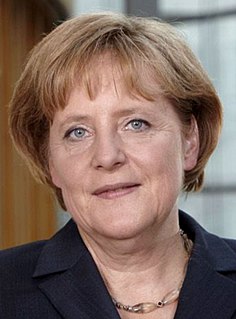
Federal elections took place on 27 September 2009 to elect the members of the 17th Bundestag (parliament) of Germany. Preliminary results showed that the Christian Democratic Union (CDU), its Bavarian sister party, the Christian Social Union (CSU), and the Free Democratic Party (FDP) won the election, and the three parties announced their intention to form a new centre-right government with Angela Merkel as Chancellor. Their main opponent, Frank-Walter Steinmeier's Social Democratic Party (SPD), conceded defeat. The Christian Democrats previously governed in coalition with the FDP in most of the 1949–1966 governments of Konrad Adenauer and Ludwig Erhard and the 1982–1998 governments of Helmut Kohl.
The 2008 Bavarian state election was held on 28 September 2008. Voters of the German state of Bavaria elected members to the Bavarian Landtag.
The Politics of Bavaria takes place within a framework of a federal parliamentary representative democratic republic, where the Federal Government of Germany exercises sovereign rights with certain powers reserved to the states of Germany including Bavaria. The state has a multi-party system where the two main parties are the rightist Christian Social Union of Bavaria (CSU) and the leftist Social Democratic Party of Germany (SPD).
The Landtag of Hesse is the Parliament of the State of Hesse in the Federal Republic of Germany. It convenes in the Stadtschloss, Wiesbaden. As a Legislature it is responsible for passing laws at the state level and enacting the budget. Its most important function is to elect and control the state government. The constitution of the State of Hesse describes the role of the Landtag in §§ 75 to 99.
Federal elections were held on 22 September to elect the members of the 18th Bundestag of Germany. At stake were all 598 seats to the Bundestag, plus 33 overhang seats determined thereafter. The Christian Democratic Union/Christian Social Union (CDU/CSU) of Chancellor Angela Merkel won their best result since 1990, with nearly 42% of the vote and nearly 50% of the seats. However, their coalition partner, the Free Democrats (FDP), failed to meet the 5% vote threshold in what was their worst showing ever in a federal election, thus denying them seats in the Bundestag for the first time in their history.
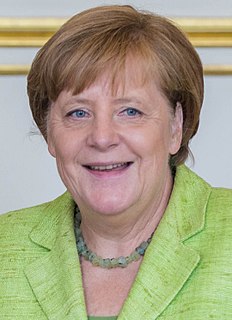
Federal elections were held in Germany on 24 September 2017 to elect the members of the 19th Bundestag. At stake were all 598 seats in the Bundestag, as well as 111 overhang and levelling seats determined thereafter.
The 2016 Rhineland-Palatinate state election was held on 13 March 2016 to elect all 101 members to the Landtag of Rhineland-Palatinate. Seats are allotted by proportional representation with a 5% threshold. State elections were held on the same day in Baden-Württemberg and Saxony-Anhalt.
Joachim Herrmann is a German politician. He is a member of the CSU party. Herrmann is a MP in the Landtag, the parliament of Bavaria since 1994. Since 16 October 2007 he has been Minister of the Interior of the state of Bavaria.

A state election was held on 15 October 2017 to elect the 18th Landtag of Lower Saxony.
Johanna Uekermann is a German politician of the Social Democratic Party of Germany (SPD). From December 2013 to November 2017, she was chairwoman of the Young Socialists in the SPD (Jusos) and since May 2017 she has been the Deputy Leader of the SPD Bayern.
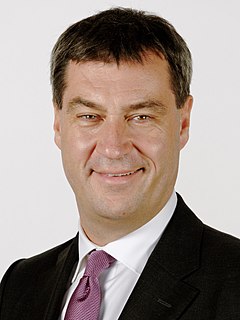
The 2018 Bavarian state election took place on 14 October 2018 to elect the 180 members of the 18th Landtag of Bavaria.
The name Free Voters of Bavaria applies to both the Bavarian State Association of Free and Independent Voters and the Bavarian state chapter of the nationwide party Free Voters.
A state election was held in Hesse on 28 October 2018.
| Wikimedia Commons has media related to Bavaria state election, 2013 . |