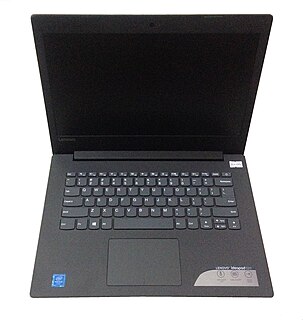
IdeaCentre Q Series

Last updated

The IdeaCentre Q Series PCs from Lenovo are a series of nettops meant primarily for home and personal use. [1] The Q Series nettops are described by the manufacturer as being multimedia-oriented nettops. [1] Comparing the size to a typical paperback book, Lenovo describes the Q Series nettops as the smallest desktops in production. [1] The general features of the Q Series desktops are the small size, low energy requirements, ability to play HD video, and low noise levels. [1]

Lenovo Chinese multinational technology company

Lenovo Group Ltd. or Lenovo PC International, often shortened to Lenovo, is a multinational technology company with headquarters in Beijing, China, and Morrisville, North Carolina, United States. It designs, develops, manufactures, and sells personal computers, tablet computers, smartphones, workstations, servers, electronic storage devices, IT management software, and smart televisions. Lenovo is the world's largest personal computer vendor by unit sales, as of March 2019. It markets the ThinkPad line of notebook computers, IdeaPad, Yoga and Legion lines of notebook laptops, and the IdeaCentre and ThinkCentre lines of desktops.

Contents

These nettops are designed to be extremely compact processing units. A nettop is a desktop computer that uses the same (or similar) components found in netbook PCs. [2] The first nettop in the IdeaCentre Q series was the Q100, launched in 2009.

Netbook category of small, lightweight, legacy-free, and inexpensive laptop computers

Netbook is a generic name given to a category of small, lightweight, legacy-free, and inexpensive laptop computers that were introduced in 2007. Netbooks compete in the same market segment as mobiles and Chromebooks.

2010

The only nettop released in 2010 in the IdeaCentre Q Series was the Q150.

Q150

Released in 2010, the IdeaCentre Q150 was a nettop like its predecessors: the Q100 and the Q110. In its review of the nettop, SlashGear described it as “a great little media PC that serves up high definition content with minimal fuss.” [3]

The single core Intel Atom processor found in 2009’s Q Series nettops was replaced by the Intel Atom D510 processor, with two cores at 1.66 GHz. [3] The nettop also included 2GB DDR2 RAM, a 500GB hard disk drive, and NVIDIA Nvidia Ion 2 graphics with support for DirectX 10. [3]

Intel Atom brand

Intel Atom is the brand name for a line of ultra-low-voltage IA-32 and x86-64 microprocessors by Intel Corporation. Atom is mainly used in netbooks, nettops, embedded applications ranging from health care to advanced robotics, and mobile Internet devices (MIDs). The line was originally designed in 45 nm complementary metal–oxide–semiconductor (CMOS) technology and subsequent models, codenamed Cedar, used a 32 nm process.

Hard disk drive Data storage device

A hard disk drive (HDD), hard disk, hard drive, or fixed disk, is an electromechanical data storage device that uses magnetic storage to store and retrieve digital information using one or more rigid rapidly rotating disks (platters) coated with magnetic material. The platters are paired with magnetic heads, usually arranged on a moving actuator arm, which read and write data to the platter surfaces. Data is accessed in a random-access manner, meaning that individual blocks of data can be stored or retrieved in any order and not only sequentially. HDDs are a type of non-volatile storage, retaining stored data even when powered off.

Nvidia Ion is a product line of Nvidia corporation intended for motherboards of low-cost portable computers. It uses graphics processing units and chipsets intended for small products.

Unlike its predecessors, the Q150 also included Wi-Fi b/g/n. [3] Ports on the nettop were available for HDMI, VGA, two USB, Ethernet, and audio input and output. [3] A stand was provided to support the nettop, and a VESA mount was provided as an alternative, so the nettop could be kept behind a TV or a monitor. [3]

Wi-Fi wireless local area network technology based on IEEEs 802.11 standards

Wi-Fi is technology for radio wireless local area networking of devices based on the IEEE 802.11 standards. Wi‑Fi is a trademark of the Wi-Fi Alliance, which restricts the use of the term Wi-Fi Certified to products that successfully complete, then after many years of testing the 802.11 committee interoperability certification testing.

HDMI proprietary audio/video interface for transmitting uncompressed video data and compressed or uncompressed digital audio data

HDMI is a proprietary audio/video interface for transmitting uncompressed video data and compressed or uncompressed digital audio data from an HDMI-compliant source device, such as a display controller, to a compatible computer monitor, video projector, digital television, or digital audio device. HDMI is a digital replacement for analog video standards.

USB industry standard

USB is an industry standard that establishes specifications for cables, connectors and protocols for connection, communication and power supply between personal computers and their peripheral devices. Released in 1996, the USB standard is currently maintained by the USB Implementers Forum. There have been three generations of USB specifications: USB 1.x, USB 2.0 and USB 3.x; the fourth called USB4 is scheduled to be published in the middle of 2019.

PCMag received the Q150 positively, calling it “one of the smallest full-featured PCs” and saying, “The Lenovo IdeaCentre Q150 is designed to be dropped on a desk or bolted behind an HDTV. It's one of the best web video/photo/music media consumption devices out there, once you've hooked up to a big screen.” [4] PCMag gave the nettop a rating of four out of five stars as well as an Editor’s Choice award. [4]

2009

The IdeaCentre Q Series nettops released by Lenovo in 2009 were the Q100, Q110, and the Q700.

Q100

The Q100 nettop was slightly larger than a typical external hard disk drive, with a plastic stand to allow it to remain upright. [2] The nettop was equipped with a 1.6 GHz Intel Atom N230 processor, which was designed for low power consumption rather than processing power. [2] The nettop also included 1GB of DDR2-667 RAM, and a 160GB hard disk drive. [2] While the storage space was limited, PCWorld indicated that this was common in other, similar nettops, citing the Acer Aspire Revo 3610 and the MSI Wind Nettop CS120 as examples. [2] While the nettop had four USB ports and a Gigabit Ethernet port there was no optical drive, and a mouse and keyboard were not included in the price. [2] The Q100 could support a single VGA monitor. [2] In its review of the nettop, PCWorld gave the PC one of five stars and indicated that it made a netbook seem like a better option. [2]

Q110

Like the Q100, the Q110 nettop was also 0.7 inches thin and featured the 1.6 GHz Intel Atom N230 processor. [5] Also like the Q100, a keyboard and mouse was not included. [5] The differences between the two nettops, however, were that the Q110 had 2GB RAM, a 250GB hard disk drive, NVIDIA Ion graphics, and a 1080p HDMI output. [5]

Q700

Launched in mid-2009, the Q700 was the Q Series third nettop from Lenovo released in that year. Unlike the Q100 and the Q110, the Q700 featured an Intel Pentium Dual Core E5700 processor, 4GB RAM, and Intel Graphics Media Accelerator X4500 integrated graphics. [6] The Q700 measured 2.36 x 7.87 x 9.84 inches, and could be equipped with up to a 640GB hard disk drive. [6] A HDMI output port was also present, as well as options for Wi-Fi b/g, a TV tuner, and different version of Windows Vista. [6] The front of the nettop included four USB 2.0 ports, a slot-loading DVD writer, a four-in-one media card reader, as well as headphone and microphone jacks. [7] The back of the nettop included an additional four USB 2.0 ports. [7]

Related Research Articles

IdeaPad

IdeaPad is a line of consumer-oriented laptop computers from Lenovo. The IdeaPad mainly competes against computers such as Acer's Aspire, Dell's Inspiron and XPS, HP's Pavilion and Envy and Toshiba's Satellite.

Acer AspireRevo

The Acer AspireRevo was a line of nettop computers from Acer Inc., first released at the end of April 2009. It is one of the first desktop computers to pair the NVIDIA ION chipset with Intel's Atom CPU.

Lenovo IdeaPad S12

The IdeaPad S12 is a line of consumer-oriented netbook computers designed by Lenovo. It is a model in the IdeaPad series and their first netbook to have a 12" screen. The computers were put on the market in 2009 and currently come in black and white.

ThinkPad W series

The ThinkPad W-series laptops from Lenovo are described by the manufacturer as being "mobile workstations", and suit that description by being physically on the larger side of the laptop spectrum, with screens ranging from 15" to 17" in size. Most W-series laptops offer high-end quad-core Intel processors with an integrated GPU as well as an Nvidia Quadro discrete GPU, utilizing Nvidia Optimus to switch between the two GPUs as required. Notable exceptions are the W500, which has ATI FireGL integrated workstation-class graphics, and the W550s, which is an Ultrabook-specification laptop with only a dual-core processor. The W-series laptops offer ISV certifications from various vendors such as Adobe Systems and Autodesk for CAD and 3D modeling software.

Acer Iconia

The Acer Iconia is a range of tablet computers from Acer Inc. of Taiwan.

The IdeaPad S100 is a line of consumer-oriented netbook computers designed by Lenovo. It is a model in the IdeaPad series. The computers were put on the market in 2011 and currently come in black, red and blue.

The first laptop in the IdeaPad U series was the U110 launched in 2008 by Lenovo. Showcased at CES 2008, the laptop also launched the IdeaPad series itself, and received the Best of CES 2008 award. The IdeaPad U series was a line of Lenovo’s consumer line of laptops, combining Lenovo’s traditional engineering with design changes that were significantly different from ThinkPad products.

The IdeaPad Y series is a consumer range of laptops produced by Lenovo, first announced in 2008. They are marketed as premium high performance laptops for multimedia and gaming, as part of the IdeaPad line. The most significant differences from Lenovo's traditional ThinkPad business laptops were a more consumer-oriented appearance and performance-oriented components. IdeaPads feature a chiclet keyboard with rounded keys, similar to the latest ThinkPads. The first of the Y series were the IdeaPad Y710 and the IdeaPad Y510 notebooks, with screen sizes of 17 inches and 15 inches respectively. Not all features were entirely new, however. Notebook Review reported that the Y710 and Y510 notebooks had a keyboard that felt similar to the ThinkPad when used, despite the absence of the TrackPoint. The Y50 and Y40, released in 2014, featured a gaming-oriented design shift and slimming down. The latest release was the Y700 in late-2015.

The A Series desktops are part of Lenovo’s ThinkCentre product line. Formerly an IBM brand, Lenovo acquired the ThinkCentre desktop brand following its purchase of IBM’s Personal Computing Division (PCD) in 2005. The first desktop in the A Series was the ThinkCentre A50p. Lenovo has released A Series desktops in multiple form factors, ranging from traditional tower, to small form factor, and all-in-ones (AIOs).

The M-series desktops are part of Lenovo's ThinkCentre product line. Formerly an IBM brand, Lenovo acquired the ThinkCentre desktop brand following its purchase of IBM's Personal Computing Division (PCD) in 2005. Following its acquisition of IBM's PCD, Lenovo has released M-series desktops in multiple form factors, ranging from traditional tower, to small form factor, and all-in-ones (AIOs).

Lenovo’s IdeaCentre A Series is a line of all-in-one desktops designed primarily for home use and the consumer PC segment. The sections below describe the IdeaCentre A Series desktops, categorized by their year of release.

The IdeaCentre B Series all-in-one desktops from Lenovo were first launched in 2010. Like other desktops in the IdeaCentre product line, the B Series desktops were designed for home users, with a focus on the consumer PC segment. The first model in the series was the B500.

The IdeaCentre is a line of consumer-oriented desktop computers. The first IdeaCentre desktop, the IdeaCentre K210, was announced by Lenovo on June 30, 2008. While the IdeaCentre line consists entirely of desktops, they share a common design language with the IdeaPad line of laptops and hybrids. One such feature was Veriface facial recognition technology.

The IdeaCentre K Series desktops from Lenovo are described by the manufacturer as being gaming-oriented desktops. Typical features on the desktops include mid-range to high-end processors, discrete graphics cards, multiple hard disk drives, multiple RAM DIMMS, multiple USB ports, and multiple optical disk drives. The K Series desktops also come with a physical switch on the CPU that allows users to shift between different levels of processing power. For example, the K330 offered red for high performance, blue for moderate performance, and green for less processing- and resource-intensive tasks.

In addition to the ThinkPad and IdeaPad laptops, Lenovo also offers a value-priced series of laptops. Called ‘Essential’ on the Lenovo Web site, the products available in this line include the G Series, B Series, and V Series. Launched in 2009, the first laptop in the Essential range was the G530.

Lenovo’s line of ‘Essential’ desktops is a collection of budget-conscious machines designed for consumers, and advertised as being "affordable, space saving, and energy efficient". The Essential desktop line is different from both Lenovo’s ThinkCentre line and Lenovo’s IdeaCentre line. Lenovo defines its ThinkCentre desktops as business-oriented computers, while the IdeaCentre desktops are meant primarily for entertainment. The Essential range of desktops can be categorized as being between the two – meant more for ordinary everyday use.
ThinkStation

The ThinkStation products from Lenovo are professional workstations designed for high-end computing. In 2008, Lenovo expanded the focus of its "THINK" brand to include workstations, with the ThinkStation S10 being the first model released. In 2014, Lenovo introduced the P Series workstations.

The ThinkServer product line began with the TS100 from Lenovo. The server was developed under agreement with IBM, by which Lenovo would produce single-socket and dual-socket servers based on IBM's xSeries technology. An additional feature of the server design was a support package aimed at small businesses. The focus of this support package was to provide small businesses with software tools to ease the process of server management and reduce dependence on IT support. The tools developed for this support package included:
ThinkCentre Edge

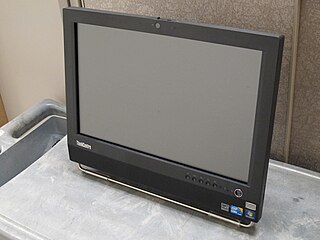
The ThinkCentre Edge is a series of desktop computer from Lenovo, designed primarily for home offices and small businesses. The product series features desktops in both tower and All-in-One form factors, designed to save up to 70% desk space as compared to traditional tower desktop PCs.

References

  1. 1 2 3 4 "IdeaCentre Q Series" . Retrieved 20 February 2012.
  2. 1 2 3 4 5 6 7 8 David Murphy (21 December 2009). "Lenovo IdeaCentre Q100 Nettop PC" . Retrieved 22 September 2011.
  3. 1 2 3 4 5 6 "Lenovo IdeaCentre Q150 Review". 28 July 2010. Retrieved 22 September 2011.
  4. 1 2 Joel Santo Domingo (19 October 2010). "Lenovo IdeaCentre Q150". PC Magazine. Retrieved 22 September 2011.
  5. 1 2 3 Danny Allen (19 August 2009). "Lenovo's Sleek IdeaCentre Q110 Nettop Has Nvidia Ion Graphics" . Retrieved 22 September 2011.
  6. 1 2 3 Chris Davies (13 August 2009). "Lenovo IdeaCentre Q700 HTPC wants to slip under your HDTV" . Retrieved 22 September 2011.
  7. 1 2 Danny Allen (19 August 2009). "Lenovo IdeaCentre Q700 Wants To Be Your Lounge Room's Black Box" . Retrieved 22 September 2011.