
Ṣadr ad-Dīn Muḥammad Shīrāzī, more commonly known as Mullā Ṣadrā, was a Persian Twelver Shi'i Islamic mystic, philosopher, theologian, and ‘Ālim who led the Iranian cultural renaissance in the 17th century. According to Oliver Leaman, Mulla Sadra is arguably the single most important and influential philosopher in the Muslim world in the last four hundred years.
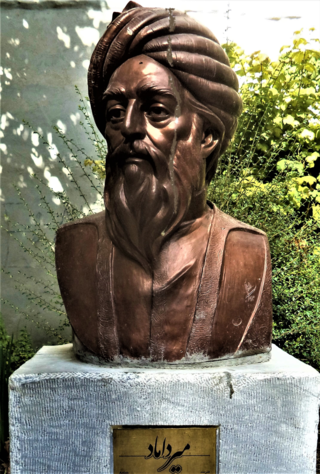
Mir Damad, known also as Mir Mohammad Baqer Esterabadi, or Asterabadi, was a Twelver Shia Iranian philosopher in the Neoplatonizing Islamic Peripatetic traditions of Avicenna. He also was a Suhrawardi, a scholar of the traditional Islamic sciences, and foremost figure of the cultural renaissance of Iran undertaken under the Safavid dynasty. He was also the central founder of the School of Isfahan, noted by his students and admirers as the Third Teacher after Aristotle and al-Farabi.
Henry Corbin was a French philosopher, theologian, and Iranologist, professor of Islamic studies at the École pratique des hautes études. He was influential in extending the modern study of traditional Islamic philosophy from early falsafa to later and "mystical" figures such as Suhrawardi, Ibn Arabi, and Mulla Sadra Shirazi. With works such as Histoire de la philosophie islamique (1964), he challenged the common European view that philosophy in the Islamic world declined after Averroes and Avicenna.

The Isfahan School is a school of Islamic philosophy. It was founded by Mir Damad and reached its fullest development in the work of Mulla Sadra. The name was coined by Seyyed Hossein Nasr and Henry Corbin.
Iranian philosophy or Persian philosophy can be traced back as far as to Old Iranian philosophical traditions and thoughts which originated in ancient Indo-Iranian roots and were considerably influenced by Zarathustra's teachings. According to the Oxford Dictionary of Philosophy, the chronology of the subject and science of philosophy starts with the Indo-Iranians, dating this event to 1500 BC. The Oxford dictionary also states, "Zarathustra's philosophy entered to influence Western tradition through Judaism, and therefore on Middle Platonism."
William Clark Chittick is an American philosopher, writer, translator, and interpreter of classical Islamic philosophical and mystical texts. He is best known for his work on Rumi and Ibn 'Arabi, and has written extensively on the school of Ibn 'Arabi, Islamic philosophy, and Islamic cosmology. He is a Distinguished Professor in the Department of Asian and Asian American Studies at Stony Brook University.
History of Islamic Philosophy, first published in 1996 with, is a collection of essays by various authorities on Islam in the Routledge series History of World Philosophies and is edited by Seyyed Hossein Nasr of George Washington University and Oliver Leaman of Liverpool John Moores University. The book has been well reviewed.
Miguel Asín Palacios was a Spanish scholar of Islamic studies and the Arabic language, and a Roman Catholic priest. He is primarily known for suggesting Muslim sources for ideas and motifs present in Dante's Divine Comedy, which he discusses in his book La Escatología musulmana en la Divina Comedia (1919). He wrote on medieval Islam, extensively on al-Ghazali. A major book El Islam cristianizado (1931) presents a study of Sufism through the works of Muhyiddin ibn 'Arabi of Murcia in Andalusia. Asín also published other comparative articles regarding certain Islamic influences on Christianity and on mysticism in Spain.
Illuminationism, also known as Ishrāqiyyun or simply Ishrāqi is a philosophical and mystical school of thought introduced by Shahab al-Din Suhrawardi in the twelfth century, established with his Kitab Hikmat al-Ishraq, a fundamental text finished in 1186. Written with influence from Avicennism, Peripateticism, and Neoplatonism, the philosophy is nevertheless distinct as a novel and holistic addition to the history of Islamic philosophy.

Akbari Sufism or Akbarism is a branch of Sufi metaphysics based on the teachings of Ibn Arabi, an Andalusian Sufi who was a gnostic and philosopher. The word is derived from Ibn Arabi's nickname, "Shaykh al-Akbar," meaning "the greatest master." 'Akbariyya' or 'Akbaris' have never been used to indicate a specific Sufi group or society. It is now used to refer to all historical or contemporary Sufi metaphysicians and Sufis influenced by Ibn Arabi's doctrine of Wahdat al-Wujud. It is not to be confused with Al Akbariyya, a secret Sufi society founded by Swedish Sufi 'Abdu l-Hadi Aguéli.
Şemseddin Ahmed (1469–1534), better known by his pen name Ibn Kemal or Kemalpaşazâde, was an Ottoman historian, Shaykh al-Islām, jurist and poet.
Kasr al-asnam al-jahiliyyah fi dhamm al-mutasawwifin. The word "mutasawwifin" referred to here is not used according to its usual meaning of one who follows Sufism but means one who pretends to follow it. In this treatise, Mulla Sadra criticizes the excesses of those in his day who, pretending to be Sufis, disregarded the Shari'ah and its teachings.
The Transcendent Philosophy of the Four Journeys of the Intellect, known as Four Journeys, is an extended compendium of Islamic philosophy written by the 17th century Islamic scholar, Mulla Sadra, In which he attempted to reach Sufism and prove the idea of Unity of Existence by offering a new intake and perspective on Peripatetic philosophy that was offered by Alpharabius and Avicenna in the Islamic world. The book explains his philosophy of transcendent theosophy. It was first published in print in 1865 in Tehran in four volumes, where it was accompanied by a commentary on three of the volumes by Hadi Sabzavari (1797–1893). To date, no notable, critical English translation of the book has been made.
Tafasir Al Quran are collections of books as commentaries on the Quran, written by Mulla Sadra.
Mahdi Fadaei Mehrabani is an Iranian writer and researcher in Islamic philosophy, mysticism and political philosophy. He is one of the winners of Farabi International Award, 2009 and the Winner of Iran’s Book of the Year Awards, 2016. Mehrabani has written several books and articles and currently is an assistant Professor at University of Tehran. Mehrabani used to be a researcher at State University of New York from 2017 to 2018.
The Arcs of Descent and Ascent, an ontological circle, are described in Neoplatonism, as well as in Islamic and Sufi cosmology, mainly inspired by the works of Ibn al-Arabi. In the Arc of Descent, from unity to diversity, God creates successively the Intellect, the Universal Soul, Prime Matter, Nature, the Universal Body and the Earth. The Arc of Ascent is the way back to the Presence of God, the process of spiritual perfection.

Zailan Moris is a Malaysian scholar of Islamic philosophy and former professor of the School of Humanities at the University Sains Malaysia. Her main interests are Islamic philosophy, comparative religion and Sufism.
Caner Dagli is a Circassian-American Islamic scholar and associate professor of Religious Studies at the College of the Holy Cross in Worcester, Massachusetts.

Insha-Allah Rahmati is an Iranian philosopher, thinker, translator and a full professor of philosophy at Islamic Azad University in Tehran. His main interests are Ethics, Islamic philosophy and Traditionalist School (perennialism).

