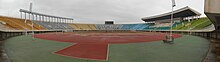
The Pakistan national football team represents Pakistan in men's international football in FIFA-authorized events and is controlled by the Pakistan Football Federation, the governing body for football in Pakistan. Pakistan became a member of FIFA in 1948 and joined the Asian Football Confederation in 1950.
The Quaid-i-Azam Academy is an institution of the Pakistan Government to promote the study and understanding of the personality and work of Quaid-i-Azam Muhammad Ali Jinnah, his associates, the Pakistan Movement and of the various aspects of Pakistan.

The National Women's Football Championship is the top cup competition for women's football clubs in Pakistan. It was started in 2005 by the Pakistan Football Federation.
Zahid Hameed is a Pakistani former footballer who played as a midfielder.
The Abbottabad Cricket Stadium is a cricket ground located in Abbottabad, Khyber Pakhtunkhwa, Pakistan. It was established in 2003 by the Pakistan Cricket Board, and was declared as a first-class cricket venue in 2010.
The National Games of Pakistan is a multi-sport event held in Pakistan. It comprises various disciplines in which sportsmen from the provinces and departments of Pakistan compete against each other. The games are organized by Pakistan Sports Board, Pakistan Olympic Association, and the host province.
The 2014 SAFF Women's Championship was an association football tournament for women's national teams organised by the South Asian Football Federation (SAFF). It was the third edition of the tournament since the first one in 2010. The competition was contested by the eight SAFF members. India were the reigning champions.
Sahar Zaman (born 6 December 1996) is a Pakistani footballer who plays as a midfielder. She is a member of the Pakistan women's national football team. Zaman is from the Gilgit-Baltistan region of Pakistan.
The 2019-2020 National Women Football Championship was the 12th season of the National Women Football Championship, the top-tier of women's football in Pakistan. The tournament took place in two phases: qualifying round in November 2019 and final round from 1 to 12 January 2020 in Karachi.
The 2010 National Women's Football Championship was the 6th season of the National Women Football Championship, the top-tier of women's football in Pakistan. The event took place from 28 September to 10 October 2010 at Jinnah Sports Stadium in Islamabad.
Young Rising Stars Women Football Club, also referred as to Young Rising Stars WFC, is a Pakistani women's association football club based in Rawalpindi. Founded in 2007, the club has won the National Women Football Championship a record five times. It has also won the U-16 National Youth Championship once.
The 2012 National Women Football Championship was the 8th season of the National Women Football Championship, the top-tier of women's football in Pakistan. The tournament ran from 28 September to 9 October 2012 in Jinnah Sports Stadium, Islamabad.
The 2005 National Women Football Championship was the inaugural of the National Women Football Championship, the top-tier of women's football in Pakistan.
The 2006National Women Football Championship was the second season of the National Women Football Championship, the top-tier of women's football in Pakistan. The tournament took place from 19 to 28 August 2006 at Jinnah Sports Stadium in Islamabad.
The 2007National Women Football Championship was the third season of the National Women Football Championship, the top-tier of women's football in Pakistan. The tournament took place in August 2007 at Jinnah Sports Stadium in Islamabad.
The 2008National Women Football Championship was the fourth season of the National Women Football Championship, the top-tier of women's football in Pakistan.
The 1986 Quaid-e-Azam International Cup was the fourth edition of the Quaid-e-Azam International Cup held in Islamabad, Pakistan.
Mohammad Tariq Hussain is a Pakistani former footballer who played as a defender. He played for Habib Bank throughout his career, serving as assistant coach of the team later on. Tariq is among the major players of the Pakistan national football team in the 1990s, and also captained the national team.