Related Research Articles
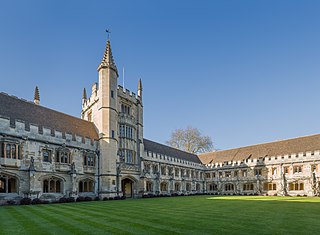
Magdalen College is a constituent college of the University of Oxford. It was founded in 1458 by Bishop of Winchester William of Waynflete. It is one of the wealthiest Oxford colleges, as of 2022, and one of the strongest academically, setting the record for the highest Norrington Score in 2010 and topping the table twice since then. It is home to several of the university's distinguished chairs, including the Agnelli-Serena Professorship, the Sherardian Professorship, and the four Waynflete Professorships.

Hertford College, previously known as Magdalen Hall, is a constituent college of the University of Oxford in England. It is located on Catte Street in the centre of Oxford, directly opposite the main gate to the Bodleian Library. The college is known for its iconic bridge, the Bridge of Sighs. There are around 600 students at the college at any one time, comprising undergraduates, graduates and visiting students from overseas.
Magdalen College School (MCS) is a private day school in the English public school tradition located in Oxford, England, for boys aged seven to eighteen and for girls in the sixth form. It was founded by William Waynflete in 1480 as part of Magdalen College, Oxford.
A demyship is a form of scholarship or research affiliation at Magdalen College, Oxford.

Magdalen Street is a short shopping street in central Oxford, England, just north of the original north gate in the city walls. Traditionally, the name of the street is pronounced and not as the name of the Magdalen College, which is always.

Ulmus × hollandicaMill. , often known simply as Dutch elm, is a natural hybrid between Wych elm and field elm Ulmus minor which commonly occurs across Europe wherever the ranges of the parent species overlap. In England, according to the field-studies of R. H. Richens, "The largest area [of hybridization] is a band extending across Essex from the Hertfordshire border to southern Suffolk. The next largest is in northern Bedfordshire and adjoining parts of Northamptonshire. Comparable zones occur in Picardy and Cotentin in northern France". Crosses between U. × hollandica and either of the parent species are also classified as U. × hollandica. Ulmus × hollandica hybrids, natural and artificial, have been widely planted elsewhere.
Gerald Leslie Harriss FBA was an English historian of the Late Middle Ages. His work focused on the parliamentary, financial and administrative history of the period. Harriss was a Fellow of Magdalen College, Oxford.
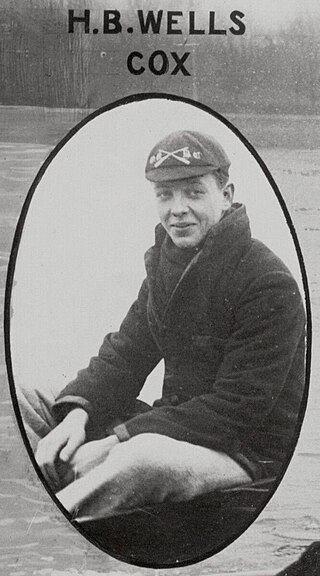
Henry Bensley Wells MBE was an English judge and rowing coxswain who competed for Great Britain in the 1912 Summer Olympics.

Leslie Graham Wormald was an English rower who competed in the 1912 Summer Olympics representing Great Britain.
Richard Mayew (1439/40–1516), also written Mayo, was an English academic, who became Bishop of Hereford and a diplomat for Henry VII of England.
Magdalen College of the Liberal Arts was a private Catholic liberal arts college in Warner, New Hampshire. The college opened in 1973. Enrollment never exceeded 90 students and it closed in May 2024.
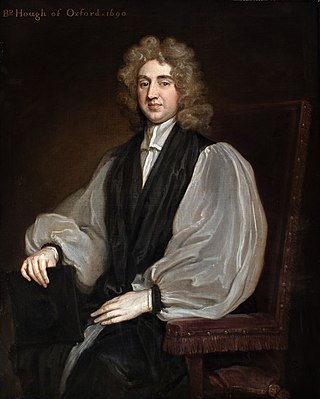
John Hough was an English bishop. He is best known for the confrontation over his election as President at Magdalen College, Oxford that took place at the end of the reign of James II of England.

New College Boat Club (NCBC) is the rowing club for members of New College, Oxford. The club's existence can be dated to 1840 when it first raced on The Isis in Oxford.
The Magdalen Ground was a cricket ground in Oxford, England. The ground was owned by the University of Oxford and used by Magdalen College, a constituent college of the University of Oxford. Originally forming the northern point of Cowley Marsh, the ground was initially associated with the Magdalen College School, whose students played cricket there. By 1829, the Oxford University Cricket Club had been given a part of the marsh where the College School played cricket. In 1851, it was purchased at auction by the University of Oxford and leased to the University Cricket Club. The ground operated as a first-class cricket venue from 1829 to 1880, hosting 69 first-class matches. The University Cricket Club left the ground following the 1880 season to play at the University Parks from 1881.
Edward Butler D.C.L. (1686–1745) was an English academic administrator at the University of Oxford.
John Parkhurst (1563-1639) was an English academic during the late 16th and early 17th centuries.
Robert Morwent was an Oxford college head in the 16th-century.
Lawrence Stubbs, D.D. was an Oxford college head in the 16th-century.

Magdalen College Boat Club (MCBC) is a rowing club for members of Magdalen College, Oxford. It is based on the Isis at Boathouse Island, Christ Church Meadow, Oxford, Oxford.
References




 | This article relating to the University of Oxford is a stub. You can help Wikipedia by expanding it. |
 | This biographical article about an English academic administrator is a stub. You can help Wikipedia by expanding it. |