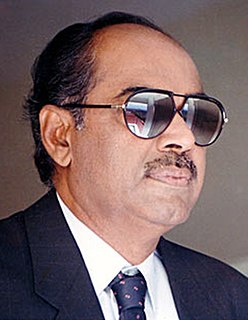
Daggubati Ramanaidu was an Indian film producer and the founder of Suresh Productions known for his work in Telugu cinema. He was placed in the Guinness Book of World Records for the most films produced by an individual, with more than 150 films in 13 Indian languages. He also served as a member of parliament for the Bapatla constituency of Guntur District in the 13th Lok Sabha from 1999 to 2004.

Yuvaraja Sri Sir Kanteerava Narasimharaja Wadiyar, was the heir apparent of the princely state of Mysore from 1895 until his death in 1940.
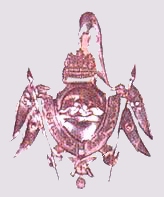
Rana dynasty is a Chhetri dynasty that ruled the Kingdom of Nepal from 1846 until 1951, reducing the Shah monarch to a figurehead and making Prime Minister and other government positions held by the Ranas hereditary. They claimed Kshatriya status themselves. Rana dynasty is historically known for the iron-fisted rule. This changed after the Revolution of 1951 with the promulgation of a new constitution, when power shifted back to the monarchy of King Tribhuvan.
The Bottle Match is a varsity match played between the Camborne School of Mines (CSM) of Exeter University and the Royal School of Mines (RSM) of Imperial College London. The first recorded match between the two sides took place on 16 December 1902.
Raja Sri Ravu SvetachalapatiSir Ramakrishna Ranga RaoKCIE was an Indian politician and zamindar who served as the Chief Minister of Madras Presidency from 5 November 1932 to 4 April 1936 and 24 August 1936 to 1 April 1937.

Maharaja Sir Bhupinder Singh or Bhuppi GCSI GCIE GCVO GBE was the ruling Maharaja of the princely state of Patiala in British India from 1900 to 1938.

Hanuman Junction is a town which lies between the borders of Krishna and West Godavari districts of Andhra Pradesh state in India. Hanuman Junction gets its name because it is located in the X-Junction of NH-16 & AH-45.
The Filmfare Award for Best Director – Telugu is presented by the Filmfare magazine as part of its annual Filmfare Awards South for Telugu films. The awards were extended to "Best Director" in 1972.

The ICC Cricket World Cup Trophy is presented to the winners of the cricket World Cup. The current trophy was created for the 1999 championships, and was the first permanent prize in the tournament's history; prior to this, different trophies were made for each World Cup. The trophy was designed by Paul Marsden of Garrard & co and produced in London by a team of craftsmen from Garrard & Co over a period of two months. The trophy is now manufactured by Ottewill Silversmiths in Ashford.

The Imperial Legislative Council was a legislature for British India from 1861 to 1947. It succeeded the Council of the Governor-General of India, and was succeeded by the Constituent Assembly of India and after 1950, was succeeded by Parliament of India.

Rao Venkata Kumara Mahipati Surya Rau (1885–1964) was Maharajah of Pithapuram. He was called by Telugu people "Abhinava Krishnadevaraya". Maharani Sita Devi of Baroda was his daughter.

Sri Krishna Devaraya Bahasha Nilayam earlier known as Sri Krishna Devaraya Andhra Bahasha Nilayam is one of the oldest non-Government Library in Telangana.

Chilaka Gorinka is a 1966 Telugu film produced and directed by Kotayya Pratyagatma. The film won the Nandi Award for Best Feature Film from Government of Andhra Pradesh. Srirangam Srinivasa Rao wrote the lyrics for the film, while Saluri Rajeswara Rao provided the music score.

R. Balasaraswathi, Raavu Balasaraswathi or Rao Balasaraswathi Devi is a singer and actress who performed from 1930 to the 1960s in Telugu and Tamil cinema.

Tanjore Rama Rao, was an Indian administrator who served as the Diwan of Travancore from 1887 to 1892. V. Nagam Aiya, in his 1906 Travancore State Manual calls him "the most popular Diwan in recent times". Rama Rao was a cousin of Rajah Sir T. Madhava Rao and Diwan Bahadur R. Raghunatha Rao. All three were grandsons of Gundopanth. Rama Rao's mother Sonamma Bai was Gundopanth's daughter, while Diwan Bahadur R. Raghunatha Rao's father Rai Raya Rai Venkat Rao and Sir. T. Madhava Rao's father Ranga Rao were Gundopanth's sons.

School Master is a 1958 Indian Kannada language film, produced and directed by B. R. Panthulu. The film starred B.R. Panthulu himself in the lead role along with Dikki Madhava Rao, M. V. Rajamma, Udaykumar, Sivaji Ganesan, Gemini Ganesan and B. Saroja Devi in important roles. It was the first Kannada film to complete a Silver Jubilee Celebration. This film had its children's dance drama in Gevacolor, taken by cinematographer W. R. Subba Rao. It was later remade into various other languages including Telugu, Malayalam and Hindi.
General elections were held in British India in 1934. The Indian National Congress emerged as the largest party in the Central Legislative Assembly.


