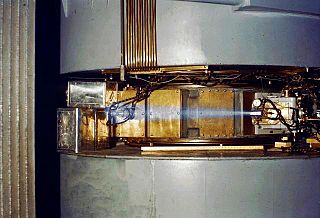
A cyclotron is a type of particle accelerator invented by Ernest O. Lawrence in 1929–1930 at the University of California, Berkeley, and patented in 1932. A cyclotron accelerates charged particles outwards from the center of a flat cylindrical vacuum chamber along a spiral path. The particles are held to a spiral trajectory by a static magnetic field and accelerated by a rapidly varying electric field. Lawrence was awarded the 1939 Nobel Prize in Physics for this invention.

The Deutsches Elektronen-Synchrotron, commonly referred to by the abbreviation DESY, is a national research center in Germany. It operates particle accelerators used to investigate the structure of matter, and conducts a broad spectrum of inter-disciplinary scientific research in three main areas: particle and high energy physics; photon science, and the development, construction and operation of particle accelerators. Its name refers to its first project, an electron synchrotron. DESY is publicly financed by the Federal Republic of Germany, the States of Germany, and the German Research Foundation (DFG). DESY is a member of the Helmholtz Association and operates at sites in Hamburg and Zeuthen.

SLAC National Accelerator Laboratory, originally named the Stanford Linear Accelerator Center, is a federally funded research and development center in Menlo Park, California, United States. Founded in 1962, the laboratory is now sponsored by the United States Department of Energy and administrated by Stanford University. It is the site of the Stanford Linear Accelerator, a 3.2 kilometer (2-mile) linear accelerator constructed in 1966 that could accelerate electrons to energies of 50 GeV.

Synchrotron radiation is the electromagnetic radiation emitted when relativistic charged particles are subject to an acceleration perpendicular to their velocity. It is produced artificially in some types of particle accelerators, or naturally by fast electrons moving through magnetic fields. The radiation produced in this way has a characteristic polarization and the frequencies generated can range over a large portion of the electromagnetic spectrum.

A synchrotron light source is a source of electromagnetic radiation (EM) usually produced by a storage ring, for scientific and technical purposes. First observed in synchrotrons, synchrotron light is now produced by storage rings and other specialized particle accelerators, typically accelerating electrons. Once the high-energy electron beam has been generated, it is directed into auxiliary components such as bending magnets and insertion devices in storage rings and free electron lasers. These supply the strong magnetic fields perpendicular to the beam which are needed to convert high energy electrons into photons.

The Institute for Theoretical and Experimental Physics is a multi-disciplinary research center located in Moscow, Russia. ITEP carries out research in the fields of theoretical and mathematical physics, astrophysics, high energy particle physics, nuclear physics, plasma physics, solid state physics, nanotechnology, reactor and accelerator physics, medical physics, and computer science. ITEP also maintains an extensive educational program and organizes physics schools for scholars and undergraduates. The institute is located near the corner of the Sevastopol prospect and the Nachimowski prospect and occupies part of the former estate "Cheryomushki-Znamenskoye" - an 18th-century manor that is a monument of architecture and landscape art of the 18th-19th centuries.
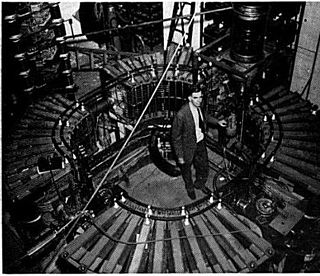
A synchrotron is a particular type of cyclic particle accelerator, descended from the cyclotron, in which the accelerating particle beam travels around a fixed closed-loop path. The magnetic field which bends the particle beam into its closed path increases with time during the accelerating process, being synchronized to the increasing kinetic energy of the particles. The synchrotron is one of the first accelerator concepts to enable the construction of large-scale facilities, since bending, beam focusing and acceleration can be separated into different components. The most powerful modern particle accelerators use versions of the synchrotron design. The largest synchrotron-type accelerator, also the largest particle accelerator in the world, is the 27-kilometre-circumference (17 mi) Large Hadron Collider (LHC) near Geneva, Switzerland, built in 2008 by the European Organization for Nuclear Research (CERN). It can accelerate beams of protons to an energy of 6.5 tera electronvolts (TeV or 1012 eV).

The Canadian Light Source (CLS) is Canada's national synchrotron light source facility, located on the grounds of the University of Saskatchewan in Saskatoon, Saskatchewan, Canada. The CLS has a third-generation 2.9 GeV storage ring, and the building occupies a footprint the size of a Canadian football field. It opened in 2004 after a 30-year campaign by the Canadian scientific community to establish a synchrotron radiation facility in Canada. It has expanded both its complement of beamlines and its building in two phases since opening. As a national synchrotron facility with over 1000 individual users, it hosts scientists from all regions of Canada and around 20 other countries. Research at the CLS has ranged from viruses to superconductors to dinosaurs, and it has also been noted for its industrial science and its high school education programs.
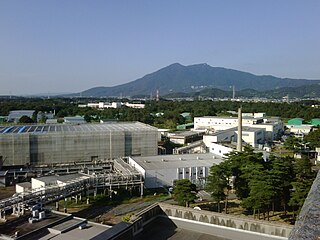
The High Energy Accelerator Research Organization, known as KEK, is a Japanese organization whose purpose is to operate the largest particle physics laboratory in Japan, situated in Tsukuba, Ibaraki prefecture. It was established in 1997. The term "KEK" is also used to refer to the laboratory itself, which employs approximately 695 employees. KEK's main function is to provide the particle accelerators and other infrastructure needed for high-energy physics, material science, structural biology, radiation science, computing science, nuclear transmutation and so on. Numerous experiments have been constructed at KEK by the internal and international collaborations that have made use of them. Makoto Kobayashi, emeritus professor at KEK, is known globally for his work on CP-violation, and was awarded the 2008 Nobel Prize in Physics.

The Budker Institute of Nuclear Physics (BINP) is one of the major centres of advanced study of nuclear physics in Russia. It is located in the Siberian town Akademgorodok, on Academician Lavrentiev Avenue. The institute was founded by Gersh Budker in 1959. Following his death in 1977, the institute was renamed in honour of Academician Budker.

The Cornell Laboratory for Accelerator-based Sciences and Education (CLASSE) is a particle accelerator facility located in Wilson Laboratory on the Cornell University campus in Ithaca, NY. CLASSE formed from the merger of the Cornell High-Energy Synchrotron Source (CHESS) and the Laboratory for Elementary-Particle Physics (LEPP) in July 2006. Ritchie Patterson is the Director of CLASSE.

The Kurchatov Institute is Russia's leading research and development institution in the field of nuclear energy. It is named after Igor Kurchatov and is located at 1 Kurchatov Square, Moscow.

The Saskatchewan Accelerator Laboratory (SAL) was a linear accelerator facility on the University of Saskatchewan campus in Saskatoon, Saskatchewan, Canada. The facility was constructed in 1962 at a cost of $1.7M under the direction of Leon Katz. SAL was identified by the OECD as a National Large-Scale Facility. SAL provided support for radiology, chemistry and sub-atomic physics research.

The Raja Ramanna Centre for Advanced Technology is a unit of Department of Atomic Energy, Government of India, engaged in R&D in non-nuclear front-line research areas of lasers, particle accelerators and related technologies.
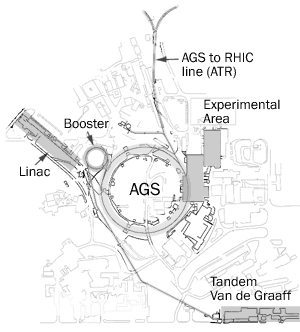
The Alternating Gradient Synchrotron (AGS) is a particle accelerator located at the Brookhaven National Laboratory in Long Island, New York, United States.

The Institute of High Energy Physics of the Chinese Academy of Sciences (IHEP) is the largest and most comprehensive fundamental research center of high-energy physics in China. It is located in Shijingshan District, Beijing and administered by the Chinese Academy of Sciences. The major research fields of IHEP are particle physics, astrophysics and astroparticle physics, accelerator physics and technologies, radiation technologies, and their applications.

A particle accelerator is a machine that uses electromagnetic fields to propel charged particles to very high speeds and energies, and to contain them in well-defined beams.

A storage ring is a type of circular particle accelerator in which a continuous or pulsed particle beam may be kept circulating typically for many hours. Storage of a particular particle depends upon the mass, momentum and usually the charge of the particle to be stored. Storage rings most commonly store electrons, positrons, or protons.
The Hiroshima Synchrotron Radiation Center, also known as Hiroshima Synchrotron Orbital Radiation (HiSOR), at Hiroshima University is a national user research facility in Japan. It was founded in 1996 by the University Science Council at Hiroshima University initially as a combined educational and research facility before opening to users in Japan and across the world in 2002. It is the only synchrotron radiation experimental facility located at a national university in Japan. The HiSOR experimental hall contains two undulators that produce light in the ultraviolet to soft x-ray range. A total of 16 beamlines are supported by bending magnet and undulator radiation for use in basic studies of life sciences and physical sciences, especially solid-state physics.
John Paul Blewett was a Canadian-American physicist, known as "a key figure in the development of particle accelerators".


