
The monumental complex of the Basilica and Convent of San Francisco of Lima, also known as "San Francisco el Grande" or "San Francisco de Jesús", is located in the Historic Center of Lima, Peru. This church together with the Sanctuary Nuestra Señora de la Soledad and the Church del Milagro set up one of the welcoming and artistic corners of Lima. Ramón Menéndez Pidal, Spanish philologist and scholar in this regard commented: "It is the largest and noblest monument that the conquest erected in these prodigious lands".

The Casa de Osambela, also known as the Casa de Oquendo, is a building built during the colonial era of Peru. It stands on the old Novitiate of the Dominican fathers, destroyed by the earthquake of 1746, and part of the garden, facing the Calle de la Veracruz in the historic center of the city of Lima. It is one of the largest mansions in the center of Lima and is notable for its wide façade and excellent quality balconies.

José de Santiago Concha y Salvatierra, 1st Marquess of Casa Concha was a Spanish politician and Royal Governor of Chile.

Jesús Omar Aramayo Cordero is a Peruvian poet and composer.

The Basilica and Convent of Saint Peter, formerly known as Basilica of Saint Paul after the school of the same name, is a Catholic church located in the historic centre of Lima, Peru.
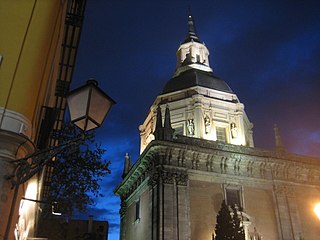
The Church of San Andrés is a church in Madrid, Spain. It was declared a Bien de Interés Cultural in 1995.

Manuel Francisco Pavón Aycinena was a conservative Guatemalan politician during the regime of General Rafael Carrera. He was influential in the founding of the government's executive branch and held several Cabinet offices during his career.
The following is a timeline of the history of the city of Camagüey, Cuba.

The Basilica and Maximus Convent of Nuestra Señora del Rosario, popularly known as the Convent of Santo Domingo, is a Catholic religious complex located in the city of Lima, Peru.

The Basilica of La Merced, also known as Convent of La Merced, is a minor basilica located in the city of Cusco, Peru. It is located 100 meters southwest of the Plaza de Armas in front of the Plazoleta Espinar. It belongs to the Order of the Blessed Virgin Mary of Mercy and has, annexes, both the convent and the premises of La Merced College. The church has a three-nave basilica plan covered with brick vaults and dome on the crossing, with Baroque altars on its lateral naves and Neoclassical style on the main altar. It also has a tower with Baroque bell tower topped with a semicircular dome. Highlights its portal-side reredos and the Renaissance portal of the muro de pies, the choir stalls, its colonial paintings and polychrome wood carvings. Inside rest the remains of Diego de Almagro, Diego de Almagro II and Gonzalo Pizarro.
The Army of the North of Peru or Restoration Army of Peru was the army of the Northern Peruvian Republic that was made up of Peruvians opposed to the establishment of the Peru-Bolivian Confederation, who accused Bolivian President Andrés de Santa Cruz of having invaded and divided Peru with the support of Peruvian President Luis José de Orbegoso whom his opponents did not recognize as legitimate. It later merged with the Chilean Army to form the United Restoration Army. The goal of the army was to restore the united Peruvian state prior to the establishment of the Confederation.

The Arrabal of Saint Martin was a medieval arrabal (neighborhood) that sat outside the Christian Walls of Madrid. It was located around the location of the current Plaza of San Martín, and occupied the space between Calle del Arenal, the Plaza de las Descalzas, Plaza del Callao, and Calle de las Navas de Tolosa. It grew as a population center around the Monastery of Saint Martin, neighboring San Martín was the Arrabal of San Ginés, and both were absorbed by the growth of the city in the 17th century.

Luis de Riaño was a Peruvian criollo painter, active in the 17th-century. His work is an important representation of Cusco School, the Peruvian colonial painting style. De Riaño is best known for his frescos painted in the 1620s at the Church of San Pedro de Andahuaylillas in Cusco, nicknamed the "Sistine Chapel of the Americas".

Leonardo Jaramillo was a Spanish mannerist painter, active in the 17th-century in the Viceroyalty of Peru.

The Catacombs of Lima are underground ossuaries in the historic centre of Lima, Peru. The catacombs were built under the Basilica and Convent of San Francisco and currently function as a museum.

José Gregorio Castro Miranda, O.F.M., was a Roman Catholic prelate who was Bishop of Cuzco from 1910 to 1917. He mainly worked to integrate the local indigenous population to the church's teachings by translating prayers and church music to Quechua.

The Royal Army of Peru, also known as the National Army, was the army organised by the viceroy of Peru, José Fernando de Abascal, to protect the Hispanic Monarchy in the Viceroyalty of Peru—and its surrounding provinces of Charcas, Chile and Quito—of the revolutions that convulsed the Spanish Empire at the beginning of the 19th century. This army was made up of 80% Creoles and indigenous Peruvians.


