
Leptobrachella is a genus of frogs in the family Megophryidae. Members of Leptobrachella are found throughout Asia including on Borneo and the Natuna Islands. They are sometimes referred to as Borneo frogs, slender-armed frogs, or dwarf litter frogs. The genus contains over 82 species with 25 found in China alone.
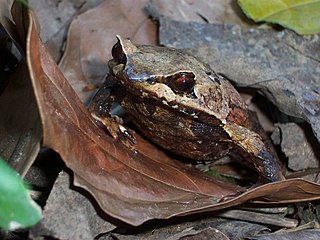
Megophrys is a genus of frogs in the family Megophryidae. They are endemic to Indonesia, where they are found on the islands of Java and Sumatra. They commonly have elongated upper "eyebrows" and are thus known as Indonesian horned toads. This group was thought to contain many more species and have a much wider distribution prior to recent taxonomic revisions.
Amolops monticola is a species of frog in the family Ranidae, the "true frogs". It is found in the Northeast India, eastern Nepal, and western China, although there is some uncertainty regarding the Chinese records. It probably also occurs in the intervening Bhutan. Common names mountain sucker frog, mountain stream frog, mountain torrent frog, and mountain cascade frog have been coined for it.

Paramesotriton, also known as warty newts or Asian warty newts, is a genus of salamanders in the family Salamandridae. The genus is found in southwestern and southern China and in northern Vietnam. Most of the species are endemic to China, and the majority of them have been described recently, since 2008. The genus includes both pond and stream dwellers.

Scutiger is a genus of toads in the family Megophryidae. Common name lazy toads has been coined for them. They occur in China, Burma, Nepal, and northern India in high-altitude habitats. Most are endemic to China.
Scutiger mammatus is a species of frog in the family Megophryidae. It is endemic to Western China and known from eastern Tibet, southeastern Qinghai, western Sichuan, and northwestern Yunnan.

Xenophrys is a genus of amphibians in the family Megophryidae. They are found in southeastern Asia to Borneo. Their common name is strange-horned toads.
Liurana alpina is a species of frog in the family Ceratobatrachidae. It is endemic to China and only known from its type locality, Dayandong in Mêdog County, Tibet. This little known species lives under moss in forest at about 3,100 m (10,200 ft) asl.
Liurana medogensis, commonly known as Medog papilla-tongued frog or Medog eastern frog, is a species of frog in the family Ceratobatrachidae. It is found in Mêdog County, Tibet (China) and in Arunachal Pradesh, northeastern India. However, the records from India might represent another species, and the IUCN SSC Amphibian Specialist Group (2020) does not include them in the range of this species.
Ingerana reticulata is a species of frog in the family Dicroglossidae. As presently known, it is endemic to Mêdog County in southeastern Tibet, China, but its range might extend to northeast India, given the proximity of the border. Common names reticulate eastern frog, reticulate wrinkled ground frog, and reticulated papillae-tongued frog have been coined for it.
Liurana xizangensis is a species of frog in the family Ceratobatrachidae. It is endemic to Tibet, China, and only known from the region of its type locality, Yi'ong, in Bomê County. It is also known as Xizang eastern frog and Xizang papillae-tongued frog.
Amolops medogensis is a species of frog in the family Ranidae, the "true frogs". It is endemic to Mêdog County in southeastern Tibet, China; its range might extend into the adjacent Arunachal Pradesh, India. Common name Medog torrent frog has been proposed for it.
Nanorana medogensis is a species of frog in the family Dicroglossidae. It is endemic to Tibet, China, and only known from near its type locality in Mêdog County in southeastern Tibet, near the Indian border. It lives in forested streams, and is sometimes also found at the edges of pools and ponds.
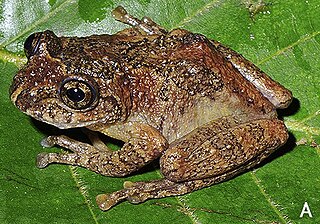
Nasutixalus jerdonii is a species of frog in the family Rhacophoridae. It is found in the northeastern India, in the West Bengal, Nagaland, Manipur, and Meghalaya states. It range might extend into the adjacent Nepal. The specific name jerdonii honours Thomas C. Jerdon, an English herpetologist. Common names Jerdon's bubble-nest frog, Jerdon's tree frog, and Jerdon's bush frog have been coined for this species.

The Ceratobatrachidae are a family of frogs found in the Malay Peninsula, Borneo, the Philippines, Palau, Fiji, New Guinea, and the Admiralty, Bismarck, and Solomon Islands.
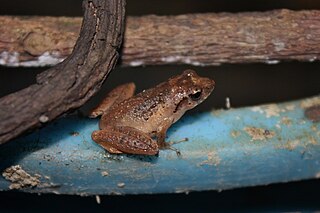
Romerus is a small genus of rhacophorid frogs that are distributed in southern China. Some species now in Romerus were originally placed in Philautus. It is thought to be the most basal genus in the Rhacophorinae.

Scutiger spinosus is a species of toad in the family Megophryidae. It is found in Medog County, Tibet (China) and in Tawang district, Arunachal Pradesh (India). Prior to its description in 2016, it was confused with Scutiger nyingchiensis. Common name spiny lazy toad has been coined for it.
Scutiger wuguanfui is a species of toad in the family Megophryidae. It is endemic to Tibet and only known from its type locality in the Medog County. The specific name wuguanfui honours Wu Guanfu, a Chinese herpetologist. Common names Wu's lazy toad, Medog lazy toad and Medog cat-eyed toad have been coined for it.
Liurana is a genus of frogs in the family Ceratobatrachidae. It is the only genus in the subfamily Liuraninae.
Nasutixalus is a genus of frogs in the family Rhacophoridae. The genus is found in northeastern India and adjacent southeastern Tibet as well as western Yunnan (China); the range might extend into the adjacent Nepal and Myanmar. Common name ridged-nose treefrogs has been coined for this genus.


