See also
 | This disambiguation page lists articles associated with the title Local council. If an internal link led you here, you may wish to change the link to point directly to the intended article. |
Local council may refer to:
| | This disambiguation page lists articles associated with the title Local council. If an internal link led you here, you may wish to change the link to point directly to the intended article. |
A bishop is an ordained, consecrated, or appointed member of the Christian clergy who is generally entrusted with a position of authority and oversight.

The Coptic Orthodox Church of Alexandria is an Oriental Orthodox Christian church based in Egypt, Africa and the Middle East. The head of the church and the See of Alexandria is the Patriarch of Alexandria on the Holy See of Saint Mark, who also carries the title of Coptic Pope. The See of Alexandria is titular, and today the Coptic Pope presides from Saint Mark's Coptic Orthodox Cathedral in the Abbassia District in Cairo. The church follows the Alexandrian Rite for its liturgy, prayer and devotional patrimony. With approximately 10 million members worldwide, it is the country's largest Christian denomination.
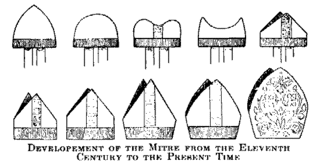
An episcopal polity is a hierarchical form of church governance in which the chief local authorities are called bishops. It is the structure used by many of the major Christian Churches and denominations, such as the Catholic, Eastern Orthodox, Oriental Orthodox, Church of the East, Anglican, and Lutheran churches or denominations, and other churches founded independently from these lineages.

The Russian Orthodox Church, alternatively legally known as the Moscow Patriarchate, is one of the autocephalous Eastern Orthodox Christian churches. The primate of the ROC is the Patriarch of Moscow and all Rus'. The ROC, as well as its primate, officially ranks fifth in the Orthodox order of precedence, immediately below the four ancient patriarchates of the Greek Orthodox Church: Constantinople, Alexandria, Antioch, and Jerusalem. As of October 15, 2018, the ROC suspended communion with the Ecumenical Patriarch of Constantinople, having unilaterally severed ties in reaction to the establishment of the Orthodox Church of Ukraine, which was finalised by the Ecumenical Patriarchate on 5 January 2019.

The Orthodox Church in America (OCA) is an Eastern Orthodox Christian church based in North America. The OCA is partly recognized as autocephalous and consists of more than 700 parishes, missions, communities, monasteries and institutions in the United States, Canada and Mexico. In 2011, it had an estimated 84,900 members in the United States.

In Christian churches with episcopal polity, the rank of metropolitan bishop, or simply metropolitan, pertains to the diocesan bishop or archbishop of a metropolis.

The Orthodox Church of the Czech Lands and Slovakia is a self-governing body of the Eastern Orthodox Church that territorially covers the countries of the Czech Republic and Slovakia. Archbishop Rastislav of Prešov was elected by the Extraordinary Synod held on January 11, 2014, as the new primate. On December 9, 2013, the Synod removed Archbishop Simeon (Jakovlevic) of Brno and Olomouc from his position as Locum Tenens, and appointed Archbishop Rastislav in his place, an action against which Archbishop Simeon protested and which was deplored by Ecumenical Patriarch Bartholomew I of Constantinople.

In several of the autocephalous Eastern Orthodox churches and Eastern Catholic Churches, the patriarch or head bishop is elected by a group of bishops called the Holy Synod. For instance, the Holy Synod is a ruling body of the Georgian Orthodox Church.

The Greek Orthodox Church of Jerusalem, officially called simply the Patriarchate of Jerusalem, is an autocephalous church within the wider communion of the Eastern Orthodox Christianity. It is headed by the Greek Orthodox Patriarch of Jerusalem, the incumbent being Theophilos III since 2005. Christians believe that it was in Jerusalem that the Church was established on the day of Pentecost with the descent of the Holy Spirit on the disciples of Jesus Christ and that the Gospel of Christ spread from Jerusalem. The church celebrates its liturgy in the Byzantine Rite, whose original language is Koine Greek, the original language of the New Testament, and follows its own calendar of feasts, preserving the Julian calendar. It is also often called "Σιωνίτις Εκκλησία".

The Soviet Union was established by the Bolsheviks in 1922, in place of the Russian Empire. At the time of the 1917 Revolution, the Russian Orthodox Church was deeply integrated into the autocratic state, enjoying official status. This was a significant factor that contributed to the Bolshevik attitude to religion and the steps they took to control it. Thus the USSR became the first state to have as one objective of its official ideology the elimination of existing religion, and the prevention of future implanting of religious belief, with the goal of establishing state atheism (gosateizm).

The Russian Orthodox Church Outside Russia, or ROCOR, is a semi-autonomous part of the Russian Orthodox Church.

The Russian Orthodox Old-Rite Church is an Eastern Orthodox Church of the Old Believers tradition, which rejected the liturgical and canonical reforms of Patriarch Nikon in the second half of 17th century. It is one of the two Old Believers churches that belong to the Belokrinitskaya Hierarchy - together with the Orthodox Old-Rite Church, sometimes also called Lipovan Orthodox Old-Rite Church.

A Local Council (LC) is a form of local elected government within the districts of Uganda.
The Evangelical Orthodox Church (EOC), founded on January 15, 1979, is a small Christian syncretic denomination established by former leaders of Campus Crusade for Christ, who, reacting against the freewheeling Jesus People movement, developed their own synthesis of Evangelicalism, Eastern Orthodoxy, and Shepherding Movement principles.
Ecclesiastical polity is the operational and governance structure of a church or of a Christian denomination. It also denotes the ministerial structure of a church and the authority relationships between churches. Polity relates closely to ecclesiology, the study of doctrine and theology relating to church organization.

The Greek Orthodox Patriarchate of Alexandria and all Africa, also known as the Greek Orthodox Church of Alexandria, is an autocephalous patriarchate that is part of the Eastern Orthodox Church. Its seat is in Alexandria and it has canonical responsibility for the entire African continent.
The most widely spread religion in Bosnia and Herzegovina is Islam and a large portion of the Muslims of Bosnia declared themselves as followers of the Sunni branch of Islam. The State Constitution of Bosnia and Herzegovina (BiH) and the entity Constitutions of the Federation of Bosnia and Herzegovina and the Republika Srpska provide for freedom of religion, and the Government generally respects this right in ethnically integrated areas or in areas where government officials are of the majority religion; the state-level Law on Religious Freedom also provides comprehensive rights to religious communities. However, local authorities sometimes restricted the right to worship of adherents of religious groups in areas where such persons are in the minority. 54% of Herzegovinian and Bosnian Muslims consider themselves as "just muslims".
Eastern Orthodoxy in Uganda refers to adherents and religious communities of Eastern Orthodox Christianity in Uganda. Majority of Eastern Orthodox Christians in Uganda are under ecclesiastical jurisdiction of the Eastern Orthodox Patriarchate of Alexandria and all Africa.

The Patriarch of Moscow and all Rus', also known as the Patriarch of Moscow and all Russia, is the official title of the Bishop of Moscow who is the primate of the Russian Orthodox Church. It is often preceded by the honorific "His Holiness". While as the diocesan bishop of the Moscow diocese he has direct canonical authority over Moscow only, the Patriarch has a number of church-wide administrative powers within and in accordance with the charter of the Russian Orthodox Church. The patriarchate was established in Moscow in 1589: the first patriarch was Job. Abolished in 1721 by Peter the Great, the patriarchate was restored on 28 October 1917, by decision of the All-Russian Local Council. Patriarch Kirill acceded to this position on 1 February 2009.
Rosemary Bikaako Tumusiime is a Ugandan marketing professional, public administrator, feminist and politician. She is the elected Member of Parliament for Entebbe Municipality and is a representative for NRM, the ruling political party in Uganda. She is the first female representative for the constituency in over three decades and succeeded Muhammad Kawuma who served for two consecutive terms from 2006 to 2016. In the 10th Parliament, she serves as a member of the Committee on Equal Opportunities and the Committee on Presidential Affairs. She also a member of the NRM Parliamentary Caucus, the Buganda Parliamentary Caucusand the treasurer of the Network for African Women Ministers and Parliamentarians (NAWMP).