
St John's Gardens is an open space in Liverpool, England, to the west of St George's Hall. The gardens are part of the William Brown Street conservation area, and comprise one of the two open spaces within Liverpool's World Heritage Site. It has been a Green Flag site since 2003. The gardens contain ornamental flower beds, and memorials to notable people of the city.

St John the Evangelist's Church lies to the southeast of the village of Chelford, Cheshire, England. The church is recorded in the National Heritage List for England as a designated Grade II* listed building. It is an active Anglican parish church in the diocese of Chester, the archdeaconry of Macclesfield and the deanery of Knutsford. Its benefice is combined with that of St Peter, Lower Withington.
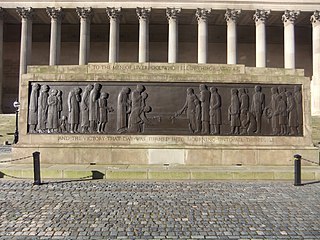
Liverpool Cenotaph stands on St George's Plateau, to the east of St George's Hall in Liverpool, England. It was erected as a memorial to those who had fallen in the First World War. The dates of the Second World War were subsequently added. The cenotaph consists of a rectangular block of stone on a stone platform, with bronze, low-relief sculptures on the sides depicting marching troops and mourners. It was designed by Lionel Budden, with carving by Herbert Tyson Smith. Initially designated as a Grade II listed building, its status was raised to Grade I in 2013.

Crewe War Memorial stands in the Municipal Square, in Crewe, Cheshire, England. It consists of a bronze sculpture of Britannia standing on a pedestal, itself on a square base. The sculptor was Walter Gilbert and the sculpture was cast in the foundry of H. H. Martin and Company. It was unveiled in 1924. The names of those killed in both world wars and in later conflicts are inscribed on bronze plaques around the base, and there are further inscriptions on the paving around the memorial. It originally stood in Market Square and was moved to Municipal Square in 2006. The memorial is recorded in the National Heritage List for England as a designated Grade II listed building.

The Boer War Memorial, also known as the South African War Memorial, stands in a prominent position in Queens Park, Crewe, England. It was erected in memory of local soldiers who had served or fallen in the Boer War, and consists of a bronze statue of soldier in uniform standing on a column on a stone plinth. The monument was unveiled in 1903, and contains plaques with the names of those who were lost in the war. It is recorded in the National Heritage List for England as a designated Grade II listed building.
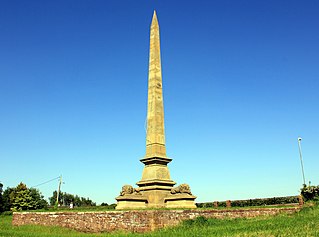
The Barnston Memorial is an obelisk in Churton Road, Farndon, Cheshire, England. It commemorates Roger Barnston, a military officer who died in 1857 from wounds sustained at the Siege of Lucknow. His memorial consists of an obelisk standing on a plinth, surrounded by four lions. It is recorded in the National Heritage List for England as a designated Grade II* listed building.

The Memorial to John Whitaker is in Roe Street, Macclesfield, Cheshire, England. It stands in the forecourt of the Sunday School that Whitaker established in 1814, and was placed there in 1846 to commemorate the school's fiftieth anniversary. The memorial was sculpted by Alfred Gatley in stone and marble, and contains a bust of Whitaker in a medallion on the south face. The monument is recorded in the National Heritage List for England as a designated Grade II listed building.

Birkenhead War Memorial, or Birkenhead Cenotaph, stands in Hamilton Square, Birkenhead, Merseyside, England, opposite the Town Hall. It consists of a cenotaph in Portland stone with carved figures and panels in Westmorland stone. The memorial was designed by Lionel Budden, and the sculptor was H. Tyson Smith. It was unveiled in 1925 by Lieutenant-General Sir Richard H. K. Butler. The memorial is recorded in the National Heritage List for England as a designated Grade II* listed building.

Moulton War Memorial stands in Main Road, Moulton, Cheshire, England. It consists of a marble statue of a soldier standing on a sandstone pedestal, and is surrounded by a wrought iron fence. The memorial was designed by Samuel Welsby, and unveiled in 1920. It is recorded in the National Heritage List for England as a designated Grade II listed building.

The Monument to Captain John Francis Egerton stands in the grounds of the Oulton Estate, Little Budworth, Cheshire, England. John Francis Egerton died in 1846 as the result of injuries sustained in the First Anglo-Sikh War. The memorial was designed by George Gilbert Scott and William Bonython Moffatt, and is recorded in the National Heritage List for England as a designated Grade II* listed building.

The Gaskell Memorial Tower and King's Coffee House are in King Street, Knutsford, Cheshire, England. As originally built, it had the triple function of being council offices, a coffee house, and a memorial to the novelist Elizabeth Gaskell, a former resident of the town who is often known as Mrs Gaskell. The building was designed by Richard Harding Watt with assistance from W. Longworth, and was opened in 1907. Its design incorporates features of many styles of architecture, and has not been praised by all critics. Incorporated on the tower are two depictions of Mrs Gaskell, a stone bust and a bronze relief. The building is recorded in the National Heritage List for England as a designated Grade II* listed building. The building is owned by Knutsford Town Council but since the early 1970s it has been used as a restaurant.

The Port Sunlight War Memorial stands in a central position in the model village of Port Sunlight, Wirral, Merseyside, England. The founder of the village and employer of its residents, William Lever, was anxious to have a memorial to commemorate those of his workers who had been lost in the First World War. As early as 1916 he commissioned Goscombe John to design a war memorial, which was completed and unveiled in 1921 by two of his employees. It consists of a granite runic cross with bronze statues and reliefs and has the theme "Defence of the Realm". On the memorial are the names of all of the company's employees who died as a result of both World Wars. It is recorded in the National Heritage List for England as a designated Grade I listed building.

The Monument to Hugh, Earl Grosvenor, is in the graveyard of St Mary's Church, Eccleston, Cheshire, England. It commemorates the brief life of the only son of Hugh Grosvenor, 2nd Duke of Westminster, who died at the age of four. The monument consists of an enclosure in bronze around his grave, and incorporates three bronze figures. It was designed by Detmar Blow, possibly assisted by Fernand Billerey, and the sculptor was Emile Madeline. The monument is recorded in the National Heritage List for England as a designated Grade II listed building.

The Statue of Queen Victoria stands on the western side of Victoria Square, St Helens, Merseyside, England. It was created after the death of Queen Victoria and given to the town by Colonel William Windle Pilkington, mayor of St Helens in 1902, and a member of the Pilkington glass manufacturers in the town. Pilkington commissioned George Frampton to design it. Frampton used the same model for the figure of the queen for two other statues, but placed it on thrones and pedestals of different designs. The St Helens statue was unveiled by the Earl of Derby in 1905. Originally placed in the centre of Victoria Square, it was moved to a position on the west side of the square in 2000. The statue is recorded in the National Heritage List for England as a designated Grade II* listed building.

Southport War Memorial is in London Square, Lord Street, Southport, Merseyside, England. It consists of an obelisk flanked by two colonnades in the form of Greek temples. Outside the colonnades are memorial gardens, each containing a Pool of Remembrance and fountains. The memorial was designed by the local architects Grayson and Barnish, and the carving was executed by Herbert Tyson Smith. It was unveiled in 1923 by the Earl of Derby. Following the Second World War and subsequent conflicts further inscriptions and names have been added. The memorial is recorded in the National Heritage List for England as a designated Grade II* listed building.

The London Troops War Memorial, located in front of the Royal Exchange in the City of London, commemorates the men of London who fought in World War I and World War II.
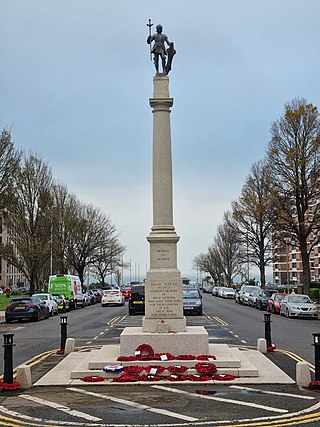
Hove War Memorial is a First World War memorial designed by Sir Edwin Lutyens and located on Grand Avenue in Hove, part of the city of Brighton and Hove, on the south coast of England. Hove was the site of one of the earliest recruiting events at the beginning of the war and later of several military hospitals. Over 600 men from the town were killed during the war, a quarter of them from the local regiment alone. A war memorial committee was established in 1919 and Lutyens was engaged as architect. A design was agreed in 1920 after two unsuccessful proposals; Lutyens chose the site from several options.

Streatham War Memorial is a war memorial to the war dead of the London district of Streatham in the two World Wars. It was unveiled in 1922, and is sited near the northwest corner of Streatham Common, London Borough of Lambeth, England.
The Bank of England War Memorial, in the internal Garden Court at the headquarters of the Bank of England in the City of London, commemorates the bank's staff who were killed while serving in the First World War and Second World War. It includes a bronze sculpture by Richard Reginald Goulden portraying Saint Christopher carrying the Christ Child. It became a Grade II listed building in 2017. The surrounding buildings of the bank are separately listed at Grade I.

The monument to the King's Liverpool Regiment is a war memorial in St John's Gardens in the city centre of Liverpool, England. The memorial commemorates those members of the King's Regiment (Liverpool) who lost their lives on campaign in the Second Anglo-Afghan War (1878–1880), the Third Anglo-Burmese War (1885–1887) and the Second Boer War (1899–1902). It was funded by a public subscription and with the support of the Corporation of Liverpool. It was unveiled on 4 August 1905 by Field Marshal Sir George White. The monument is a rare example of a large-scale public regimental memorial from the pre-First World War era. Its central figure is that of Britannia with other statues showing soldiers of the regiment in 1685, 1743 and 1902.


