Related Research Articles

John Lewis Gaddis is an American military historian, political scientist, and writer. He is the Robert A. Lovett Professor of Military and Naval History at Yale University. He is best known for his work on the Cold War and grand strategy, and he has been hailed as the "Dean of Cold War Historians" by The New York Times. Gaddis is also the official biographer of the prominent 20th-century American diplomat and historian George F. Kennan. George F. Kennan: An American Life (2011), his biography of Kennan, won the 2012 Pulitzer Prize for Biography or Autobiography.

George Frost Kennan was an American diplomat and historian. He was best known as an advocate of a policy of containment of Soviet expansion during the Cold War. He lectured widely and wrote scholarly histories of the relations between the USSR and the United States. He was also one of the group of foreign policy elders known as "The Wise Men".

Containment was a geopolitical strategic foreign policy pursued by the United States during the Cold War to prevent the spread of communism after the end of World War II. The name was loosely related to the term cordon sanitaire, which was containment of the Soviet Union in the interwar period.

Ronald Anthony MarksFRSA is a former senior Central Intelligence Agency official and Capitol Hill Staffer. He is currently Chairman and CEO of ZPN Cyber and National Security Strategies and an academic focused on Cyber and Intelligence policy issues. His book "Spying in America in the Post 9/11 World: Domestic Threat and the Need for Change," published by Praeger Publishing, focuses on the vast expansion of intelligence collection in America and the need for careful oversight.
Michael Mandelbaum is a professor and director of the American Foreign Policy program at the Johns Hopkins University, School of Advanced International Studies. He has written a number of books on American foreign policy and edited a dozen more.
Simon Frederick Peter Halliday was an Irish writer and academic specialising in international relations and the Middle East, with particular reference to the Cold War, Iran, and the Arabian Peninsula.
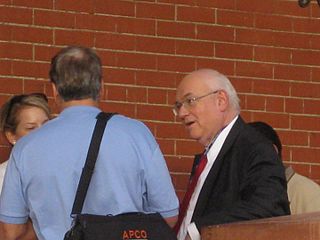
William Schneider is an American journalist. From 1990 to 2009, he served as CNN's senior political analyst. He is a Distinguished Senior Fellow & Resident Scholar at Third Way, a Washington think tank. Schneider is also serving as the Omer L. and Nancy Hirst Professor at George Mason University's School of Public Policy, and teaching at George Mason University Schar School of Policy and Government. He has also been a contributing editor to the Opinion section of the Los Angeles Times.
Robert David English is an American academic, author, historian, and international relations scholar who specializes in the history and politics of contemporary Eastern Europe, the USSR, and Russia. He is an associate professor of International Foreign Policy and Defense Analysis at the University of Southern California (USC) School of International Relations.
Jack A. Goldstone is an American sociologist, political scientist, and historian, specializing in studies of social movements, revolutions, political demography, and the 'Rise of the West' in world history. He is an author or editor of 13 books and over 150 research articles. He is recognized as one of the leading authorities on the study of revolutions and long-term social change.
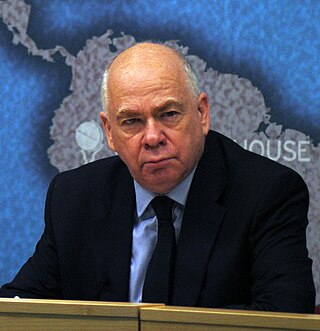
Sir Lawrence David Freedman, is a British academic, historian and author specialising in foreign policy, international relations and strategy. He has been described as the "dean of British strategic studies" and was a member of the Iraq Inquiry. He is an Emeritus Professor of War Studies at King's College London.

The Schar School of Policy and Government is the public policy school of George Mason University, a public research university in the Commonwealth of Virginia near Washington, D.C.
Peter Mandaville is an American academic and former government official.
Walter Allan McDougall is an American historian, currently a professor of history and the Alloy-Ansin Professor of International Relations at the University of Pennsylvania.

Taras Kuzio is a Professor of Political Science at the National University of Kyiv-Mohyla Academy. His area of study is Russian and Ukrainian political, economic and security affairs.

The People's Vanguard Party was a Ba'athist political party in Yemen. The party was established in the late 1950s. It was the Yemeni branch of the Baath Party. When the Baath Party was divided between Syrian and Iraqi factions, the Yemeni branch overwhelmingly sided with the Syrian-led Ba'ath Party. After the split, the Syrian-aligned Ba'athists 'Yemenized' their party and took the name People's Vanguard Party.

Stuart Malawer is an international trade lawyer, and distinguished service professor of law and international trade at George Mason University's Schar School of Policy and Government. He was a founding faculty member of both the Antonin Scalia Law School and Schar School of Policy and Government at George Mason University.
Jonathan Haslam is George F. Kennan Professor in the School of Historical Studies at the Institute for Advanced Study in Princeton and Professor of the History of International Relations at the University of Cambridge with a special interest in the former Soviet Union. He has written many books about Soviet foreign policy and ideology.
Stephen Leonard White was British political scientist and historian, emeritus professor at University of Glasgow, an author of many articles and books about politics of Soviet Union and Russia.

The Michael V. Hayden Center for Intelligence, Policy, and International Security is a think tank in Arlington County, Virginia focused on the intelligence community including topics related to intelligence studies education, intelligence analysis techniques, the operations of intelligence agencies, and public policy and international relations related to national security, international security, and foreign policy through shared experiences of senior intelligence service leaders, military officers, elected officials, journalists, academics, and other civilian scholars.
Sergey S. Radchenko is a Soviet-born British-Russian historian. He is the Wilson E. Schmidt Distinguished Professor at the Henry A. Kissinger Center for Global Affairs, Johns Hopkins School of Advanced International Studies, and visiting professor at Cardiff University. He has served as a Reader at Aberystwyth University, a Global Fellow and a Public Policy Fellow at the Woodrow Wilson Centre, and as the Zi Jiang Distinguished Professor at East China Normal University (Shanghai).
References
- ↑ "Mark N. Katz | Schar School of Policy and Government". schar.gmu.edu. Retrieved 2020-04-03.
