
Lake Michigan is one of the five Great Lakes of North America. It is the second-largest of the Great Lakes by volume and the third-largest by surface area, after Lake Superior and Lake Huron. To the east, its basin is conjoined with that of Lake Huron through the 3+1⁄2-mile (5.6-kilometer) wide, 295-foot deep Straits of Mackinac, giving it the same surface elevation as its easterly counterpart; geologically, the two bodies are a single lake that is, by area, the largest freshwater lake in the world.
Springfield may refer to:
Ottawa is a city in the province of Ontario and the capital of Canada.
Holland is a region within the Netherlands.

Jacques Marquette, S.J., sometimes known as Père Marquette or James Marquette, was a French Jesuit missionary who founded Michigan's first European settlement, Sault Sainte Marie, and later founded Saint Ignace. In 1673, Marquette, with Louis Jolliet, an explorer born near Quebec City, was the first European to explore and map the northern portion of the Mississippi River Valley.
La Salle, LaSalle or Lasalle is part of the names of two men born in 17th century France, Jean-Baptiste de La Salle and René-Robert Cavelier, Sieur de La Salle, for whom many places and things are named:
Mackinac or Mackinaw may refer to:
Black River is a common name for streams and communities around the world: in Spanish and Portuguese, Rio Negro; in French, Rivière Noire; in Turkish, Kara Su; in Serbo-Croatian, Crna Reka, Црна Река or Crna Rijeka, Црна Ријека; in Macedonian, Црна Река, Crna Reka.
Pere Marquette or Jacques Marquette (1637–1675) was a French Jesuit missionary and namesake of Marquette University.

SS Milwaukee was a train ferry that served on Lake Michigan. It was launched in 1902 and sank with all hands off Milwaukee on October 22, 1929. Fifty-two men were lost with the vessel.

The Grand Trunk Milwaukee Car Ferry Company was the Grand Trunk Western Railroad's subsidiary company operating its Lake Michigan railroad car ferry operations between Muskegon, Michigan, and Milwaukee, Wisconsin, from 1905 to 1978. Major railroad companies in Michigan used rail ferry vessels to transport rail cars across Lake Michigan from Michigan's western shore to eastern Wisconsin to avoid rail traffic congestion in Chicago.

The history of commercial passenger shipping on the Great Lakes is long but uneven. It reached its zenith between the mid-19th century and the 1950s. As early as 1844, palace steamers carried passengers and cargo around the Great Lakes. By 1900, fleets of relatively luxurious passenger steamers plied the waters of the lower lakes, especially the major industrial centres of Chicago, Milwaukee, Detroit, Cleveland, Buffalo, and Toronto.
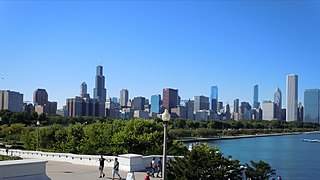
The Great Lakes megalopolis consists of a bi-national group of metropolitan areas in North America largely in the Great Lakes region. It extends from the Midwestern United States in the south and west to western Pennsylvania and Western New York in the east and northward through Southern Ontario into southwestern Quebec in Canada. It is the most populated and largest megalopolis in North America.

Due to its unique geography, being made of two peninsulas surrounded by the Great Lakes, Michigan has depended on many ferries for connections to transport people, vehicles and trade. The most famous modern ferries are those which carry people and goods across the Straits of Mackinac to the car-free Mackinac Island but before the Mackinac Bridge was built, large numbers of ferries carried people and cars between the two peninsulas. Other ferries continue to provide transportation to small islands and across the Detroit River to Canada. Ferries once provided transport to island parks for city dwellers. The state's only national park, Isle Royale cannot be reached by road and is normally accessed by ferry. The largest ferries in Michigan are the car ferries which cross Lake Michigan to Wisconsin. One of these, the SS Badger is one of the last remaining coal steamers on the Great Lakes and serves as a section of US Highway 10 (US 10). The Badger is also the largest ferry in Michigan, capable of carrying 600 passengers and 180 autos.

The SS Pere Marquette was the world's first steel train ferry. It sailed on Lake Michigan and provided a service between the ports of Ludington, Michigan, and Manitowoc, Wisconsin, for the Pere Marquette Railway from 1897 to 1930. The railway used the name Pere Marquette for many of its ships and ferries, adding a number to the end of the name.
This page is based on this
Wikipedia article Text is available under the
CC BY-SA 4.0 license; additional terms may apply.
Images, videos and audio are available under their respective licenses.
