Related Research Articles
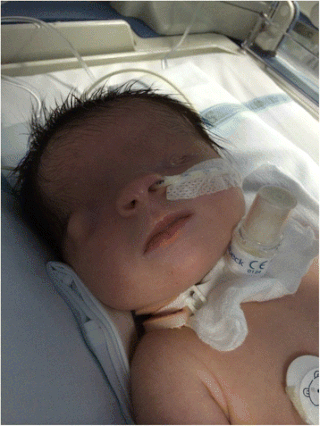
Fraser syndrome is an autosomal recessive congenital disorder, identified by several developmental anomalies. Fraser syndrome is named for the geneticist George R. Fraser, who first described the syndrome in 1962.
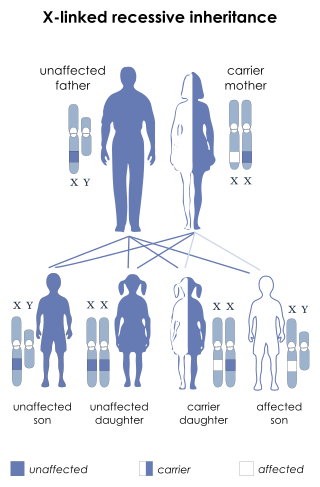
Simpson–Golabi–Behmel syndrome (SGBS), is a rare inherited congenital disorder that can cause craniofacial, skeletal, vascular, cardiac, and renal abnormalities. There is a high prevalence of cancer associated in those with sgbs which includes wilms tumors, neuroblastoma, tumors of the adrenal gland, liver, lungs and abdominal organs. The syndrome is inherited in an X-linked recessive manner. Females that possess one copy of the mutation are considered to be carriers of the syndrome but may still express varying degrees of the phenotype, suffering mild to severe malady. Males experience a higher likelihood of fetal death.

Pentalogy of Cantrell is a rare congenital syndrome that causes defects involving the diaphragm, abdominal wall, pericardium, heart and lower sternum.

22q13 deletion syndrome, also known as Phelan–McDermid syndrome (PMS), is a genetic disorder caused by deletions or rearrangements on the q terminal end of chromosome 22. Any abnormal genetic variation in the q13 region that presents with significant manifestations (phenotype) typical of a terminal deletion may be diagnosed as 22q13 deletion syndrome. There is disagreement among researchers as to the exact definition of 22q13 deletion syndrome. The Developmental Synaptopathies Consortium defines PMS as being caused by SHANK3 mutations, a definition that appears to exclude terminal deletions. The requirement to include SHANK3 in the definition is supported by many but not by those who first described 22q13 deletion syndrome.

Axenfeld–Rieger syndrome is a rare autosomal dominant disorder, which affects the development of the teeth, eyes, and abdominal region.

Arterial tortuosity syndrome is an extremely rare congenital connective tissue condition disorder characterized by tortuosity, elongation, stenosis, or aneurysms in major and medium-size arteries including the aorta. It is associated with hyperextensible skin and hypermobility of joints, however symptoms vary depending on the person. Because ATS is so rare, relatively little is known about the disease compared to more common diseases.
Schinzel–Giedion syndrome (SGS) is a congenital neurodegenerative terminal syndrome. It was first described in 1978 by Albert Schinzel (1944–) and Andreas Giedion (1925–) as a syndrome with severe midface retraction, skull anomalies, renal anomalies (hydronephrosis) and other anomalies. Babies born with Schinzel–Giedion syndrome have severe mental retardation, growth retardation and global developmental delay.

Lujan–Fryns syndrome (LFS) is an X-linked genetic disorder that causes mild to moderate intellectual disability and features described as Marfanoid habitus, referring to a group of physical characteristics similar to those found in Marfan syndrome. These features include a tall, thin stature and long, slender limbs. LFS is also associated with psychopathology and behavioral abnormalities, and it exhibits a number of malformations affecting the brain and heart. The disorder is inherited in an X-linked dominant manner, and is attributed to a missense mutation in the MED12 gene. There is currently no treatment or therapy for the underlying MED12 malfunction, and the exact cause of the disorder remains unclear.

Fryns syndrome is an autosomal recessive multiple congenital anomaly syndrome that is usually lethal in the neonatal period. Fryns (1987) reviewed the syndrome.
Malpuech facial clefting syndrome, also called Malpuech syndrome or Gypsy type facial clefting syndrome, is a rare congenital syndrome. It is characterized by facial clefting, a caudal appendage, growth deficiency, intellectual and developmental disability, and abnormalities of the renal system (kidneys) and the male genitalia. Abnormalities of the heart, and other skeletal malformations may also be present. The syndrome was initially described by Georges Malpuech and associates in 1983. It is thought to be genetically related to Juberg-Hayward syndrome. Malpuech syndrome has also been considered as part of a spectrum of congenital genetic disorders associated with similar facial, urogenital and skeletal anomalies. Termed "3MC syndrome", this proposed spectrum includes Malpuech, Michels and Mingarelli-Carnevale (OSA) syndromes. Mutations in the COLLEC11 and MASP1 genes are believed to be a cause of these syndromes. The incidence of Malpuech syndrome is unknown. The pattern of inheritance is autosomal recessive, which means a defective (mutated) gene associated with the syndrome is located on an autosome, and the syndrome occurs when two copies of this defective gene are inherited.

STAR syndrome is an extremely rare X-linked dominant syndrome that is caused by single FAM58A gene point mutations or deletions of FAM58A and its flanking genes.

Strømme syndrome is a very rare autosomal recessive genetic condition characterised by intestinal atresia, eye abnormalities and microcephaly. The intestinal atresia is of the "apple-peel" type, in which the remaining intestine is twisted around its main artery. The front third of the eye is typically underdeveloped, and there is usually moderate developmental delay. Less common features include an atrial septal defect, increased muscle tone or skeletal abnormalities. Physical features may include short stature, large, low-set ears, a small jaw, a large mouth, epicanthic folds, or fine, sparse hair.
XK aprosencephaly is an extremely rare congenital disorder characterized by the absence of the embryonic forebrain. Because the prosencephalon gives way to the cerebral cortex, survival with aprosencephaly is not possible outside utero. The external symptoms are similar to holoprosencephaly, a related disorder, including a smaller than normal head (microcephaly), small eyeballs (microphthalmia), a small mouth (microstomia), anal atresia, and abnormalities of the external genitalia, radius, nostrils, and pharynx (throat).
Filippi syndrome, also known as Syndactyly Type I with Microcephaly and Mental Retardation, is a very rare autosomal recessive genetic disease. Only a very limited number of cases have been reported to date. Filippi Syndrome is associated with diverse symptoms of varying severity across affected individuals, for example malformation of digits, craniofacial abnormalities, intellectual disability, and growth retardation. The diagnosis of Filippi Syndrome can be done through clinical observation, radiography, and genetic testing. Filippi Syndrome cannot be cured directly as of 2022, hence the main focus of treatments is on tackling the symptoms observed on affected individuals. It was first reported in 1985.
Ectrodactyly with tibia aplasia/hypoplasia also known as cleft hand absent tibia is a very rare limb malformation syndrome which is characterized by ectrodactyly, and aplasia/hypoplasia of the tibia bone. Additional findings include cup-shaped ears, pre-postaxial polydactyly, and hypoplasia of the big toes, femur, patella, and ulnae bone. It is inherited as an autosomal dominant trait with reduced penetrance.
IVIC syndrome, also known as Instituto Venezolano de Investigaciónes Científicas syndrome or oculo-oto-radial syndrome is a very rare autosomal dominant limb malformation genetic disorder that is characterized by upper limb and ocular abnormalities and congenital hearing loss on both ears.
Autosomal dominant intellectual disability-craniofacial anomalies-cardiac defects syndrome is a rare genetic disorder which is characterized by multi-systemic symptoms primarily affecting the intellect and post-natal development.
CAPOS syndrome is a rare genetic neurological disorder which is characterized by abnormalities of the feet, eyes and brain which affect their normal function. These symptoms occur episodically when a fever-related infection is present within the body. The name is an acronym for "cerebellar ataxia, areflexia, pes cavus, optic atrophy, and sensorineural hearing loss".
Splenogonadal fusion-limb defects-micrognathia syndrome, also known by its abbreviation, SGFLD syndrome, is a rare genetic disorder characterized by abnormal fusion of the spleen and the gonad alongside limb defects and orofacial anomalies. It is a type of syndromic dysostosis.
Porencephaly-cerebellar hypoplasia-internal malformations syndrome is a rare autosomal recessive syndrome that mainly affects the central nervous system. It causes cardiac defects, brain anomalies, and craniofacial dysmorphisms. It has been reported in a pair of German siblings of the opposite sex born to consanguineous Turkish parents.
References
- ↑ "Meacham Winn Culler syndrome - About the Disease - Genetic and Rare Diseases Information Center". rarediseases.info.nih.gov. Archived from the original on 2023-01-04. Retrieved 2022-06-29.
- ↑ "OMIM Clinical Synopsis - #608978 - Meacham Syndrome". omim.org. Retrieved 2022-06-29.
- ↑ "Orphanet: Meacham syndrome". www.orpha.net. Retrieved 2022-06-29.
- ↑ "Meacham Syndrome". www.mendelian.co. 2022-06-29. Retrieved 2022-06-29.
- ↑ Suri, Mohnish; Kelehan, Peter; O'neill, David; Vadeyar, Shantala; Grant, Judith; Ahmed, S. Faisal; Tolmie, John; McCann, Emma; Lam, Wayne; Smith, Shirley; Fitzpatrick, David (2007-10-01). "WT1 mutations in Meacham syndrome suggest a coelomic mesothelial origin of the cardiac and diaphragmatic malformations". American Journal of Medical Genetics. Part A. 143A (19): 2312–2320. doi:10.1002/ajmg.a.31924. ISSN 1552-4825. PMID 17853480. S2CID 20548643.
- ↑ "OMIM Entry - # 608978 - Meacham Syndrome". www.omim.org. Retrieved 2022-06-29.
- ↑ Meacham, L. R.; Winn, K. J.; Culler, F. L.; Parks, J. S. (1991-12-15). "Double vagina, cardiac, pulmonary, and other genital malformations with 46,XY karyotype". American Journal of Medical Genetics. 41 (4): 478–481. doi:10.1002/ajmg.1320410420. ISSN 0148-7299. PMID 1844355.
- ↑ "OMIM Entry - # 608978 - Meacham Syndrome". www.omim.org. Retrieved 2022-06-29.
- ↑ Killeen, Orla G.; Kelehan, Peter; Reardon, William (2002-01-01). "Double vagina with sex reversal, congenital diaphragmatic hernia, pulmonary and cardiac malformations--another case of Meacham syndrome". Clinical Dysmorphology. 11 (1): 25–28. doi:10.1097/00019605-200201000-00005. ISSN 0962-8827. PMID 11822701.
- ↑ Suri, Mohnish; Kelehan, Peter; O'neill, David; Vadeyar, Shantala; Grant, Judith; Ahmed, S. Faisal; Tolmie, John; McCann, Emma; Lam, Wayne; Smith, Shirley; Fitzpatrick, David (2007-10-01). "WT1 mutations in Meacham syndrome suggest a coelomic mesothelial origin of the cardiac and diaphragmatic malformations". American Journal of Medical Genetics. Part A. 143A (19): 2312–2320. doi:10.1002/ajmg.a.31924. ISSN 1552-4825. PMID 17853480. S2CID 20548643.