
Erik Acharius was a Swedish botanist who pioneered the taxonomy of lichens and is known as the "father of lichenology." Acharius was famously the last pupil of Carl Linnaeus.

Parmelia is a genus of medium to large foliose lichens. It has a global distribution, extending from the Arctic to the Antarctic continent but concentrated in temperate regions. There are about 40 species in Parmelia. In recent decades, the once large genus Parmelia has been divided into a number of smaller genera according to thallus morphology and phylogenetic relatedness.

The Parmeliaceae is a large and diverse family of Lecanoromycetes. With over 2700 species in 71 genera, it is the largest family of lichen-forming fungi. The most speciose genera in the family are the well-known groups: Xanthoparmelia, Usnea, Parmotrema, and Hypotrachyna.
Everniopsis is a fungal genus in the family Parmeliaceae. It consists of a single species, the bark-dwelling lichen Everniopsis trulla, which occurs in Africa and South America.
Menegazzia albida is a species of foliose lichen from South America. It was originally described as Parmelia cincinnata var. albida by Austrian botanist Alexander Zahlbruckner in 1917.
Menegazzia foraminulosa is a species of corticolous (bark-dwelling), foliose lichen that is endemic to New Zealand. The lichen was first formally described as a new species in 1876 by August von Krempelhuber. Friedrich Bitter transferred it to the genus Menegazzia in 1901. The species contains several lichen products, including depsides, depsidones, as well as fatty acids and pigments.
Menegazzia hollermayeri is a species of foliose lichen found in southern South America. It was first formally described as a new species in 1937 by Finnish lichenologist Veli Räsänen, who included it in genus Parmelia. The type specimen was collected from Chile by R. P. Atanasio Hollermayer, after whom the lichen is named. Rolf Santesson transferred the taxon to Menegazzia in 1942.
Menegazzia inflata is a species of foliose lichen found in New Zealand. Originally described as a species of Parmelia in 1940, it was transferred to the genus Menegazzia in 1983.

Menegazzia nothofagi is a species of lichen from New Zealand and Australia. It was originally named as a species of Parmelia by Austrian botanist Alexander Zahlbruckner in 1940.
Menegazzia opuntioides is a species of foliose lichen from southern South America. It was first formally described as a new species in 1889 by Swiss botanist Johannes Müller Argoviensis, as a species of Parmelia. The type specimen was collected in the Strait of Magellan in southern Chile. Rolf Santesson transferred the taxon to the genus Menegazzia in 1942. Menegazzia opuntioides has also been recorded from Argentina.
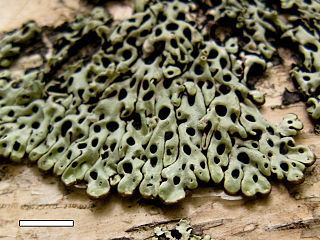
Menegazzia pertransita is a species of foliose lichen in the large lichen family Parmeliaceae. It is found in New Zealand, Australia, and South America. The lichen was first formally described by Scottish physician and bryologist James Stirton in 1877 as Parmelia pertransita. Swedish lichenologist Rolf Santesson transferred it to the genus Menegazzia in 1942.
Menegazzia stirtonii is a species of foliose lichen found in New Zealand, and Tasmania, Australia.
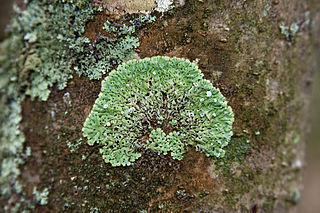
Menegazzia subsimilis is a species of lichen in the family Parmeliaceae It is found scattered across the world, including Oceania, Asia, Europe, South America, the Caribbean and North America. It has recently been recorded for the first times in Tibet (2005), in the British Isles, and in Malaysia and Indonesia (2007).
Menegazzia valdiviensis is a species of lichen found in South America. It was first described in 1932 as Parmelia valdiviensis by Finnish lichenologist Veli Räsänen. Rolf Santesson transferred it to the genus Menegazzia in 1942.
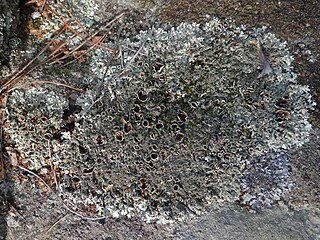
Xanthoparmelia conspersa, commonly known as the peppered rock-shield, is a foliose lichen and the type species of genus Xanthoparmelia. It is widely distributed in temperate zones, and has been recorded from Japan, Europe, Africa, North America, and South America.

Parmelia saxatilis, commonly known as the salted shield lichen or crottle, is a species of foliose lichen in the family Parmeliaceae. Several morphologically similar species, formerly lumped together, are now distinguished by their DNA.

Lecanora argopholis is a species of crustose lichen in the family Lecanoraceae. It was originally named Parmelia atra var. argopholis by Erik Acharius in 1803, then transferred by him to the genus Lecanora in 1810. The lichen has a circumpolar distribution.
Punctelia ulophylla is a species of foliose lichen in the family Parmeliaceae. It is found in Europe, where it grows on the bark of a variety of trees.

Parmelia omphalodes is a species of foliose lichen in the family Parmeliaceae. It is one of the several dozen lichen species first described in 1753 by Carl Linnaeus. Swedish lichenologist Erik Acharius transferred it to the genus Parmelia in 1803. The lichen is widely distributed, having been recorded in Asia, Africa, Europe, and North and South Americas. Morphologically similar–but genetically distinct–species include Parmelia discordans and P. pinnatifida.

