
A camera lucida is an optical device used as a drawing aid by artists and microscopists.

Lucida is an extended family of related typefaces designed by Charles Bigelow and Kris Holmes and released from 1984 onwards. The family is intended to be extremely legible when printed at small size or displayed on a low-resolution display – hence the name, from 'lucid'.

Lucida Grande is a humanist sans-serif typeface. It is a member of the Lucida family of typefaces designed by Charles Bigelow and Kris Holmes. It is best known for its implementation throughout the macOS user interface from 1999 to 2014, as well as in other Apple software like Safari for Windows. As of OS X Yosemite, the system font was changed from Lucida Grande to Helvetica Neue. In OS X El Capitan the system font changed again, this time to San Francisco.

Kris Holmes is an American typeface designer, calligrapher, type design educator and animator. She, with Charles Bigelow, is the co-creator of the Lucida font family, among many other typeface designs. She is President of Bigelow & Holmes Inc., a typeface design studio.
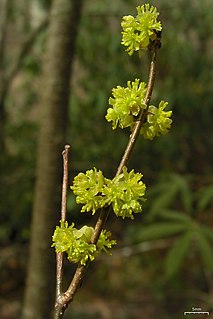
Lindera benzoin is a shrub in the laurel family, native to eastern North America, ranging from Maine and New York to Ontario in the north, and to Kansas, Texas, and northern Florida in the center and south. Within its native range it is a relatively common plant where it grows in the understory in moist, rich woods, especially those with exposed limestone.

Lindera is a genus of about 80–100 species of flowering plants in the family Lauraceae, mostly native to eastern Asia but with three species in eastern North America. The species are shrubs and small trees; common names include spicewood, spicebush, and Benjamin bush.

Tagetes lucida is a perennial plant native to Mexico and Central America. It is used as a medicinal plant and as a culinary herb. The leaves have a tarragon-like scent, with hints of anise, and it has entered the nursery trade in North America as a tarragon substitute. Common names include sweetscented marigold, Mexican marigold, Mexican mint marigold, Mexican tarragon, sweet mace, Texas tarragon, pericón, yerbaniz, and hierbanís.
Malaccensis may refer to:

Dihydrochalcone (DHC) is the organic compound with the formula C6H5C(O)(CH2)2C6H5. It is the reduced derivative of chalcone (C6H5C(O)(CH)2C6H5). It is white solid that is soluble in many organic solvents. Dihydrochalcone per se is often minor significance, but some derivatives occur in nature and have attracted attention as drugs.

Lindera aggregata is a plant species belonging to the genus Lindera.

Boldine is an alkaloid of the aporphine class that can be found in the boldo tree and in Lindera aggregata.

Reticuline is a chemical compound found in a variety of plants including Lindera aggregata, Annona squamosa, and Ocotea fasciculata. It is based on the benzylisoquinoline structure.

Acontia lucida, the pale shoulder, is a moth of the family Noctuidae. The species was first described by Johann Siegfried Hufnagel in 1766.
Lindera lucida is a species of flowering plant in the family Lauraceae. It is found in Malaysia.
L. malaccensis may refer to:

Dihydrokanakugiol is a dihydrochalcone isolated from Lindera lucida.

Alnetin is a flavone isolated from Lindera lucida.

Linderone is a bio-active isolate of Lindera lucida.

Dicentrine is an aporphinic alkaloid found in several plant species, mainly from family Lauraceae, including Lindera megaphylla. At high doses, dicentrine shows antinociceptive activity in a mouse model of pain. It probably acts via a TRPA1-dependent mechanism.

Lindera subcoriacea, the bog spicebush, is a plant species native to the southeastern United States from Louisiana to Virginia. It is a shrub that can reach up to 4 m in height. Leaves are broadly elliptic, up to 8 cm long, and faintly aromatic when young. Flowers are yellow. Fruits are ellipsoid, deep red, about 10 mm long. It grows in acidic freshwater swamp forests in the Coastal Plain and Piedmont regions. In the northern portion of its range in the Carolinas and Virginia, L. subcoriacea is found only in the specialized stream pocosin habitat, while in the southern portion from Georgia onwards, it is found only in the wettest portions of the sphagnum bog habitat. As it is specialized and restricted to both of these very rare and unique ecosystems, L. subcoriacea is endangered due to habitat destruction and fire suppression. Only around 100 sites are known across this species' range to still sustain it, and most of these have only 1-5 genetically distinct individuals.


