Related Research Articles

Otto Wichterle was a Czech chemist, best known for his invention of modern soft contact lenses.

Hideki Shirakawa is a Japanese chemist, engineer, and Professor Emeritus at the University of Tsukuba and Zhejiang University. He is best known for his discovery of conductive polymers. He was co-recipient of the 2000 Nobel Prize in Chemistry jointly with Alan MacDiarmid and Alan Heeger.

The University of Tabriz is a public university located in Tabriz, East Azerbaijan, with the fundamental aim of creating a center of excellence in higher education and research. It is one of the top five high-ranked universities in Iran and one of the ten most selective universities in the country. The University of Tabriz is the second-oldest university in Iran after the University of Tehran, and has the second largest campus area in the country which is the biggest academic institution in northwest of the country. The university is also a member of the Caucasus University Association.
Jean M.J. Fréchet is a French-American chemist and professor emeritus at the University of California, Berkeley. He is best known for his work on polymers including polymer-supported chemistry, chemically amplified photoresists, dendrimers, macroporous separation media, and polymers for therapeutics. Ranked among the top 10 chemists in 2021, he has authored nearly 900 scientific paper and 200 patents including 96 US patents. His research areas include organic synthesis and polymer chemistry applied to nanoscience and nanotechnology with emphasis on the design, fundamental understanding, synthesis, and applications of functional macromolecules.
The Willard Gibbs Award, presented by the Chicago Section of the American Chemical Society, was established in 1910 by William A. Converse (1862–1940), a former Chairman and Secretary of the Chicago Section of the society and named for Professor Josiah Willard Gibbs (1839–1903) of Yale University. Gibbs, whose formulation of the Phase Rule founded a new science, is considered by many to be the only American-born scientist whose discoveries are as fundamental in nature as those of Newton and Galileo.
Carl Shipp "Speed" Marvel was an American chemist who specialized in polymer chemistry. He made important contributions to U.S. synthetic rubber program during World War II, and later worked at developing polybenzimidazoles, temperature-resistant polymers that are used in the aerospace industry, in fire-fighting equipment, and as a replacement for asbestos. He has been described as "one of the world's outstanding organic chemists" and received numerous awards, including the 1956 Priestley Medal and the 1986 National Medal of Science, presented by President Ronald Reagan.

Mohammad-Nabi Sarbolouki was a distinguished Iranian biophysicist and polymer chemist and one of the most influential individuals behind modern scientific movement in Iran. He was known as the inventor of a DNA vehicle called "dendrosome". Sarbolouki was one of the main founders and pioneers of nano science, biomaterials, biotechnology and biophysics in Iran.

Egbert (Bert) Willem Meijer is a Dutch organic chemist, known for his work in the fields of supramolecular chemistry, materials chemistry and polymer chemistry. Meijer, who is distinguished professor of Molecular Sciences at Eindhoven University of Technology (TU/e) and Academy Professor of the Royal Netherlands Academy of Arts and Sciences, is considered one of the founders of the field of supramolecular polymer chemistry. Meijer is a prolific author, sought-after academic lecturer and recipient of multiple awards in the fields of organic and polymer chemistry.
Thanun Pyriadi is an Kurdish chemist.

Andrew Bruce Holmes is an Australian and British senior research chemist and professor at the Bio21 Institute, Melbourne, Australia, and the past President of the Australian Academy of Science. His research interests lie in the synthesis of biologically-active natural products and optoelectronic polymers.
Martina Heide Stenzel is a Professor in the Department of Chemistry at the University of New South Wales (UNSW). She is also a Royal Australian Chemical Institute (RACI) University Ambassador. She became editor for the Australian Journal of Chemistry in 2008 and has served as Scientific Editor and as of 2021, as Editorial Board Chair of RSC Materials Horizons.
Karen L. Wooley is an American polymer chemist. She is a Distinguished Professor at Texas A&M University whose research focuses on developing novel polymers and nanostructured materials.

Subramaniam Ramakrishnan is an Indian polymer chemist, a professor at the Department of Inorganic and Physical Chemistry http://ipc.iisc.ac.in/~rk/and the designer at Macromolecular Design and Synthesis Group of Indian Institute of Science. He is known for his studies on design and synthesis of controlled polymer structures and is an elected fellow of the Indian Academy of Sciences The Council of Scientific and Industrial Research, the apex agency of the Government of India for scientific research, awarded him the Shanti Swarup Bhatnagar Prize for Science and Technology, one of the highest Indian science awards, in 2005, for his contributions to chemical sciences.

Rajendra Rathore was an organic chemist and professor at Marquette University in Milwaukee, Wisconsin as Pfletschinger-Habermann professor of organic chemistry. He made important contributions in the area of supramolecular chemistry, synthesis of novel electro-active molecules, and drug discovery. Rathore died on February 16, 2018, after complications from chronic pulmonary sarcoidosis.
Eilaf Egap is an assistant professor of Materials Science at Rice University. She works on imaging techniques and biomaterials for early diagnostics and drug delivery. She was a Massachusetts Institute of Technology MLK Visiting Scholar in 2011.

Klaus Müllen is a German chemist working in the fields of polymer chemistry, supramolecular chemistry and nanotechnology. He is known for the synthesis and exploration of the properties of graphene-like nanostructures and their potential applications in organic electronics.
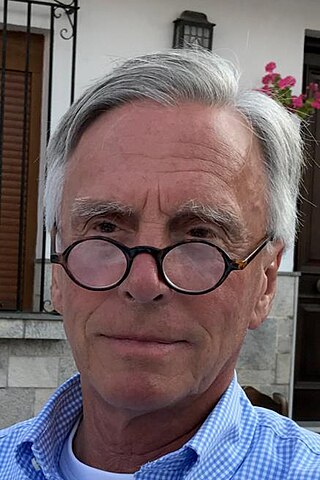
Roeland J. M. Nolte is a Dutch chemist, known for his work in the fields of organic chemistry, biochemistry, polymer chemistry, and supramolecular chemistry. He is an emeritus Royal Netherlands of Arts and Sciences professor and an emeritus professor of Organic Chemistry at Radboud University in Nijmegen, The Netherlands. Currently, he holds a special chair, i.e. professor of Molecular Nanotechnology, at this university. Nolte is considered to be one of the pioneers of the field of supramolecular chemistry, which encompasses the design and synthesis of new chemical structures from low molecular weight compounds and biopolymers using so-called non-covalent interactions. He published many studies on supramolecular assembly and biomimetic catalysts, which find applications in the field of nanomaterials and medicine.
Hamid Ghandehari is an Iranian-American drug delivery research scientist, and a professor in the Departments of Pharmaceutics and Pharmaceutical Chemistry and Biomedical Engineering at the University of Utah. His research is focused in recombinant polymers for drug and gene delivery, nanotoxicology of dendritic and inorganic constructs, water-soluble polymers for targeted delivery and poly(amidoamine) dendrimers for oral delivery.
Christopher William Bielawski is a distinguished professor at Ulsan National Institute of Science and Technology and group leader of the Synthesis Group in the Center for Multidimensional Carbon Materials. His research in synthesis and polymer chemistry has resulted in more than 290 publications and multiple patents.
Vitaliy Khutoryanskiy FRSC is a British and Kazakhstani scientist, a Professor of Formulation Science and a Royal Society Industry Fellow at the University of Reading. His research focuses on polymers, biomaterials, nanomaterials, drug delivery, and pharmaceutical sciences. Khutoryanskiy has published over 200 original research articles, book chapters, and reviews. His publications have attracted > 10000 citations and his current h-index is 49:. He received several prestigious awards in recognition for his research in polymers, colloids and drug delivery as well as for contributions to research peer-review and mentoring of early career researchers. He holds several honorary professorship titles from different universities.
References
- ↑ "Mohsen Adeli". orcid.org.
- ↑ "The name of Mohsen Adeli was included in the list of Iranian scientific leaders". Mojnews (in Persian).
- ↑ "عضو هیات علمی دانشگاه لرستان جزو سرآمدان علمی کشور شد". IRNA (in Persian). 29 December 2019.
- ↑ "Mohsen Adeli". scholar.google.com.
- ↑ "Curriculum vitae". Freie Universität Berlin . 16 January 2018.
- ↑ "Lorestan University- News > Re-election of Dr. Mohsen Adeli as one of the Countrys Leading Professors and Promotion of Lorestan University". en.lu.ac.ir.
| International | |
|---|---|
| National | |
| Academics | |

  | This Iranian academic-related biographical article is a stub. You can help Wikipedia by expanding it. |