Moschelle

Last updated

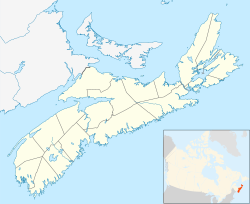
Moschelle is a community in the Canadian province of Nova Scotia, located in Annapolis County. It is on the south shore of the Annapolis River, on Nova Scotia Route 201. [1]

St John's Anglican Church was built c.1884 in brick. It is a municipally registered heritage building. [2]

Coordinates: 44°45′11.94″N65°27′55.69″W / 44.7533167°N 65.4654694°W / 44.7533167; -65.4654694 (Moschelle, Nova Scotia)

Related Research Articles

Port Royal is a toponym for a rural intersection on the north bank of the Annapolis Basin about 8 km (5.0 mi) from the town of Annapolis Royal in Annapolis County, Nova Scotia, Canada. It has no legal status in local government. It is the site of the Port-Royal National Historic Site, a replica of an Acadian settlement that existed from 1605 until its destruction by the English in 1613.

<span class="mw-page-title-main">Fort Anne</span>

Fort Anne is a four-bastion fort built to protect the harbour of Annapolis Royal, Nova Scotia. The fort repelled all French attacks during the early stages of King George's War.

Granville Centre is a rural Canadian community located in Annapolis County on the north shore of the Annapolis River in western Nova Scotia. The community is named after John Carteret, 2nd Earl Granville.

Bridgetown is a Canadian community located in north-central Annapolis County, Nova Scotia.

<span class="mw-page-title-main">Diocese of Nova Scotia and Prince Edward Island</span> Diocese of the Anglican Church in Canada

The Diocese of Nova Scotia and Prince Edward Island is a diocese of the Ecclesiastical Province of Canada of the Anglican Church of Canada. It encompasses the provinces of Nova Scotia and Prince Edward Island and has two cathedrals: All Saints' in Halifax and St. Peter's in Charlottetown. Its de facto see city is Halifax, and its roughly 24 400 Anglicans distributed in 239 congregations are served by approximately 153 clergy and 330 lay readers according to the last available data. According to the 2001 census, 120,315 Nova Scotians identified themselves as Anglicans, while 6525 Prince Edward Islanders did the same.

Mount Hanley is a Canadian rural community in Annapolis County, Nova Scotia. It is the birthplace of the mariner Joshua Slocum and of Clara Belle Marshall, the first woman to graduate from Acadia University in 1879.

Garrison Cemetery is a cemetery located on the grounds of Fort Anne in Annapolis Royal, Nova Scotia. It is located next to the old Court House, at the intersection of George St. and Nova Scotia Trunk 1.

<span class="mw-page-title-main">St. John's Anglican Church (Peggys Cove, Nova Scotia)</span> Building in Nova Scotia, Canada

St. John's Anglican Church is a historic Carpenter Gothic style Anglican church building located at 8 Church Road in Peggys Cove, Nova Scotia, Canada. Built in 1893–94 of wood, St. John's is the only church in Peggys Cove. Its steep pitched roof, board and batten siding and lancet windows are typical of Carpenter Gothic churches. The church contains two murals painted in 1963 by noted Canadian artist and local resident William E. deGarthe.

Carleton Corner is a community in the Canadian province of Nova Scotia, located in Annapolis County adjacent to Bridgetown. It is a designated place with a population of 99 in 2021. It is on Nova Scotia Route 201.

Upper Clements is a community in the Canadian province of Nova Scotia, located in Annapolis County. It is on Nova Scotia Trunk 1 on the eastern side of the Annapolis Basin. The town is the site of Upper Clements Park and Upper Clements Provincial Park.

<span class="mw-page-title-main">Granville Ferry</span>

Granville Ferry is a village in the Canadian province of Nova Scotia, located in Annapolis County. Granville Ferry is located directly across the Annapolis River from Annapolis Royal, Nova Scotia. It was the northern terminus for ferries running across the river. Granville Ferry was a major shipbuilding centre in the Golden Age of Sail. The village was also home to Bessie Hall, a notable female mariner in the 19th century. The community is named after John Carteret, 2nd Earl Granville. Its population at the 2021 census was 152, an increase of 38.2% since 2016.

Paradise is an unincorporated community in the Canadian province of Nova Scotia, located about 30 km (18 mi.) northeast of Annapolis Royal in Annapolis County. The original French name, dating to 1684, was Paradis Terrestre, or Earthly Paradise.

Belleisle is a community in the Canadian province of Nova Scotia, located in Annapolis County. It is on Nova Scotia Trunk 1, on the north side of the Annapolis River.

Albany Cross is a community in the Canadian province of Nova Scotia, located in Annapolis County. It is likely named for Albany, New York. Albany Community Church was dedicated in 1875 as a Baptist church and is now a municipally registered heritage building.

Karsdale is a community in the Canadian province of Nova Scotia, located in Annapolis County. It is situated on the west bank of the Annapolis Basin. The community is named after Sir William Williams, 1st Baronet, of Kars.

Port Wade is a community in the Canadian province of Nova Scotia, located in Annapolis County. It is situated at the foot of North Mountain on the shore of the Annapolis Basin. An earlier French name was Pree Bourgeois and it was later known as West Ferry until 1905 when it was named after Fletcher Bath Wade.

West Paradise is a community in the Canadian province of Nova Scotia, located in Annapolis County. It is located in the Annapolis Valley along Nova Scotia Route 201 across the Annapolis River from Paradise.

<span class="mw-page-title-main">Schafner Point Lighthouse</span>

Schafner Point Lighthouse is located in Annapolis County, Nova Scotia, on the north side of the Annapolis Basin facing Goat Island. It was built in 1885. It is known locally as the Port Royal lighthouse. It is a wooden construction with a square plan and tapered sides, supporting a gallery and octagonal iron lantern housing. It is protected by the Heritage Lighthouse Protection Act.

<span class="mw-page-title-main">Township (Nova Scotia)</span> Former division of Nova Scotia

A township in Nova Scotia, Canada, was an early form of land division and local administration during British colonial settlement in the 18th century. They were created as a means of populating the colony with people loyal to British rule. They were typically rural or wilderness areas of around 100,000 acres (400 km2) that would eventually include several villages or towns. Some townships, but not all, returned a member to the General Assembly of Nova Scotia; others were represented by the members from the county. Townships became obsolete by 1879 by which time towns and counties had become incorporated.

References

  1. "Moschelle". Geographical Names Board of Canada . Natural Resources Canada . Retrieved 29 January 2018.
  2. St. John's Anglican Church . Canadian Register of Historic Places . Retrieved 29 January 2018.