The Patuxent Range or macizo Armada Argentina is a major range of the Pensacola Mountains, comprising the Thomas Hills, Anderson Hills, Mackin Table and various nunataks and ridges bounded by the Foundation Ice Stream, Academy Glacier and the Patuxent Ice Stream. Discovered and partially photographed on January 13, 1956 in the course of a transcontinental nonstop plane flight by personnel of U.S. Navy Operation Deep Freeze I from McMurdo Sound to Weddell Sea and return.
Athos Range is the northernmost range in the Prince Charles Mountains of Mac. Robertson Land, Antarctica. The range consists of a large number of individual mountains and nunataks that trend east-west for 40 miles (60 km) along the north side of Scylla Glacier.

Gildea Glacier is a glacier 10 kilometres (6 mi) long and 5 kilometres (3 mi) wide flowing southwestward from Craddock Massif between Mount Slaughter and Mount Atkinson into Nimitz Glacier, in the Sentinel Range of the Ellsworth Mountains, Antarctica. The upper portion of the glacier also receives ice from Hammer Col and southern Vinson Massif.
Amos Glacier is a 3-nautical-mile (6 km) long glacier that flows southeast from Bettle Peak to a juncture with the Blue Glacier, in Victoria Land, Antarctica. It was named in 1992 by the Advisory Committee on Antarctic Names after Larry Leon Amos, a civil engineer with the United States Geological Survey (USGS), and a member of the USGS two man astronomic surveying team to South Pole Station and Byrd Station in the 1969–70 field season. Among other work, the team established the position of the Geographic South Pole and established a tie to the Byrd Ice Strain net which had been under study for several years.

Bagshawe Glacier is a glacier which drains the northeast slopes of Mount Theodore and discharges into Lester Cove, Andvord Bay west of Mount Tsotsorkov, on the west coast of Graham Land, Antarctica.
Balch Glacier is a glacier 9 nautical miles (17 km) long, on the east coast of Graham Land, flowing southeast into Mill Inlet, to the south of Gould Glacier.
Mount Baume is a mountain, 1,910 metres (6,270 ft) high, rising midway along the north flank of Novosilski Glacier near the southeast end of South Georgia. It was surveyed by the South Georgia Survey (SGS) in the period 1951–57 and named for Louis C. Baume, a member of the SGS in 1955–56.
Bradford Glacier is a glacier flowing north from Mount Dewey into Comrie Glacier, on the west coast of Graham Land. It was mapped by the Falkland Islands Dependencies Survey from photos taken by Hunting Aerosurveys Ltd in 1956–57, and named by the UK Antarctic Place-Names Committee for Samuel C. Bradford (1878–1948), English documentalist who was a pioneer advocate of scientific information services.
Bucher Glacier is a small glacier draining the west slopes of Rudozem Heights and flowing to Bourgeois Fjord just north of Bottrill Head on the German Peninsula, Fallières Coast on the west side of Graham Land, Antarctica. It was named by the UK Antarctic Place-Names Committee in 1958 for Edwin Bucher, Swiss glaciologist and author of many publications on snow and avalanches.
Mount Wallace is one of the Tapley Mountains, 1,490 m, standing at the south side of the mouth of Roe Glacier at the juncture with Scott Glacier, in the Queen Maud Mountains. Mapped by United States Geological Survey (USGS) from surveys and U.S. Navy air photos, 1960-64. Named by Advisory Committee on Antarctic Names (US-ACAN) for J. Allen Wallace, Jr., meteorologist, South Pole Station winter party, 1960.
Mount Sweatt is a mountain, 2,540 m, standing 6.5 nautical miles (12 km) northeast of Mount Soyat on the ridge between Hueneme and Norfolk Glaciers, in the Wisconsin Range. Mapped by United States Geological Survey (USGS) from surveys and U.S. Navy air photos, 1960-64. Named by Advisory Committee on Antarctic Names (US-ACAN) for Earl E. Sweatt whom passed at the age of 78, construction electrician, Byrd Station winter party, 1961.
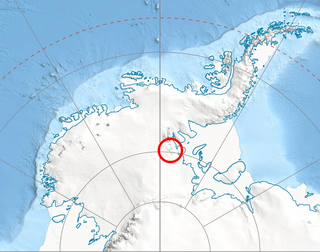
Gowan Glacier is a glacier about 15 nautical miles long in the Heritage Range of the Ellsworth Mountains of Antarctica, flowing north from the vicinity of Cunningham Peak in the Founders Escarpment to enter Minnesota Glacier just east of Welcome Nunatak. It was mapped by the United States Geological Survey from surveys and U.S. Navy air photos, 1961–66, and was named by the Advisory Committee on Antarctic Names for Lieutenant Jimmy L. Gowan, U.S. Navy Medical Corps, officer in charge and doctor at Plateau Station in 1966.
Pegmatite Peak is a peak along the west side of Koerwitz Glacier, about midway between the main summits of Medina Peaks and Mount Salisbury, in the Queen Maud Mountains. First mapped by United States Geological Survey (USGS) from surveys and U.S. Navy air photos, 1960-64. So named by New Zealand Geological Survey Antarctic Expedition (NZGSAE), 1969–70, because of the occurrence of large, whitish pegmatite dykes in a rock wall at the southeast spur of the peak.
Forman Glacier is a tributary glacier, 4 nautical miles (7 km) long, flowing east to enter Shackleton Glacier between Mount Franke and Mount Cole, in the Queen Maud Mountains of Antarctica. It was named by the Advisory Committee on Antarctic Names after John H. Forman, Construction Mechanic, U.S. Navy, a member of the McMurdo Station winter party, 1959.
Friederichsen Glacier is a glacier 7 nautical miles (13 km) long, which flows in an easterly direction into Cabinet Inlet, close north of Mount Hulth, on the east coast of Graham Land, Antarctica. It was charted by the Falkland Islands Dependencies Survey (FIDS) and photographed from the air by the Ronne Antarctic Research Expedition in 1947. It was named by the FIDS for Ludwig Friederichsen, a German cartographer who in 1895 published a chart based upon all existing explorations of the Antarctic Peninsula and the South Shetland Islands.
Gould Glacier is a glacier, 12 miles (19 km) long, on the east coast of Graham Land, Antarctica, flowing south-east into Mill Inlet, to the west of Aagaard Glacier. It was first surveyed by the Falklands Islands Dependencies Survey in 1946–47, and named "East Gould Glacier". Together with "West Gould Glacier" it was reported to fill a transverse depression across Graham Land, but further survey in 1957 showed that there is no close topographical alignment between the two. The name Gould Glacier, after Rupert T. Gould, a British polar historian and cartographer, is now only applied to this glacier, and the west glacier is now called Erskine Glacier.
Miethe Glacier is a glacier 3 nautical miles (6 km) long, flowing northwest into Gerlache Strait to the south of Mount Banck, on the west coast of Graham Land, Antarctica. The glacier appears on an Argentine government chart of 1952. It was named by the UK Antarctic Place-Names Committee in 1960 for Adolf Miethe, a German chemist who introduced the first panchromatic emulsion for photographic plates in 1903.

Mitterling Glacier is a glacier on the east coast of Graham Land, Antarctica, draining between Mount Vartdal and Mount Hayes into the northern part of Mill Inlet. It was named by the UK Antarctic Place-Names Committee after American historian Philip I. Mitterling, the author of America in the Antarctic to 1840.
Tricouni Brand Ltd is a British luxury fashion house, designing women’s luxury outerwear. Tricouni is a privately held company, headquartered in London, England.