You can help expand this article with text translated from the corresponding article in Belarusian. (February 2024)Click [show] for important translation instructions.
Machine translation, like DeepL or Google Translate, is a useful starting point for translations, but translators must revise errors as necessary and confirm that the translation is accurate, rather than simply copy-pasting machine-translated text into the English Wikipedia.
Do not translate text that appears unreliable or low-quality. If possible, verify the text with references provided in the foreign-language article.
You must provide copyright attribution in the edit summary accompanying your translation by providing an interlanguage link to the source of your translation. A model attribution edit summary is Content in this edit is translated from the existing Belarusian Wikipedia article at [[:be:Мсціслаў]]; see its history for attribution.
You may also add the template {{Translated|be|Мсціслаў}} to the talk page.
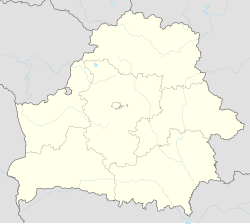
Mstislaw or Mstislavl[a] is a town in Mogilev Region, in eastern Belarus. It serves as the administrative center of Mstsislaw District. In 2009, its population was 10,804.[4] As of 2025, it has a population of 9,959.[1]
Jewish people had a historic presence in the town. In 1939, there were 2,067 Jewish people living in Mstislavl, representing almost 20% of the local population. The German army occupied the town in July 1941. In early October, they killed 30 elderly Jewish residents. On October 15, 1941, together with the local police, they murdered between 850 and 1,300 Jewish residents.[8]
Buildings of historic interest in the town include the Carmelite church (1637, renovated 1746–50) and the Jesuit cathedral (1640, renovated 1730–38, turned into an Orthodox cathedral in 1842).
Oleg Trusov - Belarusian archaeologist, Chairman of the Francysk Skaryna Belarusian Language Society. He holds a PhD in history and has authored several monographs and over 150 scholarly papers on archeology and the history of architecture.
Mikhail Tkachev - Belarusian historian, archaeologist, local history expert, and heraldist. Studied the defensive architecture of the Grand Duchy of Lithuania. He traced the genesis, evolution, and development stages of castles and fortifications in populated areas, as well as the defense organization of Belarusian cities.
Vladilen Kaler - Belarusian scientist specializing in biochemistry. He conducted research on chlorophyll biosynthesis and photosynthesis using mathematical modeling of biochemical and biophysical processes in plants. He is the author of over 160 scientific publications and monographs.
Larisa Zhunina - A scientist specializing in the chemical engineering of silicate and refractory non-metallic materials. She developed new types of glass and glass-ceramics with specialized properties. She has authored over 250 publications and approximately 20 patents.
Izrail Basov - Belarusian painter and graphic artist. He painted lyrical, urban, and industrial landscapes, still lifes, portraits, and thematic paintings. He participated in national, all-Union, foreign, and international exhibitions.
Abraham Anshelovich Manevich - Russian (present-day Belarus), Ukrainian, Jewish, and American modernist artist. He painted in the style of the Munich-Viennese modernist movement. In 1913, a very successful exhibition of Manevich's works was held at a Paris gallery. He was quite well known in the United States.[10]
Gallery
Jesuit Collegium building, from the 17th century
Mstislaw Male Gymnasium, from the beginning of the 19th century
Alexander Nevsky Orthodox Cathedral, built in the 19th century on the foundation of an earlier Catholic Cathedral
Orthodox Church
Ruins of the Church of Saint Michael the Archangel
Church of the Assumption of the Blessed Virgin Mary
This page is based on this Wikipedia article Text is available under the CC BY-SA 4.0 license; additional terms may apply. Images, videos and audio are available under their respective licenses.