
Malayalam is a Dravidian language spoken in the Indian state of Kerala and the union territories of Lakshadweep and Puducherry by the Malayali people. It is one of 22 scheduled languages of India. Malayalam was designated a "Classical Language of India" in 2013. Malayalam has official language status in Kerala, Lakshadweep and Puducherry (Mahé), and is also the primary spoken language of Lakshadweep and is spoken by 35 million people in India. Malayalam is also spoken by linguistic minorities in the neighbouring states; with a significant number of speakers in the Kodagu and Dakshina Kannada districts of Karnataka, and Kanyakumari, Coimbatore and Nilgiris district of Tamil Nadu. It is also spoken by the Malayali Diaspora worldwide, especially in the Persian Gulf countries, due to the large populations of Malayali expatriates there. They are a significant population in each city in India including Mumbai, Bengaluru, Chennai, Delhi, Kolkata, Pune etc. Malayalam is closely related to the Tamil language.

The Kingdom of Travancore, also known as the Kingdom of Thiruvithamkoor or later as Travancore State, was an Indian kingdom that lasted from c. 1729 until 1949. It was ruled by the Travancore Royal Family from Padmanabhapuram, and later Thiruvananthapuram. At its zenith, the kingdom covered most of the south of modern-day Kerala and the southernmost part of modern-day Tamil Nadu with the Thachudaya Kaimal's enclave of Irinjalakuda Koodalmanikyam temple in the neighbouring Kingdom of Cochin. However Tangasseri area of Kollam city and Anchuthengu near Attingal in Thiruvananthapuram were parts of British India.

Kalaripayattu is an Indian martial art that originated in Kerala, a state on the southwestern coast of India during the 11th–12th century CE.
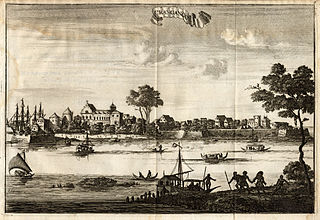
Kodungallur is a historically significant town situated on the banks of river Periyar on the Malabar Coast in Thrissur district of Kerala, India. It is 29 kilometres (18 mi) north of Kochi (Cochin) by National Highway 66 and 38 km (24 mi) from Thrissur. Kodungallur, being a port city at the northern end of the Kerala lagoons, was a strategic entry point for the naval fleets to the extensive Kerala backwaters.

The Kingdom of Cochin, also known as the Kingdom of Kochi or later as Cochin State, named after its capital in the city of Kochi (Cochin), was an Indian Hindu kingdom in the central part of present-day Kerala state. It commenced at the early part of the 12th century and continued to rule until its accession to the Dominion of India in 1949.

Kerala Varma Valiya Koil Thampuran ; 19 February 1845 – 22 September 1914) also spelt Kerala Varma Valiya Koilthampuran and known as Kerala Varma, was a Malayalam - language poet and translator who had an equal facility in writing in English and Sanskrit from the Indian state of Kerala. He was a prince of Parappanad, and consort to the Senior Rani of Attingal and Maharani of Travancore, Bharani Thirunal Lakshmi Bayi, intended to father future sovereigns of Travancore, although the couple was childless, necessitating the adoption of Lakshmi Bayi's grand-nieces. Kerala Varma is also known as the Kalidasa of Kerala, and was both brother-in-law and cousin to painter Raja Ravi Varma, also a prince of Parappanad, though from the Kilimanoor branch, whom he presented with his first oil paints. A third Parappanad prince, his grammarian nephew A. R. Raja Raja Varma, is known as the Panini of Kerala.
Venad was a medieval kingdom lying between the Western Ghat mountains and the Arabian Sea on the south-western tip of India with its headquarters at the port city of Kollam/Quilon. It was one of the major principalities of Kerala, along with kingdoms of Kannur (Kolathunadu), Kozhikode (Nediyiruppu), and Kochi (Perumpadappu) in medieval and early modern period.

The Padmanabhaswamy Temple is a Hindu temple dedicated to Vishnu in Thiruvananthapuram, the capital of the state of Kerala, India. It is one of the 108 Divya Desams which are considered the sacred abodes of Vishnu in the Sri Vaishnava tradition. The name of the city of 'Thiruvananthapuram' in Malayalam and Tamil translates to "The City of Ananta". The temple is built in an intricate fusion of the Kerala style and the Dravidian style of architecture, featuring high walls, and a 16th-century gopuram. While as per some traditions the Ananthapura temple in Kumbla in Kasaragod district in Kerala is considered as the original spiritual seat of the deity ("Mulasthanam"), architecturally to some extent, the temple is a replica of the Adikesava Perumal temple in Thiruvattar in Kanyakumari district in Tamil Nadu. It is widely considered the world's richest Hindu temple.

Malabar Gopalan Nair Sreekumar, better known as M.G. Sreekumar is an Indian playback singer, composer Bank employee, music producer, television presenter and film producer, Bank employee

The Kerala school of astronomy and mathematics or the Kerala school was a school of mathematics and astronomy founded by Madhava of Sangamagrama in Tirur, Malappuram, Kerala, India, which included among its members: Parameshvara, Neelakanta Somayaji, Jyeshtadeva, Achyuta Pisharati, Melpathur Narayana Bhattathiri and Achyuta Panikkar. The school flourished between the 14th and 16th centuries and its original discoveries seem to have ended with Narayana Bhattathiri (1559–1632). In attempting to solve astronomical problems, the Kerala school independently discovered a number of important mathematical concepts. Their most important results—series expansion for trigonometric functions—were described in Sanskrit verse in a book by Neelakanta called Tantrasangraha, and again in a commentary on this work, called Tantrasangraha-vakhya, of unknown authorship. The theorems were stated without proof, but proofs for the series for sine, cosine, and inverse tangent were provided a century later in the work Yuktibhasa, written in Malayalam, by Jyesthadeva, and also in a commentary on Tantrasangraha.
The term Kerala was first epigraphically recorded as Cheras (Keralaputra) in a 3rd-century BCE rock inscription by the Mauryan emperor Ashoka of Magadha. It was mentioned as one of four independent kingdoms in southern India during Ashoka's time, the others being the Cholas, Pandyas and Satyaputras. The Cheras transformed Kerala into an international trade centre by establishing trade relations across the Arabian Sea with all major Mediterranean and Red Sea ports as well those of Eastern Africa and the Far East. The dominion of Cheras was located in one of the key routes of the ancient Indian Ocean trade. The early Cheras collapsed after repeated attacks from the neighboring Cholas and Rashtrakutas.
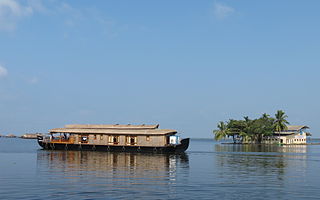
Kerala, called Keralam in Malayalam, is a state on the Malabar Coast of India. It was formed on 1 November 1956, following the passage of the States Reorganisation Act, by combining Malayalam-speaking regions of the erstwhile regions of Cochin, Malabar, South Canara, and Travancore. Spread over 38,863 km2 (15,005 sq mi), Kerala is the 21st largest Indian state by area. It is bordered by Karnataka to the north and northeast, Tamil Nadu to the east and south, and the Lakshadweep Sea to the west. With 33 million inhabitants as per the 2011 census, Kerala is the 13th-largest Indian state by population. It is divided into 14 districts with the capital being Thiruvananthapuram. Malayalam is the most widely spoken language and is also the official language of the state.

Arabi Malayalam is the traditional Dravidian language of the Mappila Muslim community. It is spoken by several thousand people, predominantly in the Malabar Coast of Kerala state, southern India. The form can be classified as a regional dialect in northern Kerala, or as a class or occupational dialect of the Mappila community. It can also be called a vernacular in general, or as a provincial patois, with the latter label being increasingly applicable in Colonial times. All the forms of the Malayalam language, including Mappila, are mutually intelligible.

Parappanangadi is a major town and a municipality in Tirurangadi taluk of Malappuram district, Kerala, India. It is a coastal town located close to the Arabian Sea.

The Government of Kerala, also known as the Kerala Government, is the administrative body responsible for governing Indian state of Kerala. The government is led by a chief minister, who selects all the other ministers. The chief minister and their most senior ministers belong to the supreme decision-making committee, known as the cabinet.

North Malabar refers to the geographic area of southwest India covering the state of Kerala's present day Kasaragod, Kannur, and Wayanad districts, and the taluks of Vatakara and Koyilandy in the Kozhikode District of Kerala and the entire Mahé Sub-Division of the Union Territory of Puducherry. Traditionally North Malabar has been defined as the northern portion of the erstwhile Malabar District which lies between Chandragiri River and Korapuzha River. The region between Netravathi River and Chandragiri River, which included the portions between Mangalore and Kasaragod, are also often included in the term North Malabar, as the Kumbla dynasty in the southernmost region of Tulu Nadu, had a mixed lineage of Malayali Nairs and Tuluva Brahmins.

Kanakakkunnu Palace is situated in Thiruvananthapuram near the Napier museum, India. It served as an official residence for Sir C.P. Ramaswami Iyer during his dewanship, in addition to Bhakti Vilas and Padma Vilas.

Jose Chacko Periappuram is an Indian cardiac surgeon and medical writer who performed the first successful heart transplant in the state of Kerala, India, as well as the first successful heart retransplant in the country. His other achievements include the first beating heart, awake bypass and total arterial revascularization surgeries in the state. Periappuram is a fellow of the Royal College of Surgeons of Edinburgh, the Royal College of Surgeons of Glasgow and the Royal College of Surgeons of London. He is the founder and chairman of "Heart Care Foundation", a charitable trust that financially assists poor heart patients. The Government of India awarded him the Padma Shri, the fourth highest civilian award, in 2011.

Arakkal Kingdom was a Muslim kingdom in Kannur town in Kannur district, in the state of Kerala, South India. The king was called Ali Raja and the ruling queen was called Arakkal Beevi. Arakkal kingdom included little more than the Cannanore town and the southern Laccadive Islands, originally leased from the Kolattiri. They owed allegiance to the Kolattiri rulers, whose ministers they had been at one time. The rulers followed the Marumakkathayam system of matrilineal inheritance, a system that is unique to a section of Hindus of Kerala. Under Marumakkathayam, the succession passes to the male offspring of its female members, in other words from a man to his sister's son and so forth. As the only Muslim rulers in Malabar, they saw the rise of Hyder Ali, de facto ruler of the Mysore Sultanate as the opportunity to increase their own power at the expense of Chirakkal, and invited him to invade Kerala. Ali Raja Arakkal Sultan Afsal Ashraf living in Konni Panchayat of Pathanamthitta district is the living heir of the Arakkal dynasty.
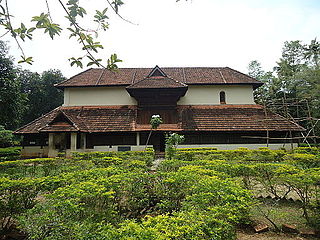
The Koyikkal Palace is a palace situated in Nedumangadu, Thiruvananthapuram District, Kerala, India. The palace was built in 16th century for Umayamma Rani of the Venad Royal Family. Umayamma Rani was the queen of Venad between 1677 and 1684. The palace is a double storied building and built in the traditional architectural style of Kerala.

