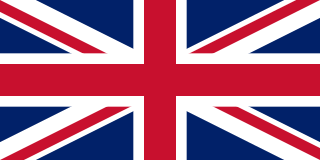
The Union Jack or Union Flag is the de facto national flag of the United Kingdom. The Union Jack was also used as the official flag of several British colonies and dominions before they adopted their own national flags. The flag continues to have official status in Canada, by parliamentary resolution, where it is known as the Royal Union Flag. However, it is commonly referred to in Canada as the Union Jack.

The flag of England is the national flag of England, a constituent country of the United Kingdom. It is derived from Saint George's Cross. The association of the red cross as an emblem of England can be traced back to the Late Middle Ages when it was gradually, increasingly, used alongside the Royal Banner. It became the only saint's flag permitted to be flown in public as part of the English Reformation and at a similar time became the pre-eminent maritime flag referred to as a white ensign. It was used as a component in the design of the Union Jack in 1606.

The flags of the Confederate States of America have a history of three successive designs during the American Civil War. The flags were known as the "Stars and Bars", used from 1861 to 1863; the "Stainless Banner", used from 1863 to 1865; and the "Blood-Stained Banner", used in 1865 shortly before the Confederacy's dissolution. A rejected national flag design was also used as a battle flag by the Confederate Army and featured in the "Stainless Banner" and "Blood-Stained Banner" designs. Although this design was never a national flag, it is the most commonly recognized symbol of the Confederacy.
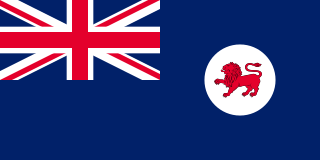
The current state flag of Tasmania was officially adopted following a proclamation by Tasmanian colonial Governor Sir Frederick Weld on 25 September 1876, and was first published in the Tasmanian Gazette the same day. The governor's proclamation here were three official flags, they being the Governor's flag, the Tasmania Government vessel flag, and a Tasmania merchant flag. Up until 1856 when Tasmania was granted responsible self-government, the Union flag and the British ensign were primarily used on state occasions.

The flag of New Zealand, also known as the New Zealand Ensign, is based on the British maritime Blue Ensign – a blue field with the Union Jack in the canton or upper hoist corner – augmented or defaced with four red stars centred within four white stars, representing the Southern Cross constellation.

The flag of Solomon Islands consists of a thin yellow diagonal stripe from the lower hoist-side corner, with a blue upper triangle and green lower triangle, and the canton charged with five white stars. Adopted in 1977 to replace the British Blue Ensign defaced with the arms of the protectorate, it has been the flag of Solomon Islands since 18 November of that year, eight months before the country gained independence. Although the number of provinces has since increased, the number of stars on the flag that originally represented them remained unchanged.

In vexillography, the canton is a rectangular emblem placed at the top left of a flag, usually occupying up to a quarter of a flag's area. The canton of a flag may be a flag in its own right. For instance, British ensigns have the Union Jack as their canton, as do their derivatives such as the national flags of Australia and New Zealand.

The state flag of Victoria is a British Blue Ensign defaced by the state badge of Victoria in the fly. The badge is the Southern Cross surmounted by an imperial crown, which is currently the Tudor Crown. The stars of the Southern Cross are white and range from five to eight points with each star having one point pointing to the top of the flag. The flag dates from 1870, with minor variations, the last of which was in 1901. It is the only Australian state flag not to feature the state badge on a round disc.

The current state flag of New South Wales was officially adopted in 1876. The flag is based on the defaced British Blue Ensign with the state badge located in the fly. The badge, based on the coat of arms, is a white disc with the cross of St George, a golden lion passant guardant in the centre of the cross and an eight-pointed gold star on each arm of the cross.

The state flag of Queensland is a British Blue Ensign with the state badge on a white disc added in the fly. The badge is a light blue Maltese Cross with a Saint Edward's Crown in the centre of the cross. The flag dates from 1876, with minor variations, and the badge was designed by William Hemmant, the Colonial Secretary and Treasurer of Queensland in 1876.
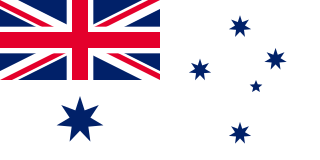
The Australian white ensign is a naval ensign used by ships of the Royal Australian Navy (RAN) from 1967 onwards. From the formation of the RAN until 1967, Australian warships used the British white ensign as their ensign. However, this led to situations where Australian vessels were mistaken for British ships, and when Australia became involved in the Vietnam War, the RAN was effectively fighting under the flag of another, uninvolved nation. Proposals were made in 1965 for a unique Australian ensign, which was approved in 1966, and entered use in 1967.

The Australian red ensign is the civil ensign of Australia, the flag of nationality flown by Australian registered ships. It is a red version of the national flag, which is mainly blue. Both flags resulted from the Commonwealth Government's 1901 Federal Flag Design Competition which required two entries: an ensign for Commonwealth Government use and another for the merchant navy. The winning design for the merchant ensign was based on the traditional British red ensign and featured the Southern Cross and Commonwealth Star.

The Australian Federation Flag, also known as the New South Wales Ensign, was the result of an attempt in the 1830s to create a national flag for Australia, which was divided at the time into several British colonies.

The national flag of Australia is based on the British Blue Ensign—a blue field with the Union Jack in the upper hoist quarter—augmented with a large white seven-pointed star and a representation of the Southern Cross constellation, made up of five white stars. Australia also has a number of other official flags representing its people and government bodies.

The flag of the governor-general of New Zealand is an official flag of New Zealand and is flown continuously on buildings and other locations when a governor-general is present. The flag in its present form was adopted in 2008 and is a blue field with the shield of the New Zealand coat of arms royally crowned. The official heraldic description is "A flag of a blue field thereon the Arms of New Zealand ensigned by the Royal Crown all proper".

The flags of British India were varied, and the British Empire used several different banners during the period of its rule in the Indian subcontinent. Flags with the Star of India emblem in their design are often referred to as the Star of India flag, and were used to represent India itself and high offices in the government of India. The Viceroy's Union Flag banner, featuring the star emblem, was officially considered the "Flag of India," and the Red Ensign bearing the star was also used as an Indian flag, particularly at international events. The Royal Indian Navy also flew a blue jack flag bearing the Star of India. The East India Company, which ruled India prior to 1858, used a flag featuring the Union Jack with red and white stripes.

The Australian flag debate is a question over whether the Australian flag should be changed, particularly to remove the Union Jack from the canton, but also to possibly introduce a completely new design without the Southern Cross.
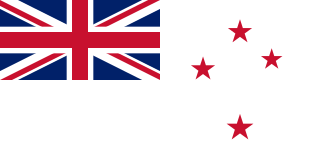
The New Zealand White Ensign is a naval ensign used by ships of the Royal New Zealand Navy (RNZN) from 1968. Based on the Royal Navy's White Ensign, it features the Southern Cross from the New Zealand national flag in place of the Saint George's Cross. One of the earliest flags associated with the country, that used by the United Tribes of New Zealand, was a white ensign. This was replaced by the Union Flag when New Zealand became a British colony. A blue ensign with the Southern Cross was introduced for ships of the colonial government in 1867 and this soon became a de facto national flag. Ships in New Zealand naval service wore the Royal Navy's White Ensign until 1968 when the distinct New Zealand White Ensign was introduced. The ensign was implemented out of a desire to distinguish New Zealand vessels from those of the Royal Navy and this decision is regarded as an important step in the development of the RNZN.
John Bingle (1796–1882) was an English-born sailor who became a businessman and landowner in Newcastle, New South Wales.

The flag now known as the flag of theUnited Tribes of New Zealand or Te Kara is a flag originally designed by Henry Williams to represent the New Zealand Church Missionary Society. It was adopted as a national flag by a group of rangatira in 1834 and is today more closely associated with the Māori people.

