
The Hydroscaphidae are a small family of water beetles known commonly as skiff beetles. As of 2010, there are 23 species in the family. Several are recently described.

Alburnoides is a genus of cyprinid fishes native to Europe and Asia. Many species are known as riffle minnows or spirlins.

Capoeta, also known as scrapers, is a genus of fish in the family Cyprinidae found in Western Asia. The distribution extends from Turkey to the Levant, to Transcaucasia, Iraq, Turkmenistan, in Armenia, particularly in lake Sevan and northern Afghanistan. This genus is most closely related to Luciobarbus and in itself is divided into three morphologically, biogeographically and genetically distinct groups or clades: the Mesopotamian clade, the Anatolian-Iranian clade and the Aralo-Caspian clade. The Mesopotamian clade was split off to Paracapoeta in 2022.
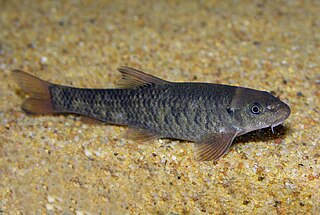
Garra is a genus of fish in the family Cyprinidae. These fish are one example of the "log suckers", sucker-mouthed barbs and other cyprinids commonly kept in aquaria to keep down algae. The doctor fish of Anatolia and the Middle East belongs in this genus. The majority of the more than 160 species of garras are native to Asia, but about one-fifth of the species are from Africa.
Garra typhlops, also known as the Iran cave barb is a species of ray-finned fish in the family Cyprinidae. It is endemic to caves in Iran. Like other cave-adapted fish, it is blind and lacks pigmentation.
Pareuchiloglanis is a genus of sisorid catfishes native to Asia. These species are rheophilic catfish chiefly found in the headwaters of major rivers in South and East Asia. They originate from the Brahmaputra drainage in India, east and south to the Yangtze drainage in China and the Annamese Cordillera drainages in southern Vietnam. Two species are known from the Mekong River: P. myzostoma and P. gracilicaudata. Four species are known from the drainage of China: P. abbreviatus, P. gracilicaudata, P. myzostoma and P. prolixdorsalis.

The pumpkin toadlet, or Spix's saddleback toad, is a small and brightly coloured species of frog in the family Brachycephalidae. This diurnal species is endemic to southeastern Brazil where it is found among leaf litter on the floor of Atlantic rainforests at an altitude of 200–1,250 m (660–4,100 ft). It is found in Espírito Santo, Rio de Janeiro, southeastern São Paulo and southeastern Minas Gerais. Although its type specimen supposedly was collected in Bahia about 200 years ago, there are no confirmed localities in this state and recent reviews consider it more likely that it was from Rio de Janeiro. B. ephippium is locally common, quite widespread compared to most other species of Brachycephalus and it is not considered threatened.
Ateleopus is a genus of ray-finned fish in the jellynose family Ateleopodidae. It is the type genus of its family, and the order Ateleopodiformes. For some time, it was known as Podateles, because Ateleopus had been used to replace the frog genus name Atelopus, which was deemed to be a spelling error. This was mistaken, however, and the fish and frog genera reverted to their original names.
Paracapoeta barroisi, also known as the Orontes scraper or Tigris barb, is a species of freshwater cyprinid fish from the Near East. This species is up to 20 cm (7.9 in) long and has sides with brownish spots irregularly arranged in the upper half of the body.
Paracapoeta trutta, the longspine scraper or spotted scraper, is a species of cyprinid fish from the Middle East. It is known from inland waters in Iran, Iraq, Syria, Armenia and Turkey, and is often quite abundant.

The Brazilian gold frog, also known as Izecksohn's toad or flea-frog, is a very small species of frogs in the family Brachycephalidae. It is endemic to southeastern Brazil and is known from the central part of the state of Rio de Janeiro and from Serra das Torres in extreme southern Espírito Santo.
Paracapoeta mandica is a species of ray-finned fish endemic to Iran.

Pygospio is a genus of marine polychaete worms in the family Spionidae.
Pygospio elegans is a species of marine polychaete worms in the family Spionidae. It is found in Western Europe.
Balgus is a genus of click beetle. They are one of several genera in the family which contain at least one bioluminescent species. The genus was originally placed in the family Eucnemidae, later transferred to Throscidae, but recent classifications establish them firmly within Elateridae.

Coniopteryx is a genus of insects belonging to the family Coniopterygidae.

Tubuca dussumieri, is a species of fiddler crab that is found in the western and south pacific including New Caledonia, Indonesia, Malaysia, Taiwan, Japan, north eastern Australia

Ghatiana atropurpurea is a species of arboreal crab from India that was first identified in 2016. Unlike other species of its genus, Ghatiana, it is not endemic to the Western Ghats.

Ghatiana splendida is a species of crab from India, first identified in 2016 in the Western Ghats. Tejas Thackeray, among the discovers of the species, has said that "locals" to where it was first described were aware of the species and would refer to it as the "purple tree crab" or the "pink forest crab". Thackeray first encountered the crab while searching for the olive forest snake.

Paracapoeta is a genus of fish in the family Cyprinidae found in Mesopotamia, Cilicia and the Levant, Western Asia. This genus is closely related to Luciobarbus and was formerly the Mesopotamian clade of Capoeta before being split off in 2022. The generic name alludes to παρά meaning "near" and Capoeta.

