
Paul Leo Butzer (born 15 April 1928) is a German mathematician who specializes in Analysis (Approximation theory, Harmonic analysis).
Paul Leo Butzer (born 15 April 1928) is a German mathematician who specializes in Analysis (Approximation theory, Harmonic analysis).
Butzer was born in Mülheim an der Ruhr on 15 April 1928. He is the son of an engineer, and his mother studied mathematics at RWTH Aachen University. As opponents of the National Socialists (Nazis), Butzer's parents left Germany with their children in 1937 and moved to England. During World War II, they relocated to Canada, where Butzer attended school in Montreal and studied mathematics at Loyola College (later Concordia University), completing his bachelor's degree in 1948. He then pursued further studies at the University of Toronto, including studying under Harold Scott MacDonald Coxeter and William Tutte, and obtained his Ph.D. in 1951 under the supervision of George G. Lorentz (On Bernstein polynomials). In 1952, he became a lecturer and then an assistant professor at McGill University. In 1955/56, he lived in Paris and then in Mainz. He decided to stay in Germany, where he completed his habilitation at the University of Freiburg, taught in Würzburg, and starting in 1958, at RWTH Aachen University. In 1962, he was appointed professor there. In 1963, he began organizing international conferences on Approximation theory at the Oberwolfach Research Institute for Mathematics, later together with Béla Szőkefalvi-Nagy. [1]
In addition to approximation theory and its connections to Fourier analysis and semigroups of operators in Banach spaces, Butzer also worked on probability theory (Central limit theorem and related Convergence tests issues), Sampling Theory, and Signal analysis. [2]
Paul Leo Butzer also delved into the history of mathematics, particularly in its connection with Aachen. He studied figures such as Peter Gustav Lejeune Dirichlet, Eduard Helly, Eugène Catalan, Pafnuty Chebyshev, Charles Jean de la Vallée Poussin, the history of splines, Otto Blumenthal, mathematics in the Carolingian era, and Elwin Bruno Christoffel (on whom he published a book).
Butzer is a member of the Royal Society of Sciences in Liège and the Royal Belgian Academy of Sciences. He is an honorary member of the Mathematical Society in Hamburg. He has received honorary doctorates from three universities: Liège, York, and Timișoara. [3]
Paul Butzer is the brother of Karl W. Butzer.
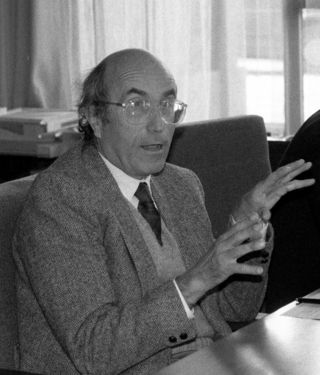
Niklas Luhmann was a German sociologist, philosopher of social science, and a prominent thinker in systems theory.
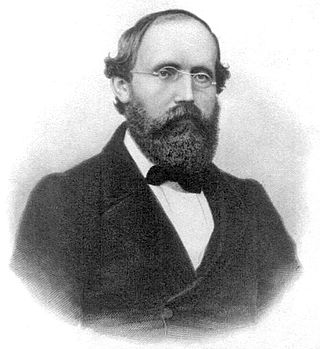
Georg Friedrich Bernhard Riemann was a German mathematician who made profound contributions to analysis, number theory, and differential geometry. In the field of real analysis, he is mostly known for the first rigorous formulation of the integral, the Riemann integral, and his work on Fourier series. His contributions to complex analysis include most notably the introduction of Riemann surfaces, breaking new ground in a natural, geometric treatment of complex analysis. His 1859 paper on the prime-counting function, containing the original statement of the Riemann hypothesis, is regarded as a foundational paper of analytic number theory. Through his pioneering contributions to differential geometry, Riemann laid the foundations of the mathematics of general relativity. He is considered by many to be one of the greatest mathematicians of all time.

Johann Peter Gustav Lejeune Dirichlet was a German mathematician. In number theory, he proved special cases of Fermat's last theorem and created analytic number theory. In analysis, he advanced the theory of Fourier series and was one of the first to give the modern formal definition of a function. In mathematical physics, he studied potential theory, boundary-value problems, and heat diffusion, and hydrodynamics.
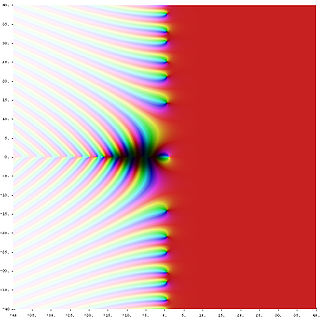
In mathematics, analytic number theory is a branch of number theory that uses methods from mathematical analysis to solve problems about the integers. It is often said to have begun with Peter Gustav Lejeune Dirichlet's 1837 introduction of Dirichlet L-functions to give the first proof of Dirichlet's theorem on arithmetic progressions. It is well known for its results on prime numbers and additive number theory.

Ferdinand Georg Frobenius was a German mathematician, best known for his contributions to the theory of elliptic functions, differential equations, number theory, and to group theory. He is known for the famous determinantal identities, known as Frobenius–Stickelberger formulae, governing elliptic functions, and for developing the theory of biquadratic forms. He was also the first to introduce the notion of rational approximations of functions, and gave the first full proof for the Cayley–Hamilton theorem. He also lent his name to certain differential-geometric objects in modern mathematical physics, known as Frobenius manifolds.
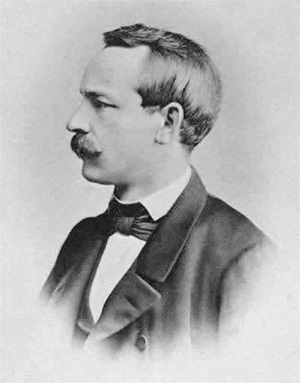
Elwin Bruno Christoffel was a German mathematician and physicist. He introduced fundamental concepts of differential geometry, opening the way for the development of tensor calculus, which would later provide the mathematical basis for general relativity.

Ludwig Otto Blumenthal was a German mathematician and professor at RWTH Aachen University.

Lothar Collatz was a German mathematician, born in Arnsberg, Westphalia.

The Gottfried Wilhelm Leibniz Prize, or Leibniz Prize, is awarded by the German Research Foundation to "exceptional scientists and academics for their outstanding achievements in the field of research". Since 1986, up to ten prizes have been awarded annually to individuals or research groups working at a research institution in Germany or at a German research institution abroad. It is considered the most important research award in Germany.
Martin Ohm was a German mathematician and a younger brother of physicist Georg Ohm.
Josef Meixner was a German theoretical physicist, known for his work on the physics of deformable bodies, thermodynamics, statistical mechanics, Meixner polynomials, Meixner–Pollaczek polynomials, and spheroidal wave functions.
Peter Wasserscheid is a German chemist and professor for chemical reaction engineering at the University of Erlangen-Nuremberg. Together with Matthias Beller he won the Gottfried Wilhelm Leibniz Prize in 2006.
Peter Wynn (1931—2017) was an English mathematician. His main achievements concern approximation theory – in particular the theory of Padé approximants – and its application in numerical methods for improving the rate of convergence of sequences of real numbers.
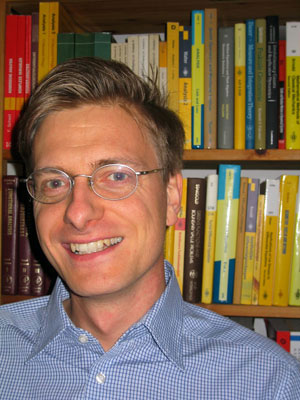
Gerald Teschl is an Austrian mathematical physicist and professor of mathematics. He works in the area of mathematical physics; in particular direct and inverse spectral theory with application to completely integrable partial differential equations.

Heribert Offermanns is a German chemist and former member of the board of the Degussa AG.
Manfred Rühl is a German communication scientist with a social science background.
Hans Günther Aach was a German botanist.

Gerhard J. Woeginger was an Austrian mathematician and computer scientist who worked in Germany as a professor at RWTH Aachen University, where he chaired the algorithms and complexity group in the department of computer science.

Volker Ludwig Mehrmann is a German mathematician.
Harald P. W. Ibach is a German solid state physicist.
| International | |
|---|---|
| National | |
| Academics | |
| People | |
| Other | |
