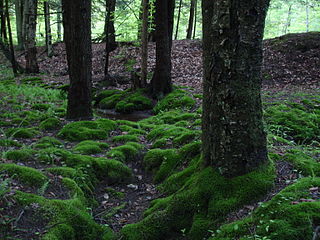
Mosses are small, non-vascular flowerless plants in the taxonomic division Bryophytasensu stricto. Bryophyta may also refer to the parent group bryophytes, which comprise liverworts, mosses, and hornworts. Mosses typically form dense green clumps or mats, often in damp or shady locations. The individual plants are usually composed of simple leaves that are generally only one cell thick, attached to a stem that may be branched or unbranched and has only a limited role in conducting water and nutrients. Although some species have conducting tissues, these are generally poorly developed and structurally different from similar tissue found in vascular plants. Mosses do not have seeds and after fertilisation develop sporophytes with unbranched stalks topped with single capsules containing spores. They are typically 0.2–10 cm (0.1–3.9 in) tall, though some species are much larger. Dawsonia, the tallest moss in the world, can grow to 50 cm (20 in) in height. There are approximately 12,000 species.

Sphagnum is a genus of approximately 380 accepted species of mosses, commonly known as sphagnum moss, also bog moss and quacker moss. Accumulations of Sphagnum can store water, since both living and dead plants can hold large quantities of water inside their cells; plants may hold 16 to 26 times as much water as their dry weight, depending on the species. The empty cells help retain water in drier conditions.

The Sphagnales is an order of mosses with four living genera: Ambuchanania, Eosphagnum, Flatbergium, and Sphagnum.
The genus Sphagnum contains the largest number of species currently discovered. The other genera are currently limited to one species each.
The Sphagnaceae is a family of moss with only one living genus Sphagnum.
The Portlethen Moss is an acidic bog nature reserve located to the west of the town of Portlethen, Aberdeenshire in Scotland. Like other mosses, this wetland area supports a variety of plant and animal species, even though it has been subject to certain development and agricultural degradation pressures. For example, the Great Crested Newt was found here prior to the expansion of the town of Portlethen. Many acid loving vegetative species occur in Portlethen Moss, and the habitat is monitored by the Scottish Wildlife Trust.

Sphagnopsida is a class of mosses that includes a single subclass Sphagnidae, with two orders. It is estimated it originated about 465 million years ago, along with Takakia. The order Sphagnales contains four living genera: Ambuchanania, Eosphagnum, and Flatbergium, which counts four species in total, and Sphagnum which contains the rest of the species. The extinct Protosphagnales contains a single fossil species.

Ambuchanania leucobryoides is the only species in the monotypic genus Ambuchanania. It is a Sphagnum-like moss endemic to Tasmania. Originally described as a species of Sphagnum, it is now a separate genus named after the original collector Alex M. Buchanan, (b.1944) an Australian botanist from the Tasmanian Herbarium in Hobart,. A. leucobryoides differs from the family Sphagnaceae in having elongate antheridia. It is entirely restricted to south-west Tasmania's Wilderness World Heritage Area where it occurs on white Precambrian quartzitic sand deposited by alluvial flows, and on margins of buttongrass sedge land. Species most commonly found in association with A. leucobryoides include: Leptocarpus tenax, Chordifex hookeri, and Actinotus suffocatus. Currently, A. leucobryoides is listed as rare under the Tasmanian Threatened Species Protection Act 1995.

Sphagnum angustifolium, the fine bogmoss, is a species of peat moss with a Holarctic distribution.
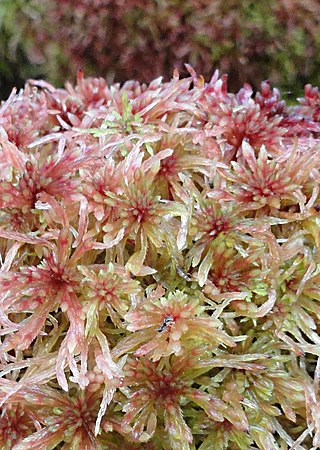
Sphagnum russowii, Russow's sphagnum or Russow's bogmoss, is a species of peat moss with a Holarctic distribution.
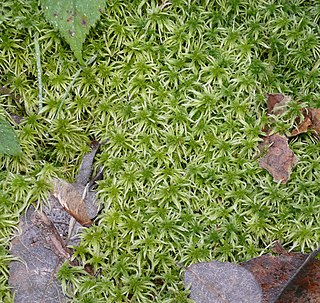
Sphagnum girgensohnii, also known as Girgensohn's bogmoss, Girgensohn's sphagnum or common green peat moss, is a species of peat moss with a Holarctic and Indo-Malesian distribution.
Moss Lake Bog is an 84-acre (34 ha) site containing a 15-acre (6.1 ha) glacial kettle lake located in the town of Caneadea, New York, outside Houghton. Over time, sphagnum moss has grown over the open water, turning it into an acidic bog. It is managed by The Nature Conservancy as part of Moss Lake Preserve, and was declared a National Natural Landmark in 1973.
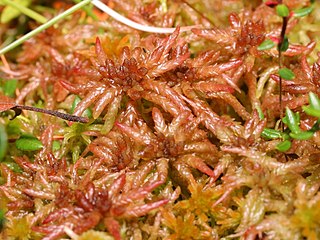
Sphagnum magellanicum, commonly called Magellanic bogmoss, Magellan's sphagnum, Magellan's peatmoss or midway peat moss, is a widespread species of moss found in wet boreal forest in the far south and southwest of South America, North America and Eurasia.

Sphagnum capillifolium, the red bogmoss, northern peat moss, acute-leaved bog-moss, or small red peat moss, is a species of peat moss native to Canada, the northern United States, Greenland, and Europe. Small red peat moss can be distinguished by its sweeping, outward-curving branches that resemble tresses. Sphagnum moss can hold large amounts of water within its cells, up to 20 times its own weight! This capability is due to its dead, empty cells called hyaline cells that fill up with water. This allows the moss to survive in wet boggy habitats around rivers and lakes
Eosphagnum inretortum is a species of moss, and the only species of the genus Eosphagnum. Originally described as a species of Sphagnum, it is now a separate genus on the basis of morphological and genetic differences.

Sphagnum squarrosum, commonly known as the spiky bog-moss or spreading-leaved bog moss is a species of moss which grows in nutrient-rich, damp soil. Typical habitats include woodland, the banks of streams and ditches; it can even be found at high altitude in damp cirques. The species often grows near sedges (Carex), rushes (Juncus) or purple moor grass.

Sphagnum fuscum, the rusty bogmoss or rusty peat moss, is a peat moss found commonly in Norway and Sweden, and can be found scattered across North America, the United Kingdom, and in southern to eastern Europe.
Snoqualmie Bog Natural Area Preserve in King County, Washington, is part of the Washington Natural Areas Program. It preserves a sphagnum moss bog now rare in the Puget Sound basin, as well as a small strip of old-growth forest.

Sphagnum fimbriatum, the fringed bogmoss, is a slender Sphagnum moss.

Sphagnum papillosum, the papillose peatmoss, is a species of peat moss distributed throughout the northern hemisphere. Although sometimes confused with Sphagnum imbricatum and Sphagnum palustre, it is distinguished by its yellow-green to brown short, blunt branches and papillose chlorophyllose cells.

Sphagnum contortum is a species of moss reported in North America and Europe. NatureServe marked its global conservation status as Secure.


