
Pseudanthus is a genus of nine species of flowering plants in the family Picrodendraceae, and is endemic to Australia. Plants in the genus Pseudanthus are small, heath-like, monoecious shrubs with simple, leathery leaves, and flowers arranged in upper leaf axils, male flowers usually with three or six stamens and female flowers with three styles.

Ricinocarpos is a genus of evergreen flowering plants in the family Euphorbiaceae and is endemic to Australia. Plants in the genus Ricinocarpos are monoecious shrubs with leaves arranged alternately along the branches, the edges curved downwards or rolled under. Male flowers are arranged singly or in racemes at the ends of branchlets, with four to six sepals that are fused at the base. There are four to six petals that are longer than the sepals, with many stamens fused to form a central column. Female flowers are arranged singly and are similar to male flowers but with three styles fused at the base and with a deeply branched tip. The fruit is a capsule containing seeds with an elaiosome.
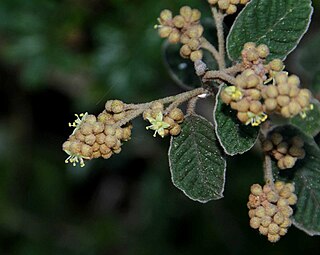
Pomaderris oraria, commonly known as Bassian dogwood, is a species of flowering plant in the family Rhamnaceae and is endemic to south-eastern Australia. It is a compact shrub with hairy branchlets, hairy, elliptic leaves and panicles of hairy, greenish to cream-coloured or crimson-tinged flowers.

Stachystemon is a genus of nine species of flowering plants in the family Picrodendraceae, and is endemic to Western Australia. Plants in the genus Stachystemon are monoecious shrubs with simple, usually thickened leaves, and flowers arranged singly or in small groups in upper leaf axils, male flowers usually with four to six tepals, usually with seven to many stamens, and female flowers with four or six tepals and two styles in each flower.

Leucopogon obovatus is a species of flowering plant in the heath family Ericaceae and is endemic to the southwest of Western Australia. It is an erect shrub with hairy young branchlets, variably-shaped, simple leaves, and erect clusters of 3 to 15 white, bell-shaped flowers on the ends of branches and in upper leaf axils.
Stachystemon polyandrus is a species of flowering plant in the family Picrodendraceae and is endemic to the southwest of Western Australia. It is a diffuse to straggling, monoecious shrub with crowded, oblong, elliptic or egg-shaped leaves with the narrower end towards the base, and small yellowish-white flowers arranged singly in upper leaf axils, but forming clusters at the ends of branches.
Ricinocarpos graniticus is a species of flowering plant in the family Euphorbiaceae and is endemic to the southwest of Western Australia. It is a monoecious shrub with linear leaves and creamy white flowers, arranged either singly, or with a single female flower surrounded by one or two male flowers.
Pseudanthus ballingalliae is a species of flowering plant in the family Picrodendraceae and is endemic to Queensland. It is a monoecious shrub with simple, oblong to narrowly oblong leaves and small yellow male and green female flowers arranged singly in upper leaf axils, but appearing clustered on the ends of branches.
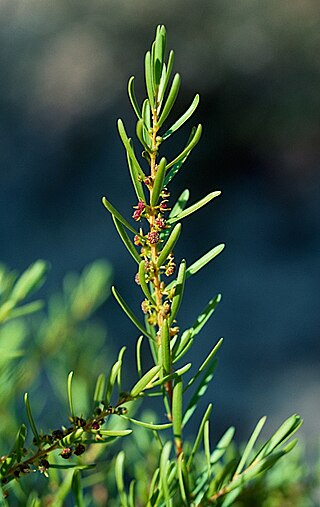
Stachystemon axillaris, commonly known as leafy stachystemon, is a species of flowering plant in the family Picrodendraceae and is endemic to the south-west of Western Australia. It is a monoecious shrub with simple, linear to narrowly elliptic or oblong leaves and small yellow flowers arranged singly in upper leaf axils.

Pseudanthus ligulatus is a species of flowering plant in the family Picrodendraceae and is endemic to northern Queensland. It is a monoecious shrub with simple, lance-shaped or linear to narrowly oblong leaves and creamy white male and pale green female flowers arranged singly in upper leaf axils, but appearing clustered on the ends of branches.
Stachystemon brachyphyllus is a species of flowering plant in the family Picrodendraceae and is endemic to the south-west of Western Australia. It is a monoecious shrub with simple, narrowly elliptic to elliptic or oblong leaves and small yellow, red, purple and brown flowers arranged singly in upper leaf axils.
Ricinocarpos oliganthus is a species of flowering plant in the family Euphorbiaceae and is endemic to a small area in the south-west of Western Australia. It is a monoecious shrub with linear to narrowly oblong leaves and white to creamy white flowers arranged singly on the ends of branchlets.
Pseudanthus micranthus, commonly known as fringed pseudanthus, is a species of flowering plant in the family Picrodendraceae and is endemic to the south-east of South Australia. It is a compact, monoecious shrub with simple, egg-shaped to round leaves and yellow flowers arranged in leaf axils, but appearing clustered on the ends of branches.
Stachystemon intricatus is a species of flowering plant in the family Picrodendraceae and is endemic to the south-west of Western Australia. It is a compact, densely-branched, monoecious shrub with crowded, elliptic or egg-shaped leaves and small, cup-shaped white flowers arranged singly in upper leaf axils.
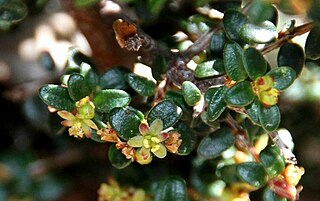
Pseudanthus orbicularis is a species of flowering plant in the family Picrodendraceae and is endemic to south-eastern continental Australia. It is a compact, monoecious shrub with simple, broadly elliptic to round leaves and creamy white, red or pale red flowers arranged singly in upper leaf axils.
Stachystemon mucronatus is a species of flowering plant in the family Picrodendraceae and is endemic to the south-west of Western Australia. It is a compact, monoecious shrub with narrowly oblong or narrowly elliptic leaves and small, greenish yellow flowers arranged singly in upper leaf axils.

Pseudanthus orientalis is a species of flowering plant in the family Picrodendraceae and is endemic to the coast of eastern Australia. It is a compact, rigid, monoecious shrub with simple, linear to narrowly oblong leaves and yellow to creamy-white flowers arranged singly in upper leaf axils, but often appearing clustered on the ends of branches.
Stachystemon nematophorus is a species of flowering plant in the family Picrodendraceae and is endemic to the Kalbarri National Park in Western Australia. It is a woody, dense, compact, monoecious shrub with simple, oblong, elliptic or egg-shaped leaves with the narrower end towards the base, and small yellowish flowers arranged singly in upper leaf axils, but forming clusters at the ends of branches.
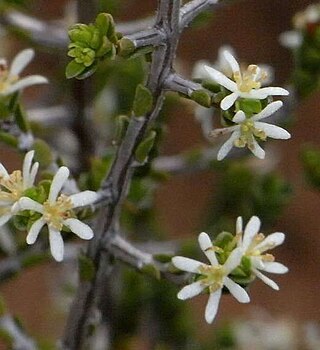
Pseudanthus ovalifolius, commonly known as oval-leaf pseudanthus, is a species of flowering plant in the family Picrodendraceae and is endemic to south-eastern Australia. It is a spreading to compact, wiry, monoecious shrub with oval leaves and whitish flowers arranged singly in upper leaf axils, but sometimes appearing clustered on the ends of branches.
Stachystemon vermicularis is a species of flowering plant in the family Picrodendraceae and is endemic to the southwest of Western Australia. It is a diffuse, monoecious shrub with linear leaves and small red male flowers and yellowish female flowers arranged singly in upper leaf axils, but forming clusters at the ends of branches.
